49 works in this view — arrow keys or swipe to move between them.
Dance in Art
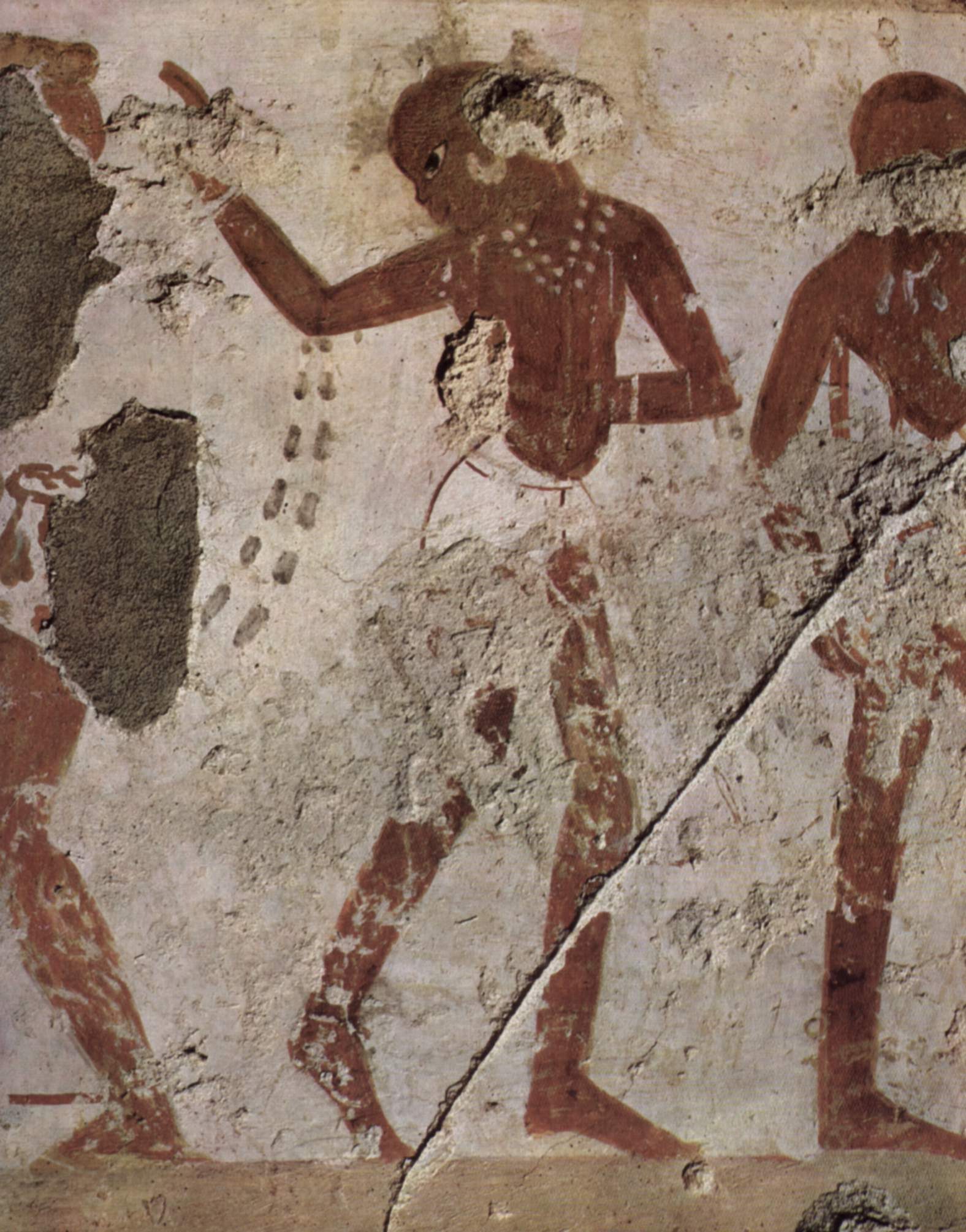
Grabkammer des Horemhab, Angehöriger des Heeres unter Thutmosis IV., Szene: Tanzender Afrikaner
Maler der Grabkammer des Horemhab
- Source:
- Wikimedia Commons
- Rights:
- Public domain — free to use, share and adapt.
- Recorded as:
- public_domain
This work documents ritual performance in ancient Egypt and demonstrates that formal, codified movement—performed before witnesses in ceremonial contexts—was considered important enough to preserve in tomb decoration. For historians of dance and ritual, it shows that structured, meaningful movement existed in antiquity outside of entertainment and courtship contexts, and that such movements were understood as performative actions worthy of representation and memory. The image reveals how Egyptian artists depicted bodies in motion or meaningful gesture, and what kinds of human activity the culture chose to immortalize.
What you are looking at
A fragmentary wall painting in reddish-brown pigment on pale plaster shows three standing figures against a light ground. The central figure is a nude or minimally clothed male dancer with a round head, depicted in profile facing left. His right arm is raised at shoulder height with palm open, fingers spread, as though scattering something downward; his left arm hangs at his side. A dotted line descends from his raised hand, suggesting the trajectory of scattered material—likely seeds, grain, or ritual substance. The figure's musculature is indicated with parallel lines across the torso. To the left stands a partial figure, mostly obscured by damage; to the right, another standing figure is visible only as a silhouette. All three figures wear what appear to be simple kilts or loincloths. The painting is severely damaged, with large areas of pigment loss and a diagonal crack running across the composition. The technique and style, combined with the figural poses and setting, suggest this is an Egyptian tomb painting, likely from the New Kingdom period.
The dancing
The central dancer stands with weight evenly distributed, legs straight and slightly apart. His raised arm is held at approximately shoulder height with the elbow slightly bent and palm facing downward in an open, dispersive gesture. This is a standing pose rather than a traveling or rotating movement—the body is upright and stable, not twisted or in transition. The gesture of the raised arm with splayed fingers and the downward trajectory line suggest a ritual or ceremonial action rather than social or entertainment dancing. The two flanking figures appear to be standing witnesses or participants in the same activity, though their poses are less clearly articulated.
The dance depicted
This appears to be a depiction of a ritual or ceremonial movement associated with Egyptian funerary or religious practice, rather than entertainment dance. The scattered-object gesture—most likely grain, seeds, or a ritual substance—suggests this may document a mourning rite, fertility ceremony, or divine offering. The catalogue identifies the central figure as an "African dancer," but the pose, setting, and context suggest a formal ceremonial action recorded in a New Kingdom tomb. The standing posture, dispersive hand gesture, and presence of witnesses are consistent with ritual performance documented in Egyptian tomb art, where such scenes served to ensure the perpetuation of these essential acts in the afterlife. Without additional context from the tomb's inscriptions or surrounding scenes, the specific dance or ceremony cannot be definitively identified, but the formality and repetition suggest a recognized, codified practice.
How it was made
This is a fresco or tempera painting on mud plaster, executed in the technique standard to Egyptian New Kingdom tomb decoration. The artist applied a light ground plaster and then painted the figures in a reddish-brown pigment, likely derived from ochre. The paint has adhered unevenly, leaving visible brushwork and areas of pigment loss. The linear rendering of musculature and the profile pose are hallmarks of Egyptian formal figural convention. The extensive damage—large areas of loss, the diagonal crack, and weathering—suggests the tomb was exposed to moisture and possibly to intentional or accidental defacement. The surviving fragments are sufficient to read the pose and gesture clearly, indicating that the original painting was executed with precision and intended to be legible across centuries.
About this work
This is a fragment of a wall painting from the tomb of Horemhab, an official or military commander serving under Thutmosis IV during Egypt's New Kingdom (likely 15th century BCE). The painting documents a ceremonial or ritual action performed by a standing male figure in the presence of witnesses. The raising and dispersal gesture, combined with the formal setting within a tomb, suggests this records a practice essential to funerary religion or religious observance—a practice the tomb owner wished to ensure would continue in perpetuity. The work is significant not as entertainment dance but as a visual record of ritual movement and its role in Egyptian religious life.
How to look at it
Attend first to the raised arm and open hand of the central figure, and follow the dotted line downward to understand the artist's intention: to show a moment of dispersal or offering, frozen mid-action. The standing posture, the balanced weight, and the presence of witnesses suggest a formal, socially recognized action rather than spontaneous movement. Notice how the artist used parallel lines to indicate the musculature of the torso, a technique that also emphasizes the body's solidity and strength. The profile pose was the Egyptian convention for depicting formal, important figures; it allowed the viewer to read the full silhouette and the gesture of the raised arm clearly, even when painted on a small scale or at a distance on a tomb wall.
The artist
The artist is identified in the catalogue only as the painter of Horemhab's tomb; no individual name is known. Egyptian tomb painters worked within a highly codified tradition that specified pose, proportion, color, and symbolic content. The painter would have been trained in the conventions of profile representation, proportion systems, and the narrative arrangement of scenes. The tomb painter's role was not artistic innovation but skilled execution of a program established by the tomb owner or his family, ensuring that essential scenes and activities would be magically perpetuated in the afterlife. The level of finish visible in this fragment suggests a competent, trained hand, though the work remains anonymous.
The period
This painting dates to the New Kingdom, approximately the reign of Thutmosis IV (1400–1390 BCE), a period of Egypt's imperial expansion and cultural flowering. Tomb decoration during this period served both commemorative and religious functions: scenes documented the tomb owner's life, status, and essential activities, while also serving as a form of sympathetic magic to ensure these activities—from hunting to ritual—would continue in the afterlife. Figurative art in this period followed strict conventions of pose, proportion, and symbolism developed over centuries. The ritual or ceremonial scene documented here reflects the profound integration of performance and religion in Egyptian culture, where repeated, formal movement was believed to have cosmic significance and to maintain social and divine order.
Where it lives
The work is documented as coming from the tomb of Horemhab, an official or military officer serving under Thutmosis IV (18th Dynasty, New Kingdom). The image appears in Wikimedia Commons and may derive from a published record or museum collection of Egyptian tomb paintings. The original location is the tomb itself; this is a photographic or reproduced image of the in situ wall painting.
Dance in this work
Questions about this work
Is this a dance or a ritual?
The painting most likely documents a ritual action—probably an offering, scattering of grain or seeds, or ceremonial gesture—rather than entertainment dance. The standing posture, the formal presence of witnesses, and the setting within a tomb all suggest a religious or funerary practice. However, in ancient Egypt, the boundary between dance and ritual movement was not sharp; formal, repetitive movement performed in ceremonial contexts often served both social and religious functions.
Why is the figure identified as an 'African dancer' in the catalogue?
The term may reflect 19th- or early 20th-century catalogue conventions that labeled non-Egyptian figures in Egyptian art as 'African.' However, Egyptian identity in the New Kingdom was complex; this figure could be an Egyptian of the period, an official, a prisoner, or a figure from the Nubian region. Without additional context from inscriptions or surrounding scenes, the figure's ethnic or geographic origin cannot be determined from the painting alone.
What is the dotted line falling from the hand?
The dotted line most likely represents a stream of scattered material—grain, seeds, sand, or a ritual substance—being dispersed downward by the raised hand. This technique of using dots or lines to indicate movement or falling matter is found in other Egyptian tomb paintings and helps the viewer understand the direction and nature of the action being performed.
Why is so much of the painting damaged?
New Kingdom tomb paintings often suffered from moisture, salt crystallization, and weathering after the tomb was opened or flooded. The diagonal crack visible here may result from structural settling or the drying of the mud plaster support. In some cases, figures or scenes were deliberately defaced or erased. The surviving portions are enough to read the original composition and intent.
More dance artwork





