49 works in this view — arrow keys or swipe to move between them.
Dance in Art
Flamenco Dancers
Jack Boul
- Source:
- Wikimedia Commons
- Rights:
- Reusable with conditions: credit the creator; share any adaptation under the same licence. Source record ↗
- Recorded as:
- cc by-sa 4.0
This work documents flamenco during a period of rapid change in how the dance was performed, staged, and understood. The intimate, participatory staging shown here—with musicians and audience in the same room as the dancer—represents a mode of flamenco that was already becoming historical by the early twentieth century as the form moved into concert halls and theaters. The painting captures the emotional intensity and physical vocabulary of flamenco through a modernist aesthetic sensibility, showing how artists of the period understood the dance as a subject worthy of serious artistic attention.
What you are looking at
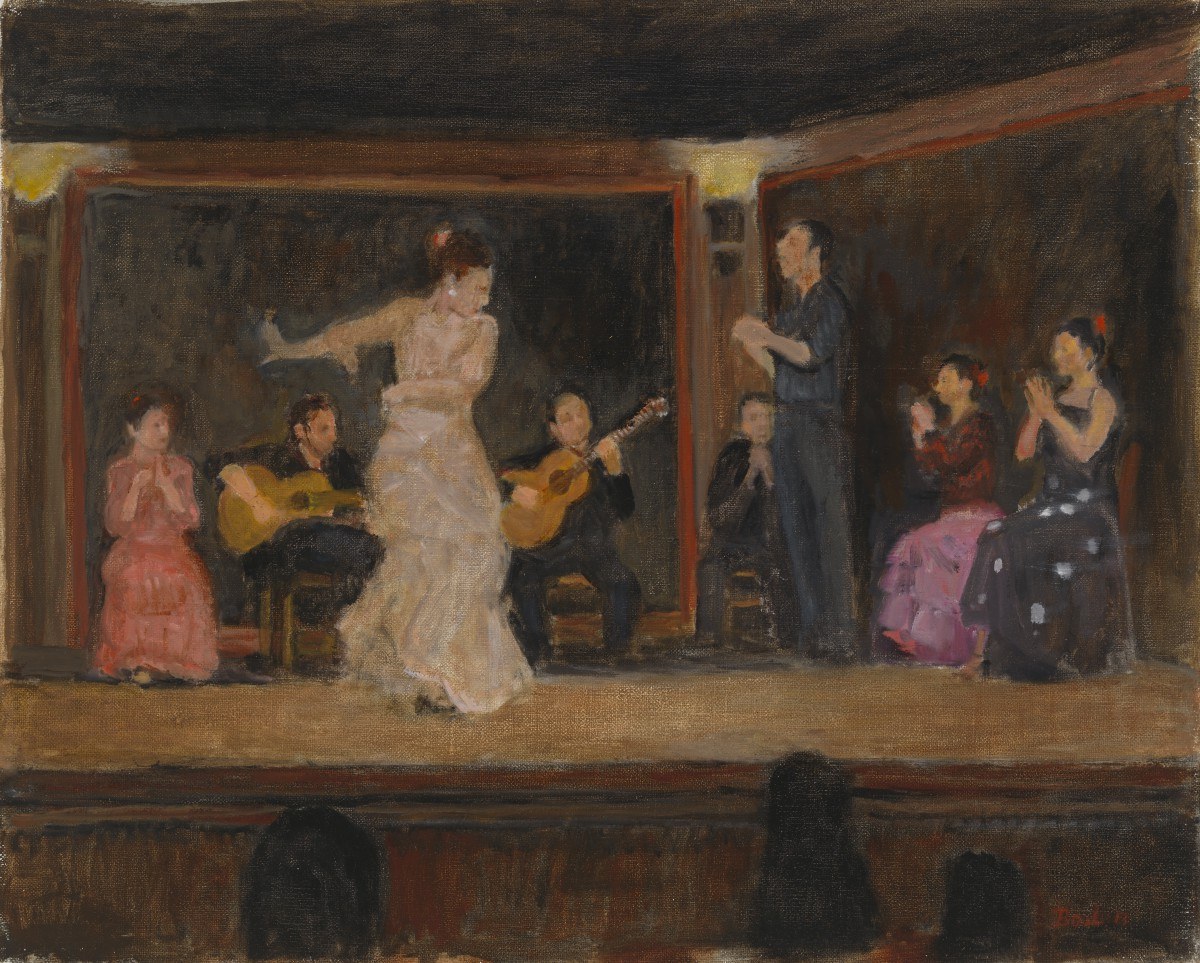
A flamenco performance unfolds on a small stage framed by red-bordered proscenium doors. A bare-shouldered dancer in a cream or pale beige dress dominates the center, her body arched backward in a dramatic pose, arms extended. She is accompanied by two guitarists seated to her left, one in yellow, playing classical guitars. The setting is an intimate theatrical space with dark walls and a sandy or pale floor. On the right side of the stage, separated by the architectural frame, several onlookers sit and stand—some in formal dress, others in brightly colored garments (pinks, reds, dark fabrics). The lighting is warm and theatrical, with soft illumination on the dancer and musicians. The composition suggests a private or semi-public performance, possibly in a tavern or small theater, capturing a moment of intense physical expression.
The dancing
The central dancer's body is in a pronounced backward arch or cambré, with her torso extended and arms open, suggesting intense emotional or physical engagement characteristic of flamenco's passionate movement vocabulary. Her weight appears shifted, with the pose suggesting either a moment of release or the preparation for a rapid footwork sequence. The two guitarists are seated in stable positions, bodies angled toward the dancer. The spectators show varied postures—some leaning forward intently, others more relaxed—indicating different levels of engagement with the performance. The spatial relationship between dancer, musicians, and audience creates a sense of intimate, participatory theater.
The dance depicted
This is flamenco, identifiable by the bare-shouldered female dancer, the presence of acoustic guitars played by male accompanists, the intensity and curvature of the dancer's body position, and the theatrical staging typical of flamenco performance contexts. The style cannot be narrowed to a specific palos (form) from the image alone—the arched, expressionistic pose could belong to several flamenco styles, though the intensity suggests forms like bulerías, alegrías, or tangos. The image captures flamenco as a participatory, intimate form in which musicians and audience are not separated from the dancer by formal barriers, reflecting how the dance was performed and experienced in Spanish social and theatrical contexts of the period.
How it was made
This appears to be an oil painting on canvas, executed with loose, impressionistic brushwork that prioritizes atmosphere and gesture over photographic detail. The artist has used warm, earthy tones and created strong contrasts between the illuminated figures and the dark surrounding space, drawing on techniques of dramatic chiaroscuro. The painterly approach—visible in the soft edges, the suggestion of movement through gestural marks, and the evocative rather than precise rendering of faces and fabrics—suggests early-to-mid-twentieth-century modernist practice. This technique would have been understood as capturing the emotional truth of the moment rather than its documentary accuracy.
About this work
This painting depicts a flamenco performance in an intimate theatrical or social setting, showing the dancer, guitarists, and audience in active relationship with one another. The work documents a moment of intense physical and emotional expression, frozen mid-movement. Flamenco in this period was undergoing transformation from purely social and regional practice into theatrical spectacle for urban and international audiences, and this image captures that liminal space—still informal and participatory in spirit, but staged and composed for aesthetic contemplation. The painting belongs in a dance gallery because it records not only the appearance of the dance but its social context: how flamenco was experienced as a collaborative, emotionally charged form involving musicians and witnesses as well as dancers.
How to look at it
Attend to the dancer's body position—the dramatic backward arch conveys both the physical demands of flamenco and the emotional intensity the artist associates with it. Notice the arrangement of the composition around her: the musicians are not subordinate but are positioned as essential partners in the performance. The spectators' varied postures and clothing suggest a mixed social gathering rather than a formal concert audience, which speaks to how flamenco was still understood in semi-social, participatory terms. The warm, loose painting technique itself—with its impressionistic handling of faces and fabrics—conveys movement and emotion over static documentation.
The artist
Jack Boul is not readily identifiable in standard art historical references. The signature, date (2013), and Wikimedia Commons attribution suggest a contemporary artist, though the work is painted in a style evocative of early-to-mid-twentieth-century expressionism or impressionism. Without additional documentation, the artist's training, geographic location, and relationship to flamenco culture cannot be established from the image alone.
The period
The 1920s–1930s saw flamenco undergoing significant transformation in Spain and internationally. The form was being adopted by concert stages and urban theaters, moving from purely regional and social contexts into the realm of theatrical spectacle. Simultaneously, modernist and expressionist artists across Europe were drawn to flamenco as a subject—its emotional intensity, exotic association for non-Spanish audiences, and connection to Gypsy (Romani) culture. Artists were interested in capturing not the technical precision of the dance but its supposed authenticity and emotional rawness. This painting reflects that moment: it stages flamenco in a theatrical frame, but insists on the intimacy and participatory nature of its music and spectatorship.
Where it lives
The work is recorded in Wikimedia Commons, a digital commons repository for media in the public domain or under open licenses. The artist is identified as Jack Boul. No physical holding institution, accession number, or acquisition history is recorded in the available metadata.
Dance in this work
Questions about this work
How do I know this is flamenco and not another Spanish dance?
The painting includes several identifying markers: the bare-shouldered female soloist, the acoustic guitars played by seated male musicians, the intensity and curvature of the dancer's body, and the theatrical staging. These are characteristic of flamenco performance. Other Spanish regional dances, like sevillanas, are typically performed in groups with more formal or folk dress, and do not feature this soloist-and-accompanist structure. The emotional intensity and expressionistic treatment also align with how flamenco was understood and depicted in early-twentieth-century modernist art.
What specific flamenco style (palo) is this?
The image does not provide enough detail to identify a specific palo with confidence. The dancer's arched posture and the intensity suggested could belong to bulerías, alegrías, tangos, or other forms. The artist was interested in capturing the emotional and physical essence of flamenco rather than documenting a particular technical form.
Why is the audience sitting so close to the performers?
This reflects the historical reality of flamenco performance in Spain before it became primarily a concert form. In tabernas, private gatherings, and early theatrical venues, the audience, musicians, and dancer shared the same intimate space. The close proximity enabled direct interaction, call-and-response between dancer and musicians, and the participatory emotional engagement that is central to flamenco culture. The painting documents this social arrangement as it was being displaced by modern theater conventions.
More dance artwork





