49 works in this view — arrow keys or swipe to move between them.
Dance in Art
Flamenco Gold
Sibthorp
- Source:
- Wikimedia Commons
- Rights:
- Reusable with conditions: credit the creator. Source record ↗
- Recorded as:
- cc by 3.0
This work matters because it captures flamenco at a specific moment in its global circulation—the late 1990s, when contemporary and fusion flamenco was reaching international audiences through recording, publication, and visual culture, and when artists outside Spain were beginning to claim the form as their own subject. The painting's insistence on treating a flamenco dancer's body as worthy of precious materials and fine art technique—using gold leaf, glass, layered canvas—reflects a larger cultural argument about which bodies and which dance forms deserve aesthetic elevation.
What you are looking at
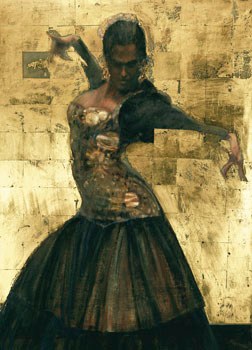
A single female figure dominates the composition, caught in a dynamic, twisting pose against a heavily textured, aged background of creams and golds. Her body is angled sharply, with her torso twisted and one arm extended upward in an expressive arc while the other gestures outward; her head is tilted back, dark hair falling away. She wears a fitted, patterned bodice or corset featuring ornate designs in warm tones, paired with a full, voluminous skirt in deep charcoal or black that extends to mid-calf, creating strong movement lines through the composition. The background is treated as a weathered, translucent surface—a palimpsest of marks, scratches, and ghosted imagery suggesting age and layered history. Gold leaf has been incorporated into the work, lending luminosity and richness to the upper portions of the composition. The overall effect is theatrical and emotionally charged: the dancer appears suspended in a moment of passionate expression, her body language suggesting intensity, drama, and expressive force.
The dancing
The single dancer's frame is open and expansive, with the upper body twisted in countermovement to suggest rotation or a sharp directional change. Her extended arm and arched back convey weight and momentum; there is no closed partnership hold, and her stance reads as solo performance. The skirt's full volume and the positioning of her body suggest a moment mid-phrase where gravity and momentum are evident—this is not a held pose but a fleeting instant of movement. The dancer's head position and the overall musculature evident in the painting indicate someone trained and purposeful, moving through deliberate choreography rather than casual gesture.
The dance depicted
This is flamenco, and the work captures a moment of the passionate, body-driven improvisation central to the form. The costume—the fitted, decorative bodice and full skirt—is consistent with flamenco dress, particularly styles of the late 20th century that draw on historical flamenco aesthetic but are updated for contemporary presentation. The body language reads as the kind of expressive torso work and arm extensions characteristic of flamenco's more theatrical and commercially performed variants—likely contemporary or fusion flamenco rather than traditional palos such as soleá or bulerías, which tend toward more grounded, contained movement. The title and the visual language together confirm the genre.
How it was made
The work is executed in oil and gold leaf on glass and canvas, a technically ambitious layering that creates depth and luminosity. The use of gold leaf is particularly significant: it has been embedded into the composition to catch light and suggest richness, opulence, and a kind of sacred or precious quality applied to the dancer's body and gesture. The glass substrate (or glass layering) allows for transparency effects and adds a sculptural, dimensional quality. The heavily worked, aged background suggests the work has been intentionally distressed or painted to suggest patina and history—a common approach in late 20th-century expressive painting meant to elevate the subject matter into fine art rather than illustration.
About this work
This is a portrait of flamenco in paint and precious materials, created in 1998 by an artist working in the expressive realist tradition. The work takes a single moment—a dancer twisted in mid-phrase, arms extended, full of force and feeling—and elevates it through technique: the application of gold leaf, the layering of glass and canvas, the weathered, palimpsed background all suggest that this ordinary moment of dance deserves to be seen as worthy of fine art treatment. The painting has circulated beyond the gallery wall: it became a book jacket, a CD cover, and a poster, a pathway from fine art into popular culture that mirrors how flamenco itself has moved from regional Spanish tradition into international performance and fusion.
How to look at it
Look first at the body: the artist has chosen to freeze a moment of extreme expressivity and momentum rather than a technically neutral or demonstrative pose. The twisted torso, the extended arms, the arched back—these tell you this is a moment of felt emotion rendered through the body, which is at the heart of flamenco's expressive vocabulary. Then look at the materials: the gold leaf catches light and creates a sense of preciousness and dignity. The weathered background, with its ghosted imagery and visible texture, suggests both history and the body's relationship to tradition—the dancer is not floating in empty space but emerging from and shaped by accumulated cultural material.
The artist
Sibthorp is identified in the catalogue record only by surname. The work's technical sophistication—the layering of glass and canvas, the incorporation of gold leaf, the painterly handling of the background—suggests training in fine art painting, likely in Britain or Europe given the aesthetic register. The circulation of the work beyond gallery walls (as book jacket, CD cover, poster) suggests an artist working in the late 20th-century landscape where fine art, commercial art, and popular culture were increasingly permeable categories.
The period
In 1998, flamenco was experiencing a second wave of international popularity following the commercial and critical success of Paco de Lucía's fusion innovations in the 1970s and 80s, and the rise of flamenco in contemporary dance through choreographers like Joaquín Cortés and others who were bringing the form to international stages and festivals. Simultaneously, the 1990s saw a broader fine art investment in representing non-Western and marginalized dance forms as subjects worthy of aesthetic seriousness—part of a larger postcolonial reassessment of cultural hierarchies. The painting's date coincides with the moment flamenco was becoming securely established as an international art form rather than a regional or 'folkloric' practice.
Where it lives
The work is recorded as part of Wikimedia Commons, a public-access digital collection. The catalogue record notes that the finished painting followed preparatory studies and was subsequently used for a book jacket and music CD cover, as well as being produced as a poster print—indicating that the original painting has had significant circulation and cultural reach beyond the gallery context.
Dance in this work
Questions about this work
Is this a portrait of a specific dancer?
The catalogue record does not identify a specific dancer, and the painting does not include identifying information. It appears to be a study of flamenco as a form and a moment of expressive dance rather than a commissioned portrait of an individual performer.
Why is gold leaf used in a painting of flamenco?
Gold leaf serves multiple purposes: it adds luminosity and a sense of richness and preciousness, suggesting that flamenco—often dismissed as mere entertainment or folklore—deserves fine art treatment. It also creates a visual reference to religious and sacred art traditions, elevating the dancer's body and gesture to a comparable level of cultural importance.
What does the distressed background mean?
The weathered, layered, aged background suggests that flamenco is not a new or invented form but an old one—rooted in history and tradition. The visible marks and scratches suggest palimpsest, accumulated time, and cultural depth. This visual choice grounds the contemporary dancer in a longer narrative of the form.
Why did this painting become a book jacket and CD cover?
The image's combination of visual drama, emotional intensity, and cultural specificity made it well-suited to commercial uses promoting flamenco music, literature, and culture. The painting's success in circulating across multiple formats suggests that fine art and commercial culture were not separate spheres for this artist.
More dance artwork





