49 works in this view — arrow keys or swipe to move between them.
Dance in Art
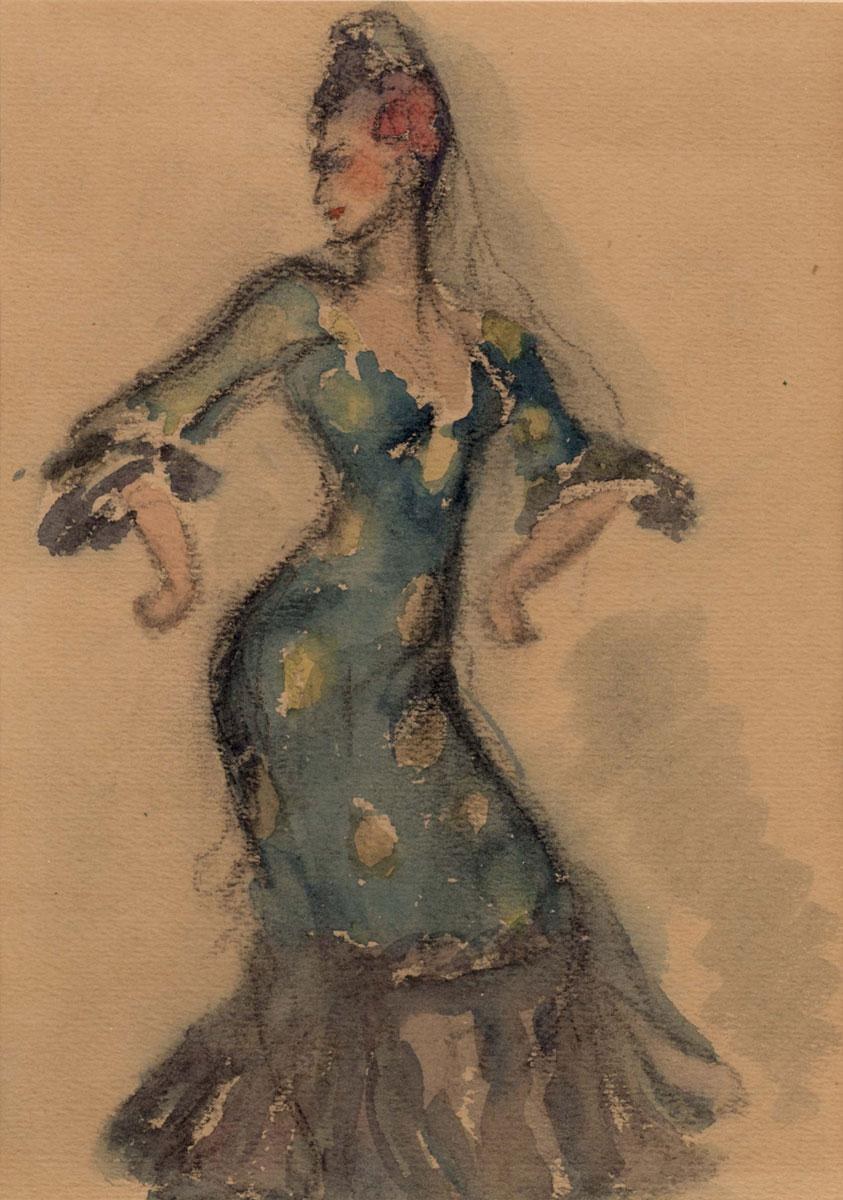
Painting The Last Flamenco by Charlotta Burešová
Charlotta Burešová
- Source:
- Wikimedia Commons
- Rights:
- Public domain — free to use, share and adapt.
- Recorded as:
- cc0
This painting documents a moment of flamenco performance practice during the Second World War, when many dancers were displaced or their careers interrupted; the commemorative title suggests the work may record a final performance or a particular cultural moment. For dance historians, the image preserves a record of how flamenco was danced and costumed outside Spain during this period, and by a non-Spanish performer—evidence of flamenco's international circulation and adaptation in early twentieth-century Europe.
What you are looking at
A single female figure is shown in profile against a plain tan background, her body angled toward the viewer's right. She wears a deep teal or greenish dress with gold or cream-colored accents or patterning across the bodice and skirt. A delicate veil or headdress frames her upswept dark hair, and her face shows rouged cheeks and defined features in three-quarter view. Both arms are extended outward and slightly back in an expansive gesture, with the fabric of the dress falling away from her limbs. The pose suggests arrested motion—a moment of turning or pivoting—with her weight appearing to shift through her torso. The painting technique is loose and painterly, with visible brushwork and a warm, aged tonality suggesting watercolor or gouache on paper.
The dancing
A single dancer is depicted mid-movement, her body arranged in an open, rotational position with both arms extended laterally and trailing slightly backward. Her frame is upright but fluid, with the torso twisted and the head held high; the extended arms create a sense of momentum and control rather than abandon. The dress movement—particularly how the fabric falls away from the body—suggests weight and velocity, implying the figure has just passed through or is about to enter a turn. The gesture is contained and deliberate, showing technical awareness rather than folk exuberance.
The dance depicted
The subject is almost certainly flamenco, as confirmed by the catalogue record attribution to 'The Last Flamenco.' The pose and arm carriage are consistent with classical flamenco movement vocabulary—particularly the use of extended, trailing arms and the rotational energy evident in the torso and head position. The costume (a fitted dress with decorative patterning) and the veil-like headdress are consistent with early-to-mid twentieth-century flamenco theatrical dress rather than folk costume. However, the specific flamenco style (palo) cannot be determined from the pose alone; this could represent alegrías, bulerías, or another form. The painting's title—'The Last Flamenco'—may carry historical or thematic significance beyond what the image itself reveals.
How it was made
The work appears to be executed in watercolor or gouache on paper, worked with loose, atmospheric brushwork that creates soft edges and blended tones. The technique allows for the transparent layering of the dress fabric and the subtle modeling of the figure's form. The warm paper tone (visible especially in the background) is integral to the color harmony. This medium was common for studio portraiture and theatrical studies in early twentieth-century Central European art, suggesting this was likely a preparatory study or independent portrait rather than a large-scale narrative composition. The technique prioritizes capturing the momentary gesture and the quality of the costume over fine detail.
About this work
This is a portrait study of a flamenco dancer, likely executed in the 1940s by Czech-born artist Charlotta Burešová. The work depicts Catharina Brücker, a dancer known to have performed during the Second World War era. The painting captures a single moment from the flamenco vocabulary—a turning motion with extended arms—rendered in loose watercolor technique that emphasizes the flow of the costume and the dancer's upright, controlled posture. The title 'The Last Flamenco' suggests a valedictory or commemorative intent, though its precise historical reference remains unclear from the image alone. The work belongs to the tradition of theatrical portraiture that documented dancers and their movements in the early twentieth century, existing at the intersection of fine art and performance documentation.
How to look at it
Attend first to the extended arm position and the rotational energy of the torso: the artist has frozen the dancer at a moment of turning or pivoting, capturing the trailing motion of the arms and the upswept head position characteristic of flamenco. The loose brushwork—particularly in the dress and veil—conveys the physical sensation of movement even in a still image. Notice how the figure's weight appears to be shifting through her center, and how the extended arms create a sense of spatial command. The painting prioritizes the gesture and the costume over facial likeness, treating the dancer's body as the primary subject of portraiture.
The artist
Charlotta Burešová was a Czech artist active in the mid-twentieth century. The work's presence on Wikimedia Commons and its connection to Theresienstadt—a concentration camp that also functioned as a cultural and artistic center for some inmates—suggests Burešová may have had connections to the camp or to the cultural community surrounding it. Artists in and around Theresienstadt documented performances and cultural life, often as a means of bearing witness. The painting's style and subject matter are consistent with Central European modernist practice of the 1930s–1940s, and the figure of Catharina Brücker may have been a performer active in that milieu.
The period
The 1940s were a period of displacement and fragmentation for European artists and performers. Flamenco, originating in Andalusia, had already begun to circulate internationally during the early twentieth century through theatrical performances and cultural exchange, though the Second World War disrupted many circuits. In Central Europe during the war years, cultural performances—particularly in contexts like Theresienstadt—served multiple functions: as documentation, as resistance, and as preservation of cultural identity. Burešová's painting belongs to this moment of disruption and creative witness. The work predates the major postwar revival of flamenco in European concert halls, but reflects the form's presence in European cultural consciousness during the war.
Where it lives
The work is held in Wikimedia Commons, suggesting it is in the public domain or under a permissive license in its country of origin. The catalogue record notes the subject as Catharina Brücker and associates the work with Theresienstadt, indicating the painting may have been preserved as part of documentation efforts related to that site or discovered among cultural materials associated with it.
Dance in this work
Questions about this work
What is 'The Last Flamenco' and why is it called that?
The title refers to Burešová's 1944 painting of dancer Catharina Brücker. The 'last' may refer to a final performance by Brücker, or may carry a more symbolic meaning related to wartime disruption of cultural life. Without additional documentation, the precise historical reference cannot be determined from the image alone, though the connection to Theresienstadt suggests the work commemorates a performance or performer from that context.
Is this a Spanish flamenco dancer?
No. Catharina Brücker was a non-Spanish dancer who performed flamenco, evidence of how the form had spread beyond Andalusia by the early twentieth century. The painting documents flamenco as an international performance practice and cultural form, not as a folk tradition restricted to Spain.
What does the costume tell us?
The fitted teal dress with gold patterning and delicate veil are consistent with theatrical flamenco costume of the 1930s–1940s, rather than folk dress. This indicates a professional or semi-professional performance context, likely in a concert or theater setting rather than a folk or social venue.
What is the connection to Theresienstadt?
Theresienstadt was a concentration camp that also functioned as a cultural center where performances and artistic activities were documented and, in some cases, encouraged. The painting's association with Theresienstadt suggests Brücker may have performed there, or that Burešová documented performances in that context. The painting may be part of the historical record of cultural life in and around the camp.
More dance artwork





