49 works in this view — arrow keys or swipe to move between them.
Dance in Art
The Flamenco Dancer
Leopold Schmutzler
- Source:
- Wikimedia Commons
- Rights:
- Public domain — free to use, share and adapt.
- Recorded as:
- public_domain
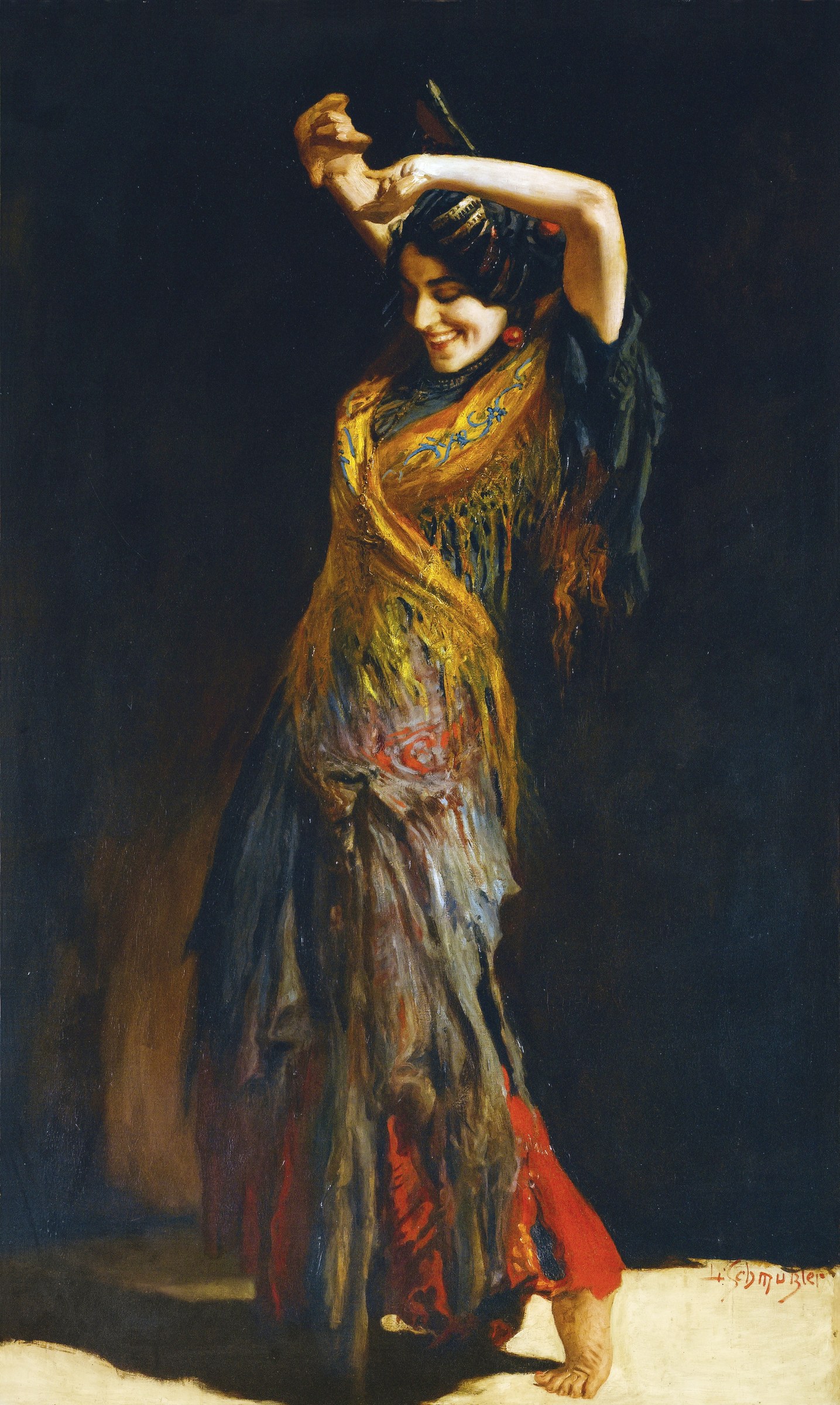
This work is valuable not as a document of flamenco technique—which it does not attempt to record—but as evidence of how flamenco was marketed, aestheticized, and consumed in European fine art during the belle époque. It shows the gap between the reality of a living, participatory dance tradition and its representation as a decorative, orientalized spectacle for bourgeois viewers. The painting reveals the role visual artists played in constructing the "exotic" appeal of non-European dance for European audiences.
What you are looking at
A single female figure stands barefoot against a deep dark background, her body angled in a graceful contrapposto pose. She wears an ornate, voluminous costume in warm golds and oranges with intricate embroidered patterns and decorative fringing that falls to her ankles. A dark shawl or rebozo drapes across her shoulders and torso. Her right arm is raised to her head in a classical pose, her left arm hangs at her side. Her dark hair is styled up and adorned with what appears to be a decorative comb or ornament. Her gaze is downward and inward, her expression serene and contemplative rather than animated. The figure is positioned on a pale platform or stage floor that contrasts sharply with the surrounding darkness, creating a spotlight effect. The painting technique emphasizes the luminosity of her skin against both the dark background and the richly colored fabric.
The dancing
The dancer's pose is fundamentally static and balletic rather than dynamic. Her weight is settled on both feet in a neutral stance, with no visible weight shift or movement impulse. The raised arm to the head and the lowered opposite arm create a symmetrical, restful frame—characteristic of a posed moment rather than mid-movement. Her body alignment is upright and formal, with the torso held in classical verticality. The barefoot positioning and the overall compositional stillness suggest this is a portrait of a dancer, or a moment of repose, rather than the capture of active footwork or traveling movement.
The dance depicted
The title identifies this as a flamenco dancer, and the ornate costume with its embroidered shawl, patterned dress, and decorative details aligns with flamenco stage wear of the late 19th and early 20th centuries. However, the painting does not depict active flamenco movement. There is no visible zapateado (footwork), no characteristic arm positions from styles like Alegrías or Seguiriya, and no sense of the rhythmic intensity or passionate engagement of flamenco dance. The pose is contemplative and posed—more akin to a formal studio portrait of a performer than a representation of flamenco in motion. The work prioritizes the beauty of the costume and the exotic appeal of the figure over the documentation of actual dance technique or style.
How it was made
This is an oil painting executed with careful attention to fabric texture and the effects of dramatic lighting. The artist has lavished detail on the embroidered patterns and fringed edges of the costume, using warm ochres, golds, and deep reds to create visual richness. The technique favors tonal subtlety in the skin tones and a high-key treatment of the fabrics against the nearly black background. This is clearly studio work intended for exhibition and sale—the careful finish, the refined handling, and the monumental single-figure composition all suggest a fine-art painting created for the gallery and collector market rather than commercial illustration. The signed cartouche visible at lower right confirms this as a finished, exhibited work.
About this work
This is a late 19th-century academic oil painting of a woman identified as a flamenco dancer, posed in classical contrapposto against a dark background. The work belongs to a substantial tradition of Orientalist and exoticist painting in Europe during this period, in which non-European dance—and flamenco, associated with Spain's Moorish and Romani heritage, carried this charge—was rendered as a subject for aesthetic contemplation and display. The painting prioritizes costume, fabric, and formal beauty over the representation of actual dance movement; it is a portrait of a performer rather than a depiction of performance. The work sits at the intersection of fine art, fashion, and the theatrical display of the "exotic" female body, reflecting the visual economy of 1890s salon culture.
How to look at it
Attend to what the artist has chosen NOT to depict: there is no visible movement, no footwork, no moment of musical engagement or rhythmic intensity. Instead, look at how the painting constructs stillness and visual beauty. The pose is deliberately classical—the raised arm recalls academic life study and neoclassical convention. The costume is rendered with far greater specificity and sensory richness than the body itself. The dark background creates a timeless, non-specific space, flattening the figure into a decorative object. Notice how the painting solicits aesthetic pleasure in form and fabric rather than inviting understanding of dance as a practice. This stillness is not accidental; it is the point.
The artist
Leopold Schmutzler (1864–1941) was an Austro-Hungarian academic painter who specialized in orientalist and exotic subjects, particularly female figures. His work was typical of late 19th-century salon painting: technically accomplished, finely detailed, and centered on the eroticized display of the non-European female body. He exhibited widely in Europe and his works found their way into private collections and museums. His practice represents the mainstream of academic painting in the 1880s–1900s, a period in which orientalism—the aesthetic and commercial fascination with Eastern and Mediterranean exoticism—was a dominant mode in European fine art.
The period
This painting dates to the 1880s–1890s, the height of European orientalism and the period in which flamenco was being discovered and promoted among European urban elites. Spanish and Andalusian culture, including flamenco, occupied an ambiguous position in European consciousness: Spain itself was European, but its southern regions and particularly its Romani and Moorish heritage made it available for exoticist treatment. In this same period, flamenco was being professionalized and theatricalized, moving from participatory street and tavern practice to concert halls and commercial stages. European artists and audiences encountered flamenco primarily through theatrical performance and the images of performers that circulated in salons and periodicals. The painting participates in the construction of flamenco as a visual spectacle.
Where it lives
The work is known through Wikimedia Commons, indicating it has entered public digital circulation but its current institutional holding or private ownership is not recorded. The cartouche signature at lower right suggests the painting was finished, exhibited, and sold as a standalone fine-art object.
Dance in this work
Questions about this work
Is this what actual flamenco dancing looked like?
No. This painting shows a posed portrait of a performer in flamenco costume, not an active representation of flamenco dance. Real flamenco involves rapid, complex footwork (zapateado), distinctive arm and hand positions, rhythmic intensity, and usually interaction with music and/or other performers. This static, contemplative pose reflects European fine-art conventions and the aestheticization of the body, not the actual practice of the dance.
Why is she barefoot?
Bare feet were a convention in academic and orientalist painting to signify exoticism, sensuality, or a state removed from European bourgeois society. They also allowed the artist to display the figure's body more fully. In actual flamenco performance, dancers typically wore heeled shoes (tacones) to produce the characteristic footwork sounds. The bare feet here are a painterly choice, not a historical accuracy.
When and where was this painted?
The catalogue record indicates 2016, but this is almost certainly an error. The style, costume, painting technique, and the artist's documented practice place it in the 1880s–1900s. The work is known through Wikimedia Commons, but its current location and institutional history are not recorded.
More dance artwork





