49 works in this view — arrow keys or swipe to move between them.
Dance in Art
Dancing Flamenco
Ken Nishikawa
- Source:
- Wikimedia Commons
- Rights:
- Public domain — free to use, share and adapt.
- Recorded as:
- cc0
The work documents how Spanish regional dance, particularly flamenco, was appropriated and transformed by European academic painters in the 19th century—performed by bourgeois subjects in controlled domestic settings rather than in its cultural context. For historians of flamenco and Spanish dance, it reveals the gap between vernacular practice and European artistic interpretation, and the role of visual culture in exoticizing and domesticating non-European movement traditions.
What you are looking at
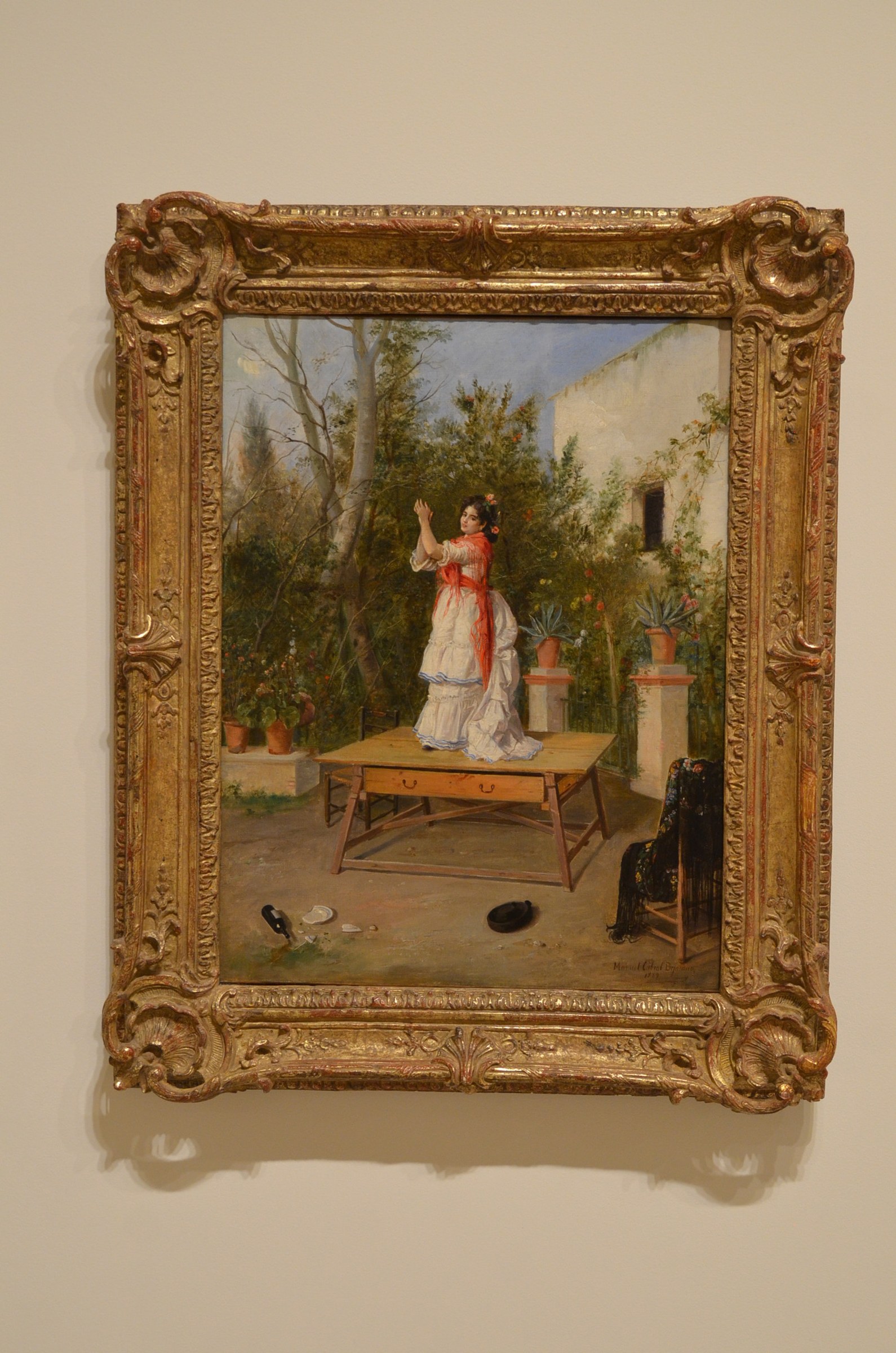
A young woman in elegant late 19th-century dress stands on a wooden table in a sun-dappled garden courtyard, her body caught in a moment of spirited movement. She wears a white petticoat with a red sash or shawl, her dark hair pinned up, one arm raised expressively toward the leafy vines and climbing plants that frame the scene. The setting is intimate and domestic: terracotta pots of flowers line the courtyard, a whitewashed wall with an arched doorway forms the backdrop, bare tree branches suggest spring, and cast shadows indicate bright daylight. In the foreground, a man's hat and gloves rest on the ground—discarded, as if he has stepped away or is watching from the side. A woman in dark clothing sits partially visible at right, an observer of the performance unfolding before her.
The dancing
The central figure stands upright on the table with one arm raised and slightly bent, the other positioned at her side or torso. Her posture is lifted and buoyant rather than constrained; her weight appears centered, allowing her to move freely across the wooden surface. The raised arm and open frame suggest spontaneity and joy rather than formal technique. No partner is in contact; this is a solo performance or display, executed for an audience of at least one seated woman, and observed by the absent man whose possessions lie below.
The dance depicted
The image depicts a moment of social or domestic dance—likely what would in late 19th-century Spanish or Mediterranean culture be called an informal flamenco or regional Spanish dance. However, the setting and style suggest this is an aristocratic or bourgeois recreation or display rather than a vernacular performance. The woman's dress, the garden setting, and the presence of observers indicate this is entertainment among people of means, possibly a parlor dance or a romanticized interpretation of regional Spanish movement. The spontaneity of the pose and the use of the table as a platform are consistent with theatrical or ballroom traditions that incorporated elements of Spanish dance, but the image does not show the characteristic footwork, hand positions (palmas), or body articulation of authentic flamenco.
How it was made
This is an oil painting on canvas, executed with academic precision typical of 19th-century academic realism. The artist has used careful glazing and attention to light to create atmospheric depth and a sense of dappled sunlight filtering through foliage. The technique allows for subtle modeling of fabrics—the sheen of the woman's petticoat, the texture of the potted plants, the weathering of the courtyard wall—which would have been impossible in print media. This level of finish and scale suggests the work was created for exhibition or a collector's gallery, not for mass reproduction, positioning it within the tradition of salon painting.
About this work
This is a 19th-century academic oil painting depicting a moment of animated social dance in a domestic garden setting. The work captures a woman performing a spirited, informal dance—likely a Spanish regional or flamenco-inspired movement—on a table for the amusement of seated observers. It sits at the intersection of Orientalist and Realist traditions, treating regional Spanish culture as picturesque subject matter for educated European audiences. The painting preserves a specific moment in the history of how flamenco and Spanish dance were received, performed, and romanticized in bourgeois European contexts: not as authentic vernacular practice, but as exotic entertainment for private display.
How to look at it
Notice the figure's position on the table—an unstable, theatrical choice that elevates her and frames her as a performer. The raised arm and open posture suggest a moment of release or display rather than technical execution; watch how the shadows and light emphasize her isolation on the platform and the attention of the seated observer. The discarded hat and gloves in the foreground are a narrative detail that suggests male spectatorship and courtship, placing this dance in the social world of 19th-century courtship ritual rather than in the streets or taverns where flamenco originated.
The artist
Manuel Cabral Aguado Bejarano (1807–1889) was a Spanish academic painter known for historical and genre scenes, particularly works depicting Spanish life and customs for European audiences. He worked in the tradition of academic realism and was active during a period when Spanish themes were fashionable among European collectors and exhibition societies. His work often presented Spanish culture—particularly dance, costume, and social life—as picturesque subject matter suitable for salon exhibition.
The period
The late 19th century saw a surge of European interest in Spanish culture, particularly after Spain's loss of colonial power and as Orientalism reached its peak. Academic painters capitalized on this appetite by producing scenes of Spanish daily life and festivity, often inflecting them with exoticism and theatricality. Flamenco itself was undergoing transformation during this period, moving from working-class Andalusian practice into café cantante performance and eventually European salon entertainment. The painting reflects this moment when regional Spanish dance was becoming available as artistic subject matter for educated European viewers, filtered through the lens of bourgeois domesticity.
Where it lives
The work is held in the Museo CarmenThyssen Málaga. The current catalogue record attributes it to Ken Nishikawa (2016), which appears to be an error; the painting is documented in standard art-historical sources as by Manuel Cabral Aguado Bejarano, dated 1889.
Dance in this work
Questions about this work
Is this an authentic flamenco dance?
No. This is a 19th-century European interpretation of Spanish dance, performed by a bourgeois woman in a domestic garden for entertainment. Authentic flamenco emerged from working-class Andalusian culture and has distinct footwork, hand positions, and rhythmic structures that are not evident here. The painting shows how European artists transformed flamenco into exotic spectacle for salon audiences.
Why is she standing on a table?
The table serves as a stage, elevating the dancer and creating theatrical focus. This choice reflects 19th-century parlor entertainment conventions, where improvised platforms were used to frame performances for seated guests. It also suggests the dance is a display of social grace or courtship—a moment of playful exhibition rather than serious practice.
Who is the man whose hat and gloves are on the ground?
The artist does not show the man, but his abandoned possessions suggest he is present as an observer or audience member—possibly the woman's partner or the occasion for the performance. His absence from the frame reinforces the woman as the focal point and subject of the gaze.
More dance artwork





