49 works in this view — arrow keys or swipe to move between them.
Dance in Art
Ricard Canals i Llambí Flamenco Dance
Ricard Canals
- Source:
- Wikimedia Commons
- Rights:
- Public domain — free to use, share and adapt.
- Recorded as:
- public_domain
The work documents flamenco in a specific historical moment—not as folk or concert practice but as cabaret entertainment in a cosmopolitan, multicultural space. It shows how the dance was transformed and presented to European audiences, and how artists visualized both the solitary performer and the collective experience of watching her. For historians of flamenco's diaspora and modernization, and for students of theatrical dance in the early 20th century, this painting is primary evidence.
What you are looking at
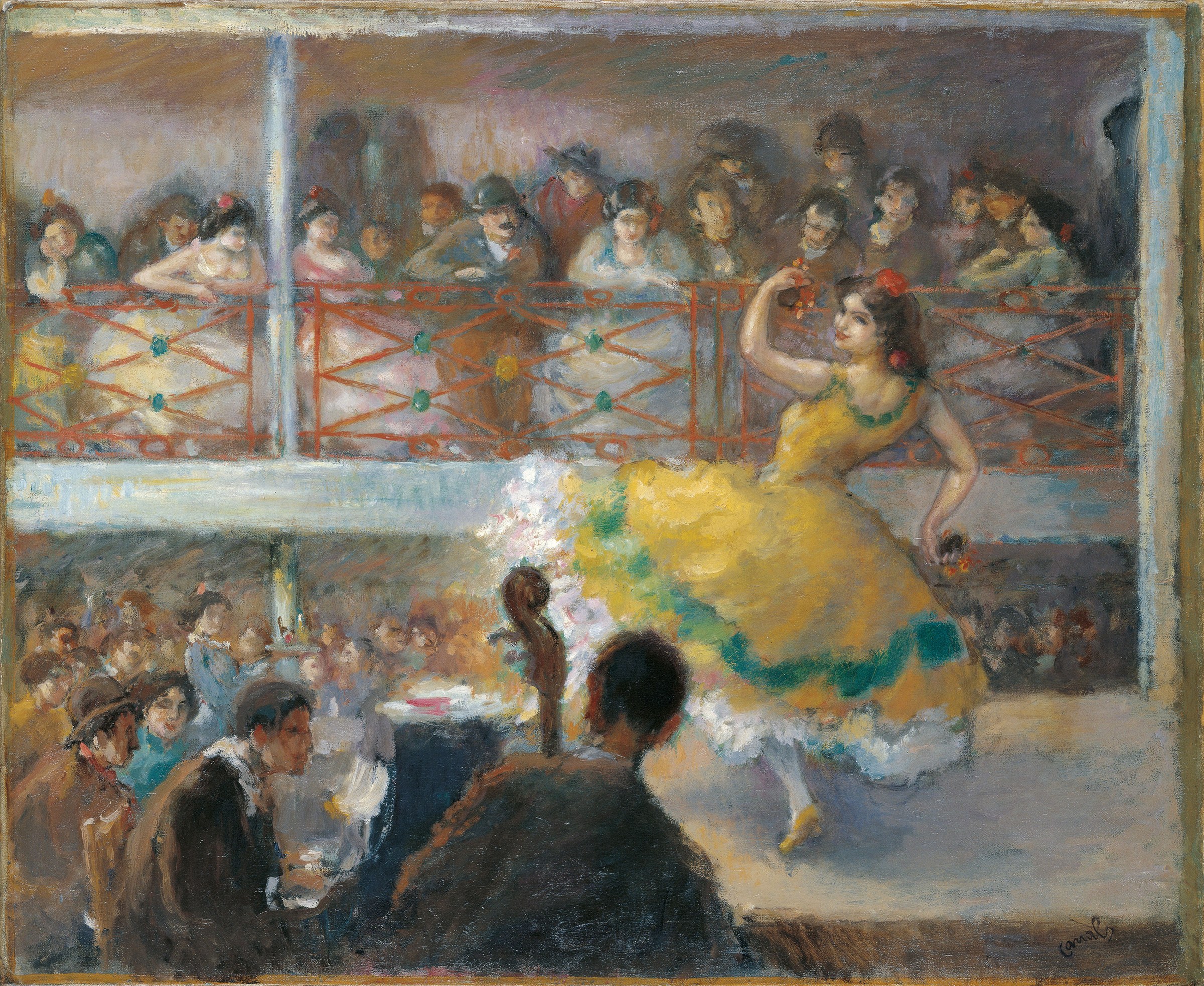
A circus or music-hall interior painted in warm ochres and greys, divided into two tiers. The upper level shows an audience of fashionably dressed spectators leaning over an ornate red-brown railing with turquoise-green medallions, their faces intent on the performance below. The lower level depicts the performance space itself, crowded with standing onlookers in dark coats and hats. Center stage stands a woman in a brilliant yellow dress with white lace trim at the hem, her body caught mid-movement in profile, one arm raised toward her head in a graceful arc. Her posture and the vivid isolation of her figure against the muted crowd suggest a moment of performance intensity. The painting's loose, impressionistic brushwork and soft lighting create an atmosphere of theatrical immediacy—we see not a frozen pose but a glimpse of continuous motion.
The dancing
The dancer occupies the compositional center in an upright, engaged stance. Her raised arm and tilted head suggest expressiveness and control rather than explosive energy. Her yellow dress allows the artist to track the line of her body clearly—spine extended, legs straight, weight centered. She stands alone in the performance space, isolated from the crowd around her. The dozens of spectators are rendered as blurred, shadowy figures; their postures show absorption and forward lean, eyes directed toward the soloist.
The dance depicted
The catalogue identifies this as flamenco dance. The soloist's upright carriage, the arm position, and the stillness of her lower body are consistent with flamenco's emphasis on upper-body expression, arm articulation, and postural control. However, the image lacks the visual markers most strongly associated with flamenco—we see no obvious footwork, no guitar, no characteristic hand positions (palmas, vueltas of wrist and arm), and no costume elements like the flamenco dress's characteristic ruching or the traditional mantón. The yellow dress and theatrical setting suggest a cabaret or music-hall performance rather than a formal flamenco stage. The work may depict flamenco as it was performed in early 20th-century European venues, or it may be a theatrical dance influenced by flamenco rather than authentic flamenco performance. The identity remains somewhat ambiguous from the image alone.
How it was made
Oil on canvas, approximately 61.5 × 74.5 cm. The technique is painterly and impressionistic—forms are suggested through loose brushwork and color rather than rendered in detail. The artist captures atmosphere and movement through soft transitions between warm and cool tones, and through the contrast between the vivid yellow figure and the muted surrounding crowd. This approach allows the painter to convey the momentary, fleeting quality of performance—we see impression rather than documentation. The size and medium suggest this was created for exhibition and private collection rather than reproduction or popular circulation.
About this work
This is an oil painting of a solo dancer performing before an audience in an early 20th-century European music hall or circus venue. The work is catalogued as depicting flamenco dance, though the visual evidence is ambiguous: the soloist's upright posture and arm gesture are consistent with flamenco's aesthetic, but the costume, setting, and lack of visible footwork or traditional performance markers suggest a theatrical interpretation or adaptation rather than authentic flamenco. The painting sits at the intersection of theatrical dance and audience culture, documenting not only the performer but the social and architectural experience of watching dance in a modern entertainment venue. It belongs in a dance gallery as an artifact of how flamenco and Spanish dance were performed and consumed in European culture during the 1930s.
How to look at it
Focus first on the dancer's isolation and posture: she is upright, controlled, self-possessed, lit by an invisible spotlight that makes her yellow dress glow against the crowd. Notice how the artist has caught a moment of pause or stillness—not explosive movement, but readiness and expression. Then look at the composition's social architecture: the strict division between performer and audience, the way the upper tier of fashionable spectators looks down on both the lower-class crowd and the dancer. The railing is as much the subject as the dance. The painting documents not a virtuosic feat but a relationship between performer, audience, and venue.
The artist
Ricard Canals i Llambí (1876–1946) was a Catalan painter and printmaker associated with modernisme and post-impressionism. He trained in Barcelona and Paris, and worked in a range of genres including portraiture, landscape, and social scenes. Canals was particularly drawn to theatrical and musical subjects, and to the life of performance venues, cafés, and public entertainment. His work often combined sharp social observation with painterly sensitivity to light and atmosphere. The loose brushwork and color harmonies in this painting are typical of his mature style.
The period
This painting dates to 1935, a moment when flamenco was undergoing significant transformation in Spain and across Europe. The Spanish Republic was in its final years before the Civil War (1936–39), and flamenco was being increasingly codified and elevated as high art and national heritage, even as it continued to be performed in popular venues. Simultaneously, flamenco was circulating internationally through cabaret, vaudeville, and cinema—exotic, eroticized, and adapted for European audiences. In visual art, dance scenes were popular subjects for modernist and post-impressionist painters; the combination of movement, light, costume, and social space offered rich material. Canals's painting documents this internationalized, theatrical moment in flamenco's history.
Where it lives
The work is held in the Carmen Thyssen Málaga (Museo Carmen Thyssen Málaga, established 2011), a major private collection and public museum in Málaga, Spain. The museum specializes in 19th and early 20th-century Spanish and European art. The accession number CTB.2000.47 indicates it was acquired in 2000.
Dance in this work
Questions about this work
Is this actually flamenco?
The catalogue identifies it as such, and the soloist's upright posture and arm position are consistent with flamenco aesthetics. However, the image lacks visible footwork, traditional costume markers, and the performance setting is a European music hall rather than a Spanish flamenco venue. The work likely shows flamenco adapted for a European cabaret audience, or a theatrical dance influenced by flamenco rather than flamenco itself. Early 20th-century European venues often presented hybridized versions of Spanish and other dances.
What is the yellow dress?
It is a theatrical costume designed to be visible and eye-catching under stage lighting. The vivid yellow and white lace trim distinguish it sharply from the muted crowd. Traditional flamenco dress is typically black, red, or white with ruffles and considerable volume; this simpler silhouette suggests a stylized or adapted version created for a specific venue and audience.
Why are there two levels of audience?
The upper tier represents a gallery or balcony seating area, likely reserved for wealthier patrons. The lower level shows standing room or pit seating. This division reflects the social hierarchy of early 20th-century music halls and cabarets, and the painting documents how dance was consumed across class lines.
Who is the dancer?
The painting does not identify her by name. She is a professional performer in a commercial venue, painted as a type and a moment rather than as an individual portrait. This was common practice for theatrical dance scenes of the period.
More dance artwork





