49 works in this view — arrow keys or swipe to move between them.
Dance in Art
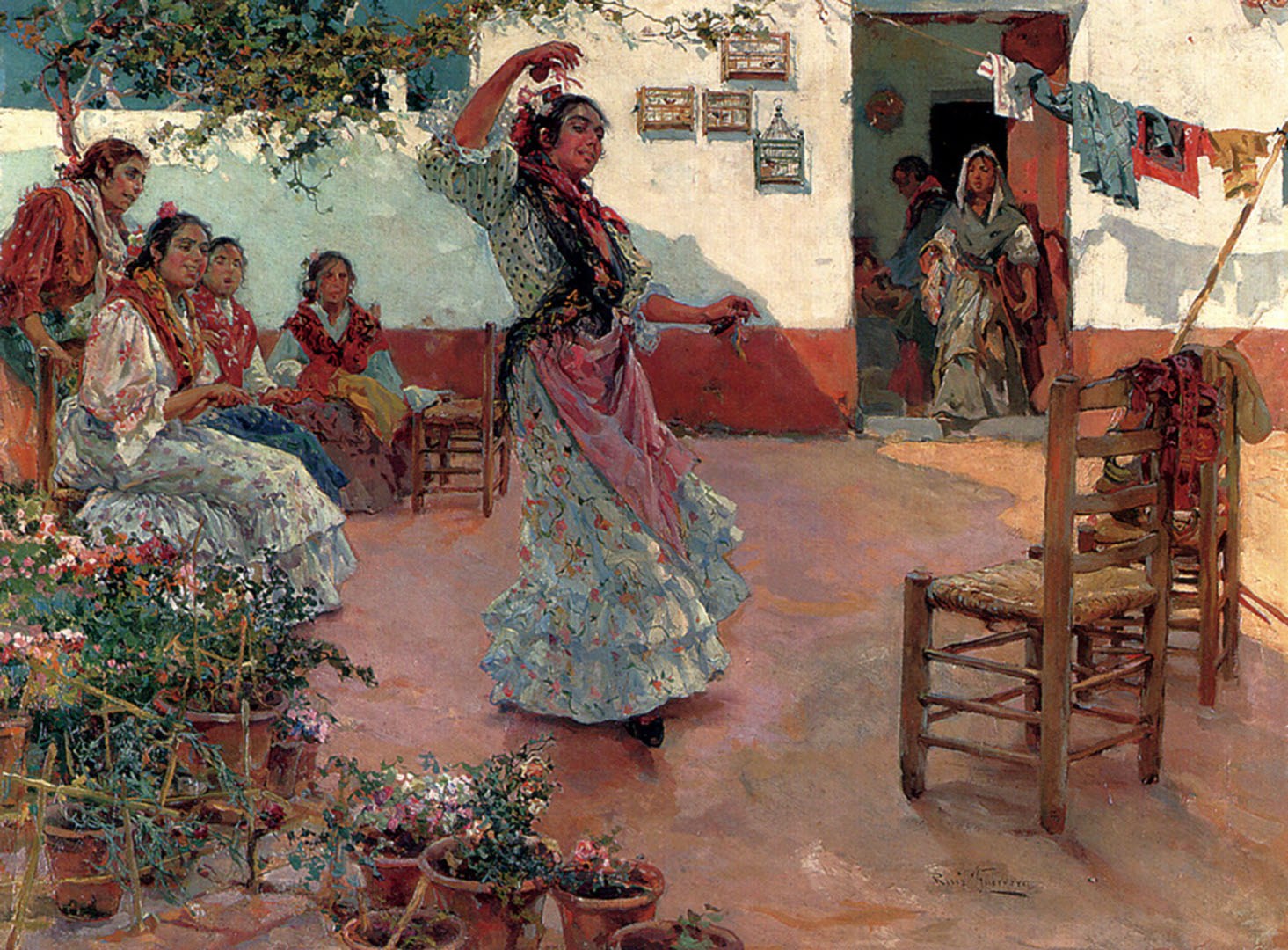
El baile flamenco - Manuel Ruiz Guerrero
Manuel Ruiz Guerrero
- Source:
- Wikimedia Commons
- Rights:
- Public domain — free to use, share and adapt.
- Recorded as:
- public_domain
This work documents flamenco at a moment when the tradition was being discovered and reinterpreted by European artists and audiences, and shows the dance in its vernacular setting rather than on a stage. For flamenco historians and dancers, the image is valuable not as a technical record of footwork but as evidence of how flamenco was understood, aestheticized, and presented to non-specialist viewers in the early twentieth century.
What you are looking at
A woman in a vivid pink-red flamenco dress dances in the center of a sunlit courtyard, her body caught mid-turn with one arm raised expressively. She wears the characteristic voluminous, ruffled skirt of flamenco costume, and a decorative comb or ornament in her dark hair. The scene is set against whitewashed walls with a russet-colored dado; potted flowers bloom in the foreground, and laundry hangs drying in the upper right. A small audience of women and girls, dressed in period costume with shawls and headscarves, sits or stands watching from the left side and from the shadowed doorway at the rear. The light is warm and Mediterranean, flooding the scene from above and creating soft shadows. The composition is intimate and theatrical—a street performance or courtyard entertainment rather than a formal stage.
The dancing
The central dancer's posture is upright and controlled, with her raised arm curved expressively while the other hangs at her side; her weight appears engaged through her torso and hips rather than emphasized in the legs or feet. Her skirt, held in layers of ruffled fabric, swirls around her body, suggesting a turning or swaying movement. The spectators are stationary, seated on simple wooden chairs or standing, their attention fixed on the dancer. The spatial relationship places the dancer as the singular focus, with the onlookers arranged to frame her performance.
The dance depicted
This is a depiction of flamenco, most likely a palos like Alegrías, Tangos Flamencos, or perhaps Soleá—common nineteenth-century Spanish flamenco forms associated with Andalusian street culture and domestic entertainment. The woman's costume, posture, and the informal setting all confirm flamenco tradition. However, the image captures the dance in a moment of arm and torso expression rather than footwork, so the specific palos cannot be determined with certainty. The setting suggests this is vernacular flamenco as practiced in domestic or communal spaces among working people, not the theatrical flamenco of later commercial stages.
How it was made
This is an oil painting, identifiable by the soft blending of colors, the luminous treatment of light on the whitewashed walls and the dancer's skin, and the painterly handling of the fabric textures. The technique is academic realist with strong attention to local color and atmospheric effect. Oil on canvas allowed the artist to build up rich, translucent glazes—particularly in the rendering of the pink dress, the shadow play in the courtyard, and the subtle gradations of the Mediterranean light. The finish and size suggest this was a finished exhibition work rather than a sketch.
About this work
This is a Spanish realist painting of flamenco, the dance tradition of Andalusia, captured in a domestic or street setting rather than a theater. The work dates to the late nineteenth or early twentieth century, when European academic painters were increasingly drawn to scenes of Spanish folk life and 'exotic' local customs. Flamenco was experiencing a transition during this period: it was being codified into a concert art form for middle-class and international audiences even as it remained rooted in working-class culture, street celebrations, and family entertainment. The painting sits at that intersection—it renders flamenco with respectful attention to costume and setting, but frames it as a picturesque scene for a viewer of refined taste rather than as a living community practice.
How to look at it
Notice the moment the artist chose: not the climactic stamp or turn of footwork, but a moment of upper-body expression and dress display. The arm position and the sculptural quality of the ruffled skirt are what the painter emphasizes, not the precise mechanics of the feet. Observe also how the composition frames the dance as spectacle for a settled audience—the painting invites you to watch as the courtyard dwellers do, from the side, stationary. The warm light and the rendered textures of fabric, stone, and flowers create a sense of intimate authenticity, a convention of nineteenth-century realism that works to make this scene feel like documentary rather than interpretation.
The artist
Manuel Ruiz Guerrero (1864–1917) was a Spanish painter best known for scenes of Spanish regional life, particularly flamenco dancers and Andalusian street culture. He worked in the academic realist mode and exhibited widely in Spain and internationally. His practice was part of a wider European fashion for 'costumbrismo'—the artistic documentation and romanticization of folk and regional customs. Ruiz Guerrero's works were popular among European collectors and helped establish flamenco imagery as a staple of Spanish-themed art.
The period
In the early twentieth century, flamenco was undergoing rapid transformation. The dance had emerged from Andalusian Romani and working-class culture but was being professionalized and packaged for middle-class Spanish and international audiences. Theaters dedicated to flamenco were opening in Madrid and Barcelona; dancers were becoming named celebrities; and the tradition was being codified into distinct palos with standardized music and choreography. Simultaneously, European artists were developing an intense fascination with Spanish culture—the legacy of Orientalism, Romanticism, and the rise of tourism—and painters like Ruiz Guerrero were meeting the demand for scenes of Spanish 'authenticity' and local color. This painting, with its domestic courtyard and informal audience, presents flamenco as picturesque folk tradition even as the actual practice was becoming professionalized.
Where it lives
The work is recorded via Wikimedia Commons, a digital archive of public-domain and openly-licensed cultural works. The catalogue record offers minimal information; no collection holding, acquisition history, or current location is documented in the source consulted.
Dance in this work
Questions about this work
How do we know this depicts flamenco and not another Spanish dance?
The costume is diagnostic: the voluminous ruffled skirt, the ornament in the hair, and the posture and movement of the torso are all characteristic of flamenco tradition. The domestic courtyard setting and the presence of intent spectators also fit the context in which flamenco was performed in nineteenth-century Andalusia. Other Spanish regional dances—sevillanas, for example—have different costumes and contexts.
What specific flamenco style is being danced here?
The image does not show footwork clearly enough to identify a specific palos (form). The upright, expressive posture and the arm gesture could belong to Alegrías, Tangos Flamencos, Soleá, or another nineteenth-century form. Without seeing the feet or hearing the music, we can only say this is flamenco.
Was flamenco really danced in courtyards like this in 1917?
Yes. Though flamenco was being professionalized and moved into theaters, it remained deeply embedded in working-class and Romani domestic and street culture. Courtyard performances, family celebrations, and informal gatherings where flamenco was danced were widespread in Andalusia. The painting documents a real social practice, though it aestheticizes it for a middle-class European viewer.
Why did European painters become so interested in flamenco?
Flamenco fit into broader European fascination with Spanish culture, particularly after the decline of Spanish imperial power—it was seen as 'exotic,' passionate, and authentically folk. Painters like Ruiz Guerrero met demand from collectors for picturesque scenes of regional life. The dance also offered painters opportunities to display virtuosity in rendering light, fabric, and the human figure in motion.
More dance artwork





