49 works in this view — arrow keys or swipe to move between them.
Dance in Art
Spanish: Flamencolabel QS:Les,"Flamenco"
Antoni Coll i Pi
- Source:
- Wikimedia Commons
- Rights:
- Public domain — free to use, share and adapt.
- Recorded as:
- public_domain
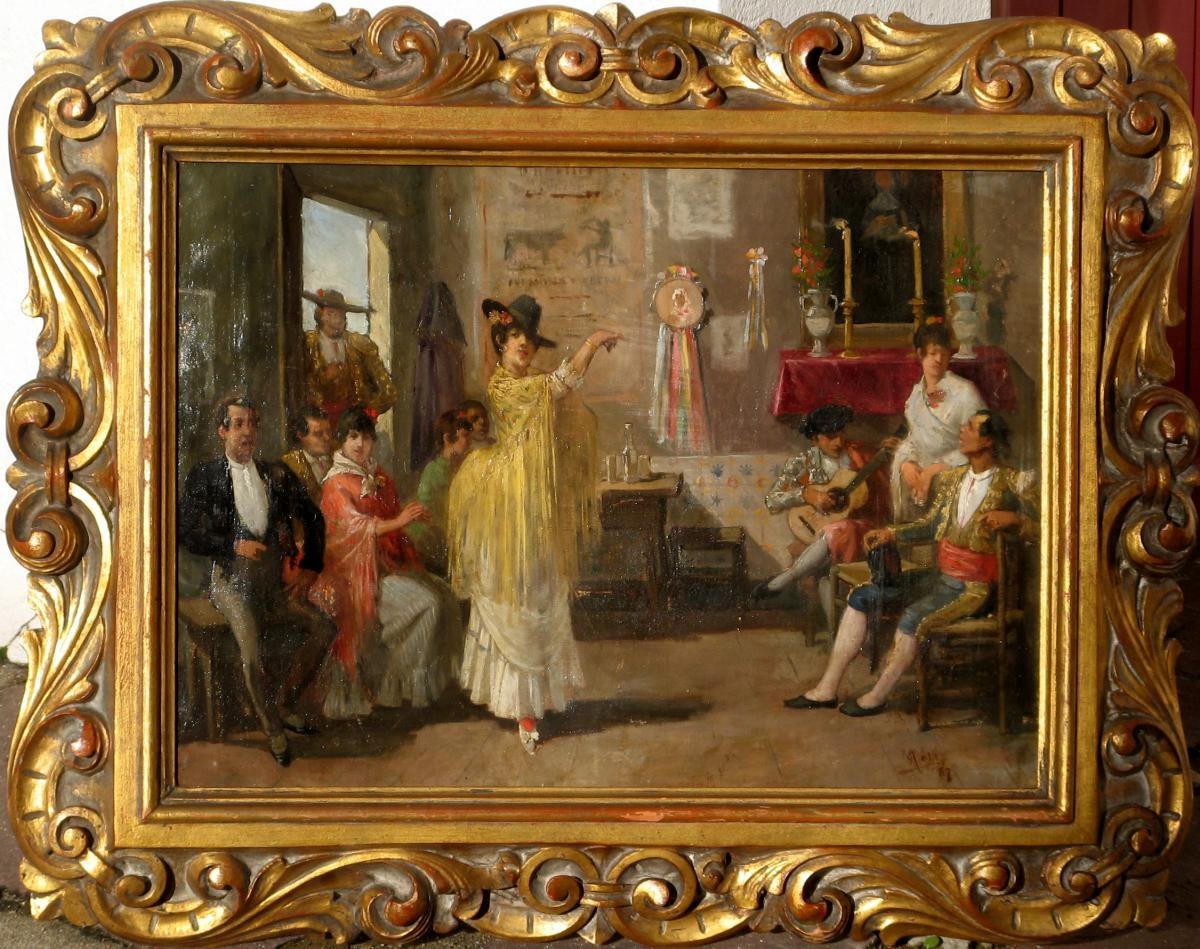
This painting documents how flamenco and flamenco-related dance circulated in refined domestic settings in the 1880s, reaching audiences far beyond the taverns and streets with which the form is historically associated. It provides visual evidence of the repertoire, dress, and social context of late 19th-century peninsular Spanish dance performance, and shows how dance functioned as a marker of cultural identity and cosmopolitan taste in Catalan and Spanish salon society.
What you are looking at
A theatrical interior dominated by a woman in a brilliant yellow dress, captured mid-movement with her body angled and one arm raised in an expressive gesture. She stands in the center of a crowded room of well-dressed spectators in late 19th-century costume—men in dark suits and evening wear, women in fashionable dress—who watch from around the periphery. The setting appears to be an elegant drawing room or salon, with high walls, doorways, and decorative furnishings visible in the background. A red-draped table with flowers and vessels sits to the right. The lighting is warm and atmospheric, with darker tones in the background and stronger illumination on the central dancer, creating a sense of theatrical focus. The composition suggests a private entertainment or performance in a privileged domestic or semi-public space.
The dancing
The central figure shows an open, asymmetrical posture: torso angled, legs in a walking or stepping attitude, the left arm raised at shoulder height with the hand gestural rather than formally positioned. The pose reads as mid-stride with dynamic weight transfer, not a held static position. Spectators are distributed unevenly around the room—some standing, some seated, all facing toward or aware of the dancer. No formal partnering is visible; the dancer performs solo before an audience. The energy is outward and expansive, the body unselfconsciously turned to catch light and motion.
The dance depicted
The catalogue identifies this as flamenco, and the yellow dress, the gestural arm work, and the open posture with asymmetrical weight are consistent with flamenco movement vocabulary and presentation. However, the scene depicts a salon or parlor performance—a private entertainment before an assembled audience of society figures—rather than a public taberna or theatrical stage. This suggests a context of amateur or semi-professional performance in a domestic or semi-public interior, a common venue for flamenco-inflected entertainment in late 19th-century Catalan and Spanish society. The exuberance of the pose and the bright yellow fabric dominating the composition suggest a moment of maximum expressivity, but without visible footwork (obscured by the dress), rapid hand passages, or the architectural frame of a proper stage, the specific style of flamenco cannot be determined with confidence.
How it was made
This is an oil painting, identifiable from the soft handling of fabric, the warm atmospheric light, and the fluid blending of tones in the background and figures. The technique allows Coll i Pi to achieve depth through overlapping figures and atmospheric perspective, and to capture the shimmer and weight of the dancer's silk dress. The painting's finish and detail suggest it was created for exhibition or private collection display, not for mass reproduction; it circulated among collectors with means to acquire such salon scenes. The focus on dramatic lighting and gesture over anatomical precision is characteristic of late 19th-century romantic realism—the painting aims to capture mood and movement impression rather than documentary record.
About this work
This oil painting by Antoni Coll i Pi, signed and dated 1887, depicts a performance of flamenco or flamenco-influenced dance in a private salon setting. A woman in a brilliant yellow dress performs before an assembled gathering of well-dressed onlookers in what appears to be an elegant interior—a typical venue for amateur theatrical entertainment in late 19th-century Spanish and Catalan society. The work belongs to a tradition of salon painting that documented social life, performance, and fashion among the urban elite. It sits at the intersection of genre painting, social documentation, and dance imagery: it shows not only a dance being performed, but a moment of cultural practice and social display.
How to look at it
Look at how the painter has positioned the dancer's body in space—the torso twist, the raised arm, the forward stepping leg—as a moment of maximum openness and extension, not a closed or balanced posture. The bright yellow fabric is the visual anchor of the composition; the painter has made the dress itself part of the dance, its folds and movement inseparable from the body beneath. Notice how the spectators frame the scene without dominating it; they provide context and scale, establishing this as a social performance rather than an isolated figure study. The warm indoor lighting and the density of figures create a sense of intimacy and privilege—this is a performance for invited guests in a private space.
The artist
Antoni Coll i Pi (1823–1891) was a Catalan painter known for genre scenes, historical subjects, and society portraits. He worked in the second half of the 19th century during a period of cultural and economic expansion in Barcelona and Catalonia. His oeuvre included salon paintings of social gatherings, theatrical subjects, and scenes of contemporary life; he was attentive to costume, interior decoration, and the capture of momentary gesture. This work is characteristic of his interest in contemporary social life and the performance traditions of his region.
The period
In the 1880s, flamenco was undergoing a process of codification and professionalization, moving from localized Andalusian tradition into wider Spanish and European contexts through both theater and salon performance. The rising urban middle classes of Barcelona and Madrid consumed performances of Spanish dance and music as markers of regional identity and artistic sophistication. Simultaneously, salon painting in Europe was at its height as a genre: painters like Tissot, Boldini, and their contemporaries documented the interiors, gatherings, and entertainments of the wealthy. Coll i Pi's work reflects both the Catalan interest in preserving and displaying regional dance traditions and the broader European appetite for paintings of contemporary social ceremony and performance.
Where it lives
The work is recorded as held by an unspecified collection and was sourced from Wikimedia Commons, suggesting it has entered public access or institutional holdings with digitization. No accession number or current location is recorded in the available catalogue data.
Dance in this work
Questions about this work
Is this really flamenco? It doesn't look like what I think of as flamenco.
The painting shows flamenco or flamenco-inflected performance in a 19th-century salon context, not the stage flamenco or taberna tradition viewers may be familiar with today. The yellow dress, the gestural arm work, and the open posture are consistent with period flamenco vocabulary. But the setting—a private gathering, an interior, an amateur or semi-professional performer—would have been normal for how flamenco circulated among the Spanish upper classes at this date. It is flamenco as salon entertainment, not concert art.
Who was Antoni Coll i Pi?
A 19th-century Catalan painter (1823–1891) known for genre scenes, historical subjects, and portraits of social life. He worked during a period of cultural flourishing in Barcelona and was attentive to contemporary dress, interior decoration, and the traditions of his region. This painting is typical of his interest in documenting social gatherings and performance.
What can we learn about 19th-century flamenco from this painting?
The painting shows that flamenco was performed in elite domestic settings, not only in public theaters or working-class taverns. The dress—a high-fashion yellow silk gown rather than the theatrical or folk garments of later periods—suggests that flamenco had been absorbed into cosmopolitan entertainment. The open posture and gestural arm work show the vocabulary of the form as understood and performed in this period. The presence of an assembled audience of well-dressed spectators indicates that flamenco performance was a valued social activity among the Catalan and Spanish urban elite.
More dance artwork





