49 works in this view — arrow keys or swipe to move between them.
Dance in Art
Spanish: Flamencolabel QS:Les,"Flamenco"
Antoni Coll i Pi
- Source:
- Wikimedia Commons
- Rights:
- Public domain — free to use, share and adapt.
- Recorded as:
- public_domain
This painting documents a crucial moment in flamenco's visibility in European art, before flamenco became institutionalized as concert dance. The informal setting and audience response show how flamenco functioned as social and street entertainment in 19th-century Spain, not yet codified into named styles or professional theater. For dance historians, the image preserves a record of 1880s flamenco costume, posture, and performance context.
What you are looking at
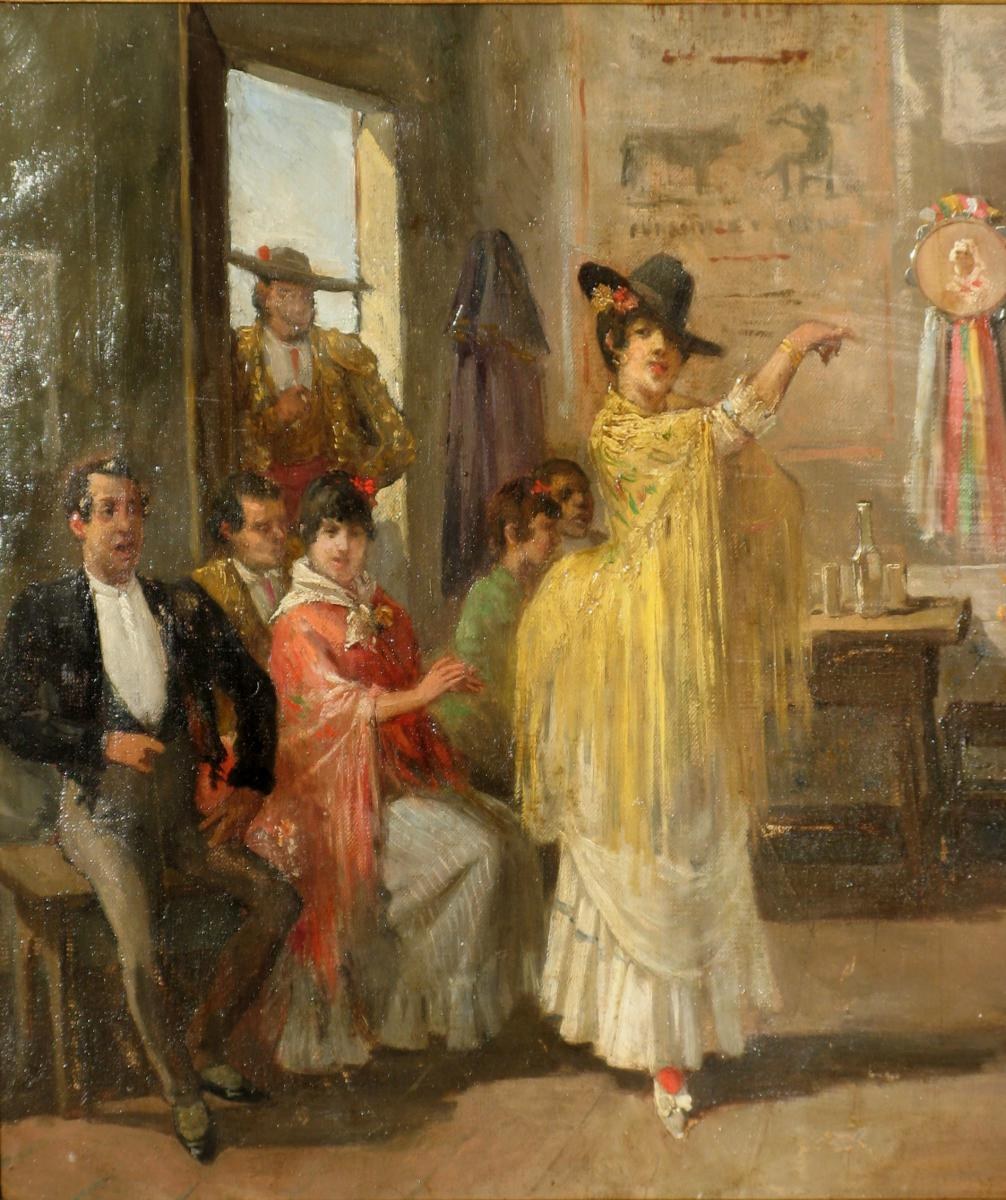
A woman in a brilliant yellow dress dominates the center of the composition, her body tilted back in an exuberant pose with one arm extended outward. She wears a dark hat and white undergarments visible beneath the translucent yellow fabric. Around her stand five onlookers in a modest interior—two men in dark coats and three women in colored dress (red, green, white)—gathered as if witnessing a performance. One man stands in a doorway at left, silhouetted against bright exterior light. The setting appears to be a modest room with faded decorative marks on the wall above; a small table with bottles and a glass sits in the right background. The composition captures a moment of performance, with the yellow-dressed figure commanding attention while the audience regards her with expressions ranging from rapt to amused.
The dancing
The central dancer leans backward at a pronounced angle, with her weight shifted onto one leg while the other extends forward—a position suggesting vigorous, unrestrained movement. Her right arm sweeps outward in a broad gesture; her left arm position is less clear but suggests she is fully engaged in expressive movement. The onlookers form a loose semi-circle, their postures upright and attentive, creating a clear spatial distinction between performer and audience. The pose conveys dynamism and abandon rather than the controlled line of academic dance.
The dance depicted
This is a flamenco scene, as the catalogue indicates. The yellow dress, the dynamic arched-back posture, and the informal performance setting with an engaged audience align with 19th-century flamenco in Spain. However, the specific flamenco style cannot be confidently identified from gesture alone—the exaggerated back arch and broad arm sweep suggest the theatrical, audience-facing expressiveness of a fiesta or informal performance rather than a codified form like Alegrías or Soleá. The work appears to document a moment of social dancing or entertainment rather than concert performance.
How it was made
The work is painted in oil, showing characteristic brushwork of the period—loose, atmospheric handling in the background and walls, with more defined rendering of the figures. The warm palette of ochres and muted tones, with the yellow dress as the focal point, suggests the artist used strong color contrast for compositional emphasis. The painting technique, with its sketchy treatment of the setting against carefully observed figures, suggests this was made for exhibition or gallery sale rather than as documentary illustration.
About this work
Antoni Coll i Pi painted this scene of flamenco in 1887, capturing a moment of informal Spanish dance performance witnessed by an gathered audience. The work belongs to a 19th-century European tradition of depicting regional and exotic dance as subject for fine art—a tradition that included orientalist, Spanish, and folk-dance subjects as markers of authenticity and local character. The painting treats flamenco not as an exotic spectacle viewed from a distance, but as an intimate social occasion, with the performer's audience present and engaged in the same room.
How to look at it
Look at the relationship between the dancer's exaggerated backward arch and the contained postures of the audience. The artist has chosen a moment of maximum expressive abandon, contrasting it with the stillness and attention of the witnesses. Notice the handling of light: the bright exterior visible through the doorway provides a cool accent against the warm interior, and the yellow dress reads as a beacon against the muted palette—a compositional choice that subordinates the setting and audience to the performer's visual dominance. The painting is about the moment of performance and its effect on those who witness it.
The artist
Antoni Coll i Pi (1823–1891) was a Catalan painter known for genre scenes and historical subjects. He worked primarily in Barcelona and Madrid and was aligned with the development of Catalan artistic institutions in the late 19th century. His interest in Spanish regional and folk subjects reflects a broader European interest in picturesque and authentic national character—a theme central to Romantic and post-Romantic visual culture.
The period
In the 1880s, flamenco was undergoing transformation from marginalized street and tavern dance to a subject of artistic and ethnographic interest among European audiences. Spanish painters, in particular, had begun to document flamenco as a subject worthy of gallery exhibition. At the same time, the professionalization of flamenco was beginning—the first formal academies and staged performances were emerging. Coll i Pi's painting sits at this threshold, showing flamenco still rooted in informal social performance while already being framed as worthy of fine art representation.
Where it lives
The work is held in a public collection and was encountered via Wikimedia Commons, suggesting it is in the public domain in its source jurisdiction. The catalogue record provides minimal detail on holding institution, accession, or exhibition history.
Dance in this work
Questions about this work
What is she dancing?
The painting is titled 'Flamenco' and the woman's dynamic posture, dress, and the Spanish interior setting support that identification. The specific flamenco form—Alegrías, Soleá, Tangos, or another—cannot be determined from the image alone. The informal setting and broad, expressive gesture suggest this is a social or fiesta performance rather than a formally codified style.
Why is her dress so bright yellow?
In 19th-century flamenco, bright colors, especially warm tones, were common in women's dresses. Here, the yellow dress serves both as costume documentation and as a compositional device—the artist uses it to draw the viewer's eye to the dancer and emphasize her dominance of the scene. It also signals the festive, joyful character of the moment.
Is this a real performance or an imagined scene?
This is almost certainly imagined—a genre scene composed for exhibition rather than a documentary record of a specific event. However, it documents the real conditions under which flamenco was performed in Spain in the 1880s: in modest rooms, before gathered audiences of friends and neighbors, with the dancer commanding attention through uninhibited movement and gesture.
Why are there men in dark suits watching a dancer?
In 19th-century Spain, flamenco was a mixed social occasion, not segregated by gender. The presence of men and women as audience reflects the reality of Spanish tavern and fiesta culture. The men's formal dark dress, contrasted with the women's colored garments, may also indicate class or social difference—a common theme in European genre painting of the period.
More dance artwork





