49 works in this view — arrow keys or swipe to move between them.
Dance in Art
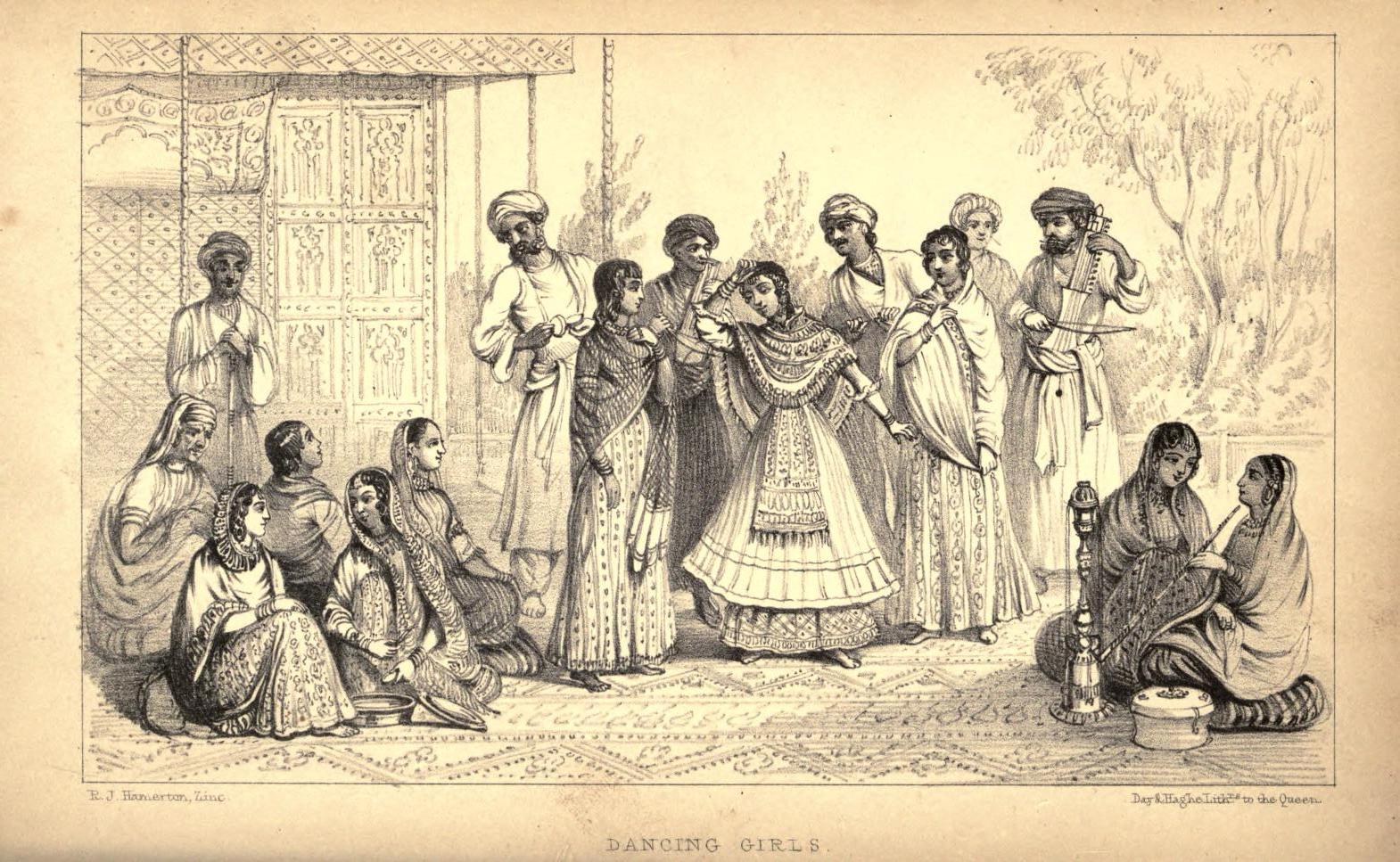
Lithograph titled 'Dancing Girls', from 'The Court and Camp of Runjeet Sing' by William Godolphin Osborne, ca.1840
Unknown authorUnknown author
- Source:
- Wikimedia Commons
- Rights:
- Public domain — free to use, share and adapt.
- Recorded as:
- public_domain
This image is one of the few visual records of professional dance practice in the Sikh court before the region's transformation following British annexation in 1849. It documents a tradition of female court performers whose cultural and social role has been largely erased from subsequent histories. For historians of South Asian dance and of Sikh cultural practice, it is a rare early-19th-century primary source combining visual and textual evidence.
What you are looking at
A courtly scene set in an ornate garden pavilion where professional dancers perform for an assembled audience of nobility and attendants. The setting features elaborate architectural elements—a decorated doorway with intricate carved panels, a patterned ceiling with geometric designs, and mature trees suggesting a formal garden enclosure. At the center stands a solo female dancer in rich costume: a heavily embroidered long skirt with deep borders, an ornate necklace, and an elaborate headdress. She is flanked by musicians and attendants. To her left, several seated women watch from low seats; to her right, standing male attendants in turbans and loose robes hold instruments. The entire composition suggests a formal court entertainment, with clear spatial separation between the performing and observing roles.
The dancing
The central dancer stands with an upright, composed posture, her body held in controlled verticality characteristic of court performance tradition. Her arms appear relaxed at her sides or held at waist height rather than in extended gestures. Her weight is evenly distributed, suggesting a position between movements rather than a dynamic lunge or turn. The attendants frame her symmetrically, emphasizing her central role. The seated women to the left are in repose, their bodies low and gathered, creating a visual hierarchy between performer and audience. The standing male attendants maintain formal bearing, their postures upright and their roles clearly demarcated as musicians or guards rather than dancers.
The dance depicted
This depicts court dance from the court of Maharaja Ranjit Singh (r. 1780–1839), the Sikh ruler whose military and political power dominated the Punjab in the early 19th century. The figure is almost certainly a professional dancing girl (often called a *tawaif* in North Indian contexts, though the specific terminology for Sikh court dancers requires care). The static, formal pose and the elaborate costume suggest a moment of presentation rather than active movement, which is typical of lithographic documentation of court performance—the artist has frozen a pose of display. The musician and attendant figures, the garden pavilion setting, and the formal protocol all align with documented Sikh court entertainment practices of the period, though the specific dance form—whether *kathak*, regional Punjab styles, or court-specific traditions—cannot be determined from the image alone.
How it was made
This is a lithographic engraving (the inscription credits 'R.J Hamilton, Zinc'), a reproductive print technique that allowed mass circulation of documentary images. Lithography, which transfers ink from a chemically treated stone or metal plate to paper, was the leading technology for illustrated travel and ethnographic publishing in the 1830s–1840s. The fine linear detail, the control of tone through cross-hatching and stipple, and the legible reproduction of ornamental detail reflect the technique's capacity for precision and visual hierarchy. As a print from William Godolphin Osborne's book *The Court and Camp of Runjeet Sing* (1840), this was created for a European audience seeking documentary evidence of unfamiliar courtly practices, which shaped how the subject was framed and what details the artist chose to emphasize.
About this work
This lithographic print documents a scene of professional dance entertainment at the court of Maharaja Ranjit Singh in the early 19th-century Punjab. It is part of a broader 19th-century European genre of travel writing and visual ethnography that used illustrated books to present the customs, architecture, and social practices of colonial-era India to British audiences. The work sits at the intersection of dance history, Sikh court culture, and the visual conventions of colonial documentation—it records a now-lost or transformed tradition while simultaneously filtering it through the aesthetic and compositional expectations of European printmaking.
For dance historians, the image is valuable not for its detail about movement or specific technique (which the static, formal pose obscures) but for what it confirms about the existence, structure, and elite patronage of professional court dance in early-19th-century Punjab. The composition emphasizes protocol, costume, and the separation of performer and audience—evidence of how court dance functioned as formal spectacle.
How to look at it
Attend first to the costume and ornament—the embroidered skirts, the necklace, the headdress—which signal the dancer's status and the wealth lavished on court entertainment. Note the formal, almost sculptural quality of the dancer's pose and the absence of captured movement or mid-gesture dynamism; this is a portrait of a role rather than a record of motion. Observe how the artist has structured the scene spatially: the dancer is isolated at center, elevated slightly, with musicians and attendants arranged symmetrically. This composition reflects both the actual protocol of court performance and the European artistic conventions (symmetry, centrality, framing) that Osborne's draughtsman applied when transcribing an unfamiliar scene. The garden setting, though lightly indicated, emphasizes that this is courtly leisure, not street or temple performance.
The artist
The engraving is credited to R.J. Hamilton (working as 'R.J Hamilton, Zinc'). Hamilton was a reproductive engraver working in London for the publishing industry, creating plates from original drawings and paintings supplied by travellers and artists. He did not create the original composition; he translated the visual design into lithographic form for mass production. The original drawing was likely supplied by William Godolphin Osborne or a draughtsman travelling with him. Hamilton's role was technical and semi-anonymous, typical of the print trade in this period—skilled craft labour serving the commercial and documentary purposes of illustrated publishing.
The period
The 1830s–1840s saw intense European interest in visualizing the courts and military camps of Indian rulers, particularly those—like Ranjit Singh—who had successfully resisted or delayed British territorial expansion. Osborne's work was part of a surge of illustrated travel literature aimed at British audiences curious about India as a space of power, luxury, and exoticism on the eve of fuller colonial administration. Within South Asian dance history, this period marks the transition from court patronage systems (which were beginning to fracture) toward the eventual codification of classical dance forms in the 20th century. Professional female court dancers occupied a complex social position: skilled performers with elite patronage but also vulnerable to later stigmatization and erasure. The lithograph captures a moment of their visibility before they largely disappear from official British colonial archives.
Where it lives
This print originates from *The Court and Camp of Runjeet Sing: With an Introductory Sketch of the Origin and Rise of the Sihk State: Illustrated with Sixteen Engravings* (London: Henry Colburn, 1840), a substantial illustrated travel narrative aimed at educated British readers. The copy noted in the catalogue (Shelfmark B1277, Copy No 20096) is held by The Portico Library in Manchester, a historic private library founded in 1806. Such libraries collected travel literature, scientific treatises, and illustrated books as primary sources for self-education and cosmopolitan knowledge.
Dance in this work
Questions about this work
What kind of dance was this?
The lithograph does not show enough movement or technical detail to identify a specific dance form. The formal pose, ornate costume, and court setting suggest professional entertainment, possibly *kathak* or a regional Punjabi court tradition, but the image alone cannot confirm this. The static presentation reflects the limitations of early lithography in capturing motion, and likely also the conventions of how European artists chose to document unfamiliar performance.
Who was Maharaja Ranjit Singh and why does he matter for dance history?
Maharaja Ranjit Singh (1780–1839) ruled the Sikh Empire in the Punjab and was one of the last major Indian rulers to maintain independent military and political power before British annexation. His court supported classical and courtly arts, including professional dancers. After his death and the British conquest of the Punjab, the court system collapsed, and the patronage networks that sustained professional dancers largely disappeared, contributing to the erasure of Punjabi court dance traditions from historical memory.
What was the social status of professional court dancers in this period?
Professional female court dancers held ambiguous status: they were skilled artists with elite patronage, access to wealth, and formal court roles. However, they were also often unmarried, performed publicly, and occupied a sexually and socially liminal position. Colonial British administrators and later Indian nationalists frequently stigmatized such performers, contributing to their exclusion from 'respectable' histories of Indian classical dance in the 20th century. This lithograph captures them at a moment of visibility and patronage.
Why was this book illustrated and distributed to British audiences?
Osborne's narrative was part of a large genre of illustrated travel literature aimed at educated British readers in the 1830s–1840s. These books satisfied curiosity about India's rulers, military strength, wealth, and 'exotic' customs at a moment when Britain was consolidating colonial control. Illustrated books like this one served as evidence, documentation, and entertainment—they positioned the reader as an educated observer of distant worlds and justified colonial interest through knowledge and visual spectacle.
More dance artwork





