49 works in this view — arrow keys or swipe to move between them.
Dance in Art
Edison's Greatest Marvel-The Vitascope - Restoration
Metropolitan Print Company; Copyright 1896 by Raff & Gammon
- Source:
- Wikimedia Commons
- Rights:
- Public domain — free to use, share and adapt.
- Recorded as:
- public_domain
This poster is a primary source for understanding how cinema entered popular culture as a form of theatre, and how the moving body on film was presented as spectacle to paying audiences. For dance historians, it documents the moment cinema became a vehicle for capturing and distributing choreographed movement to masses of viewers, fundamentally changing how dance could circulate and be experienced. The image itself is historically significant as an artifact of 1890s American popular culture and chromolithographic printing.
What you are looking at
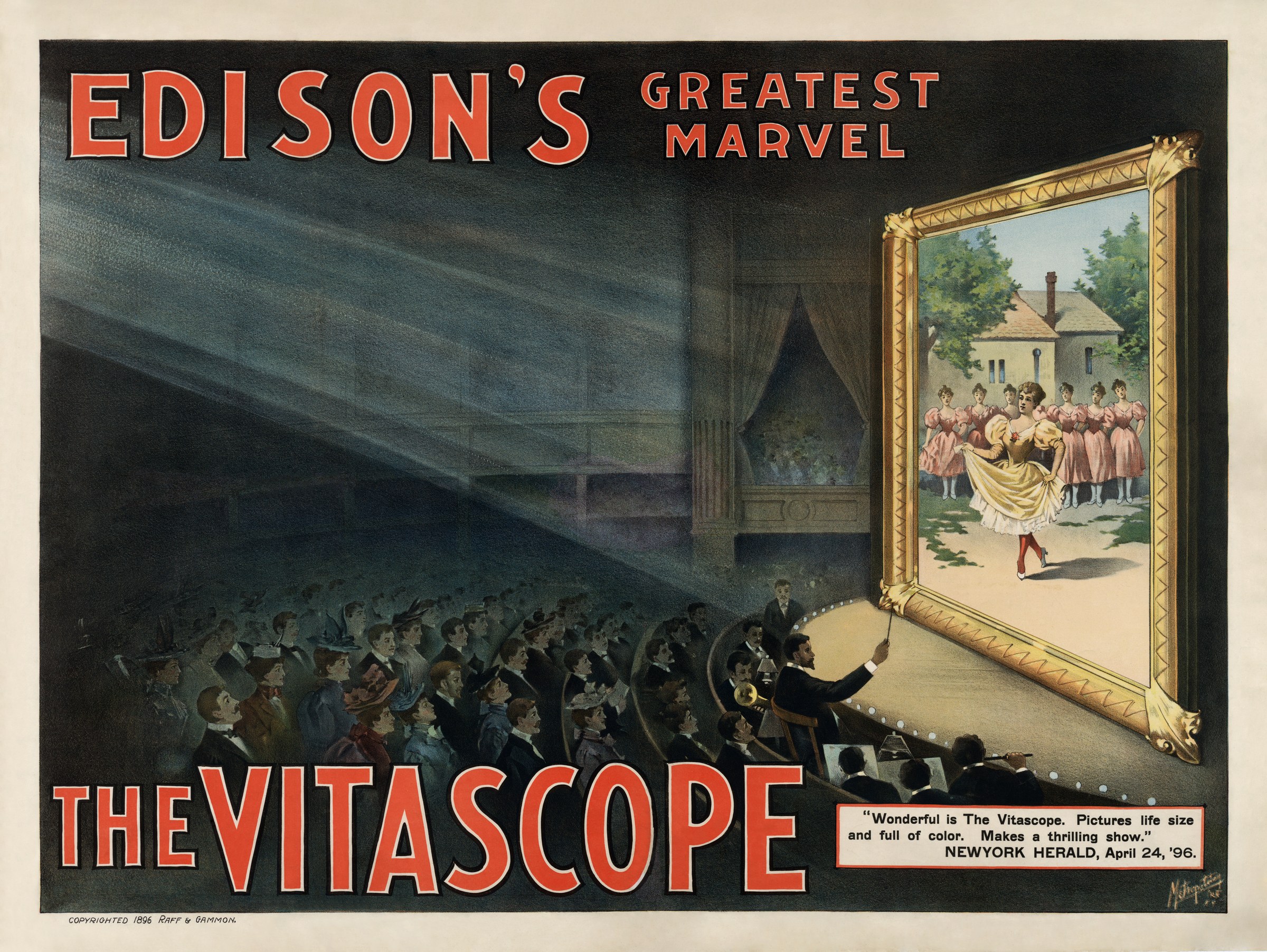
This is a chromolithographic poster advertising the Vitascope, Thomas Edison's early film projection technology. The composition is divided into two spaces: a darkened theatre interior in the foreground shows an audience of well-dressed spectators (men in dark suits and hats, some women in the box seats) seated in rows facing a large golden-framed screen. The screen displays a sunlit outdoor scene with women in pale pink dresses dancing or moving in an animated group before a white clapboard house with a peaked roof and tall chimney. A small orchestra with visible instruments sits in the pit immediately in front of the screen. The poster's dramatic lighting emphasizes the glow of the projected image and the contrast between the shadowy audience and the bright, detailed pastoral scene on screen. The composition demonstrates the novelty and spectacle of cinema: this technology projects life-sized figures onto a wall, a marvel for audiences accustomed to small photographic images or live theatre.
The dancing
The dancers on the projected screen are depicted in light, airy poses suggesting movement and animation—their bodies lean and turn, skirts appear to be in motion. The figures are rendered in pale colors against green landscape, with individual arms and legs visible. The audience figures are static, seated or standing in formal posture, their stillness contrasting sharply with the kinetic energy of the projected dancers. The small orchestra musicians hold instruments (brass and strings are discernible) in playing position.
The dance depicted
The image does not clearly depict a specific named dance style. Rather, it documents early cinema itself as a medium for showing movement and choreography to mass audiences. The women on screen appear to be performing some form of stage or theatrical movement—their gestures and loose grouping suggest choreographed action rather than social dance. The Vitascope's ability to capture and enlarge human motion was itself the marvel being advertised, making the specific dance form secondary to the technology. This is a record of how early film presented the human body in motion to paying audiences.
How it was made
This is a chromolithographic colour poster, a printing technique that allowed bright, eye-catching colour reproduction and mass distribution of promotional images. Lithography's ability to render tonal gradation is evident in the subtle shadow work inside the theatre, while the bold primary colours of the title text and the glowing golden frame ensure legibility at a distance. The medium implies this was a promotional object circulated to advertise the Vitascope's novelty exhibition, intended to hang in public spaces or be distributed as broadside publicity. Chromolithography was the dominant colour printing technology of the 1890s and reached audiences far beyond New York.
About this work
This poster documents a threshold moment in entertainment history: the public debut of cinema as spectacle. Created to advertise Edison's Vitascope projection system at Koster and Bial's Music Hall in New York in April 1896, it visualizes the experience of early cinema-going and the shock of seeing life-sized projected figures moving on a screen. The poster itself is evidence of how cinema was marketed—not as a technical marvel alone, but as a form of theatrical entertainment comparable to stage performance, complete with orchestra accompaniment and fashionable audiences. The dancing figures on screen, though small in the composition, are what drew crowds: the promise of seeing human bodies move, enlarged beyond life size, fixed on film yet appearing to move with the immediacy of live theatre.
For dance historians, this image is invaluable documentation of how early cinema was experienced and positioned within the entertainment landscape. The women dancers, though their specific choreography is not clearly legible, represent the first generation of movement captured on film for mass viewing—a watershed moment when dance could be recorded, replayed, and distributed beyond the theatre building.
How to look at it
Observe the composition's emphasis on the frame-within-the-frame: the golden theatrical border isolates the projected scene and makes it the focal point, even though it occupies less visual real estate than the theatre interior. This was a conscious choice to emphasize the screen as a new kind of stage. Notice how the artist rendered the theatre interior in cool, dark tones to make the screen glow luminously—a visual metaphor for the projection of light. The dancers on screen are rendered in lighter, more delicate tones than the audience, suggesting both their distance and their ephemeral projected nature. The poster's designer understood and communicated that cinema was about the creation of a bright, moving image in darkness—a sensory experience distinct from live theatre.
The artist
The Metropolitan Print Company manufactured this poster under copyright held by Raff & Gammon, Edison's agents in charge of Vitascope exhibitions. The company was one of the major commercial lithographic printing houses in America in the 1890s, producing promotional and theatrical posters. Raff & Gammon held the right to exhibit and license the Vitascope technology throughout the United States in this period.
The period
The Vitascope premiere on April 23, 1896, occurred at a moment when cinema was not yet an established entertainment medium—it was a novelty attraction, a wonder to be experienced like a world's fair exhibit or a diorama. Theatre orchestras accompanied films from the earliest screenings; cinema was understood as continuous with theatrical entertainment rather than as a separate medium. The dancers depicted reflect late Victorian theatrical conventions: women in modest but eye-catching pastel costumes performing choreographed movement in daylight settings. The image's emphasis on the audience's formal dress and the respectable family theatre setting (note the box seats for women) signals that cinema was being positioned as genteel entertainment, not a working-class attraction—a significant marketing choice in 1896.
Where it lives
This poster is held in the Library of Congress (accession 29057B), catalogued in the U.S. Copyright Office records. It is a theatrical advertising poster, one of thousands produced during the 1890s to promote touring entertainments and technological novelties.
Dance in this work
Questions about this work
What is the Vitascope?
The Vitascope was Thomas Edison's motion picture projector, patented in 1896. Unlike earlier film devices that required viewers to peer through a microscope-like hood, the Vitascope projected moving images onto a screen visible to an audience of hundreds. The April 23, 1896 premiere at Koster and Bial's Music Hall in New York was the first commercial public exhibition of projected motion pictures in America and marked the beginning of cinema as a mass entertainment medium.
Who are the dancers in the film?
The poster does not identify the specific dancers or the choreography being performed. Early Vitascope films were typically brief (less than one minute), and many featured popular performers of the era, but surviving records and the poster itself do not specify who danced in this particular film. The dancers are less important to the poster's message than the technology itself—what mattered to audiences was seeing any human figure enlarged and moving on a screen.
Why is there an orchestra in front of the screen?
From the earliest cinema screenings, live music accompanied the film—an orchestra would play throughout the exhibition to mask the mechanical noise of the projector and to enhance the emotional experience. Cinema inherited this practice from theatre; silent films were not truly silent. The orchestra visible in this poster is an essential part of the experience being advertised.
How do we know this advertises the April 1896 premiere?
The Library of Congress catalogue and the quotation from the New York Herald on the poster itself (dated April 24, 1896) place this as promotional material for the Vitascope's first public exhibition in America. Raff & Gammon, the licensed exhibitors, would have produced this poster to advertise the specific engagement at Koster and Bial's.
More dance artwork





