49 works in this view — arrow keys or swipe to move between them.
Dance in Art
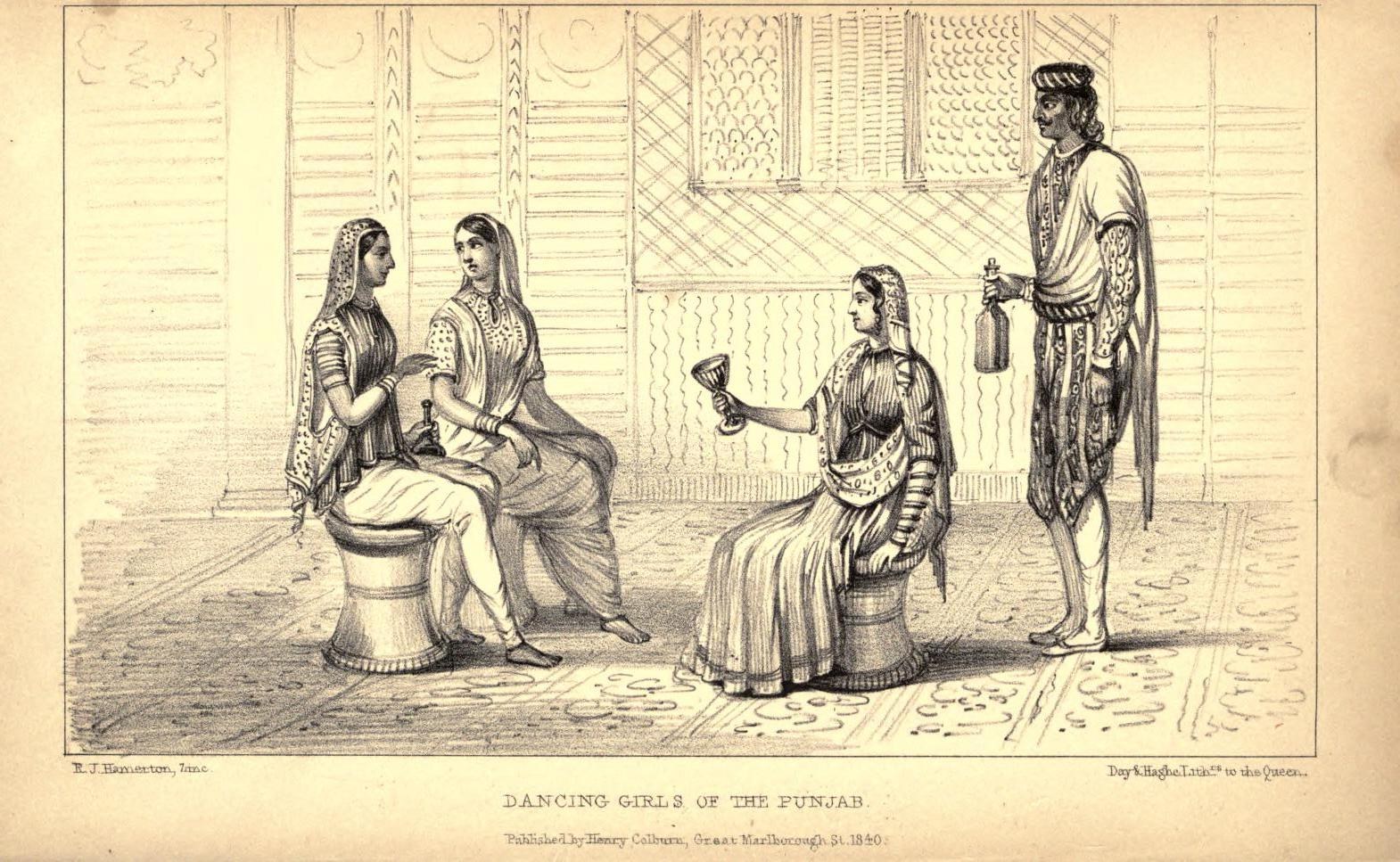
Lithograph titled 'Dancing Girls of the Punjab', from 'The Court and Camp of Runjeet Sing' by William Godolphin Osborne, ca.1840
Unknown authorUnknown author
- Source:
- Wikimedia Commons
- Rights:
- Public domain — free to use, share and adapt.
- Recorded as:
- public_domain
The image preserves a visual record of South Asian women's performance practice in a moment of political transition and colonial expansion, when such practices were being documented, reframed, and eventually suppressed by colonial authority. For dance historians, it is evidence of how non-Western dance forms entered European visual culture—not through their own records but through the mediation of colonial observers.
What you are looking at
A lithograph depicts an interior palace or zenana scene with ornate architectural details—carved wooden screens, decorated ceiling panels, and patterned flooring—suggesting a high-status Punjabi household. Four women sit or kneel in the foreground, dressed in long fitted garments with decorated borders and head coverings typical of early 19th-century Punjab dress. A fifth figure, a man in similar period dress with a long tunic, stands to the right holding what appears to be a vessel or offering. The women hold vessels in their hands and appear to be in poses of engagement or conversation. The composition suggests an interior performance or social gathering, with the architectural setting giving equal weight to the human figures.
The dancing
The four women are positioned at varied heights and angles—two seated at left on what may be footstools, one kneeling center, one seated right—creating visual rhythm rather than strict formation. Their upper bodies angle toward one another; arms are held at mid-height, engaged with objects or in gesture. The standing man observes from the right, one hand raised. The poses suggest social interaction or performance rather than synchronized movement, with individual attention to balance and posture rather than partnered hold or formal frame.
The dance depicted
This image purports to document the dancing women (likely devadasi or courtesans) of the Punjab court of Ranjit Singh. The composition does not show synchronized dancing but rather individual women in posed positions that may represent attitudes or moments within performance tradition. The ritual or social context is suggested by the formal dress, architectural setting, and presence of a male figure of apparent authority. Without clear footwork or dynamic momentum, the image functions as a documentation of dress, decorum, and interior practice rather than capture of movement itself.
How it was made
A lithograph, likely created in the 1830s–1840s for Western publication. The medium allowed fine linear detail in architectural ornament and textile pattern while rendering faces and figures with careful modeling. The technique supports the work's likely purpose: a documentary illustration for a book intended for European readers curious about colonial subjects. Lithography permitted mass reproduction and wide circulation among the educated classes.
About this work
This lithograph is a visual document of early 19th-century Punjab court life under Ranjit Singh, specifically depicting women performers in an interior domestic or performance space. It comes from 'The Court and Camp of Runjeet Sing' by William Godolphin Osborne, a work of colonial ethnography designed for British audiences. The image conflates performance, domestic life, and exoticized female bodies for a Western gaze, presenting Punjab dance and music practice through the framing of European artistic convention rather than indigenous documentation.
The work belongs to a broader 19th-century tradition of lithographic orientalism—commercial visual narratives of colonial territories that served British curiosity about India while reinforcing hierarchies of knowledge and power. As such it is as much a document of British artistic and colonial practice as of Punjabi dance.
How to look at it
Attend to the posture and hand positions of the women: they are neither in synchronized unison nor in the dynamic, weight-shifted positions that would suggest active dancing. The artist has chosen to depict a moment of stillness, display, or preparation rather than movement itself. Note how the architectural detail competes with the figures for visual interest—suggesting this is as much a document of place and luxury as of the women themselves. The formal composition and measured technique convey a colonial observer's aesthetic of control and classification rather than the intensity or fluidity of a performance moment.
The artist
The lithograph bears a credit line indicating it was made by or under the supervision of R.J. Hamilton or a publishing house (Day & Haghe). William Godolphin Osborne (1808–1863) was a British military officer and artist who served in India and published illustrated accounts of his observations. Osborne's 'The Court and Camp of Runjeet Sing' was part of a substantial market in illustrated colonial narratives aimed at British middle-class readers. These works combined firsthand observation with artistic convention and often reflected the political interests of the East India Company and British imperial ideology.
The period
The image dates to the final decades of Ranjit Singh's rule and the early years of British East India Company consolidation in Punjab (pre-1849). This was a moment of intense European curiosity about and documentation of Indian courts and practices—undertaken as those same practices were under pressure from colonial administration and Christian missionary activity. The women performers depicted here were part of long-established courtly and devotional traditions (associated with temples and courts across South Asia) that would be suppressed, reframed, or criminalized during the later 19th century. The lithograph thus captures a moment of transition and documents a practice partly through the lens of imminent cultural erasure.
Where it lives
This image comes from 'The Court and Camp of Runjeet Sing', a multiplate illustrated book published by Henry Colburn, Great Marlborough Street, in 1840. The lithograph was made from Osborne's sketches or paintings. It was part of a substantial market in illustrated travel narratives aimed at British readers.
Dance in this work
Questions about this work
Did Punjabi women actually dance in these costumes and settings?
The dress and interior likely reflect actual court practice under Ranjit Singh, drawing on observations Osborne made during his service in Punjab. However, what we see here is mediated through European artistic convention—perspective, modeling, composition—and shaped for British consumption. The image documents real practice but reframes it through colonial aesthetics.
What happened to these dance traditions after the British takeover?
Many courtesan and temple dance practices in South Asia were suppressed, criminalized, or reframed during the late 19th century under colonial and missionary pressure. Some survived; others were reinvented. This lithograph thus documents a practice at a moment of vulnerability and transition.
Is this a depiction of a single performance or a composite scene?
The formal arrangement and the mix of poses suggests the artist may have posed the women for study, or combined observations into a composite that illustrates 'dancing girls of the Punjab' as a category. It is documentary in intent but not necessarily documentary of a single moment.
More dance artwork





