49 works in this view — arrow keys or swipe to move between them.
Dance in Art
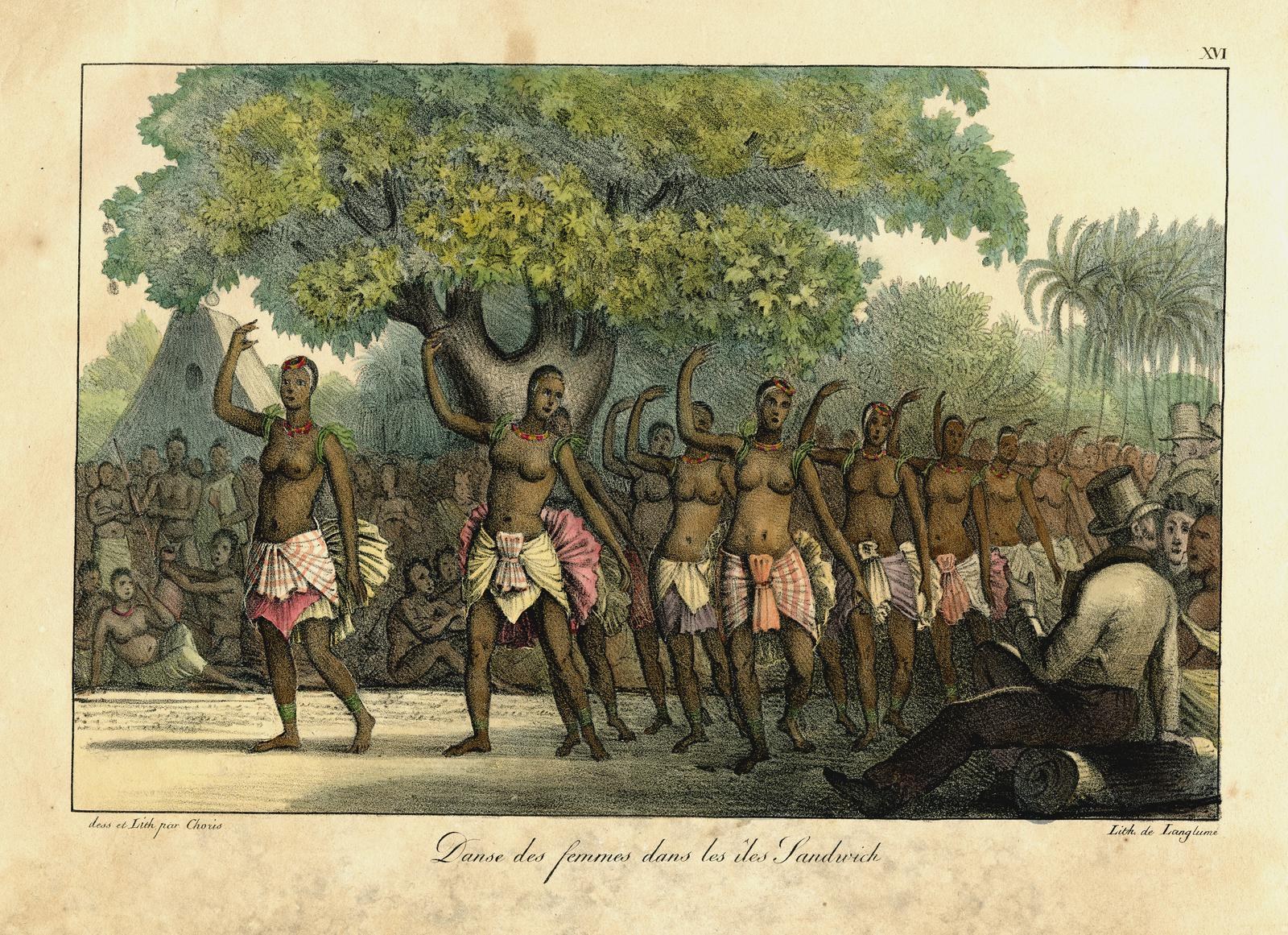
Danse les Femmes dans les iles Sandwich (Womens dance in the Sandwich Islands)
Print made by: Ludwig Choris Printed by: Langlumé
- Source:
- Wikimedia Commons
- Rights:
- Public domain — free to use, share and adapt.
- Recorded as:
- public_domain
This is one of the earliest visual records of Hawaiian hula before large-scale Western cultural assimilation, preserving details of costume, body position, and movement vocabulary that are otherwise documented only in oral tradition and late-19th-century written accounts. For historians of Hawaiian dance and Pacific art, it offers evidence of early-contact-era practice; for dance scholars, it illustrates how Indigenous movement systems were perceived and depicted by European artists operating under different aesthetic and theatrical conventions.
What you are looking at
A lithograph depicting a formal performance of Hawaiian women's dance before European observers. In the foreground, a line of seven women dancers stands in profile or three-quarter view, each wearing a white and pink pleated skirt-like garment (*lei niho*, feathered skirt) and minimal upper-body covering, with their dark skin visible. Their hair is distinctive: the front section is whitened or limed, a practice recorded in early Hawaiian dance. Their arms are raised in varied positions—some extended upward, others bent—suggesting active movement and gesture. The women face toward the right side of the frame. Behind them, a large spreading tree provides shade and a naturalistic canopy. To the right, seated European men in dark suits and top hats observe the performance, establishing a colonial encounter. Behind the dancers, a crowd of Hawaiian men and women—some seated, some standing—watches intently. The composition emphasizes the staging and spectatorship of the dance rather than its communal or sacred aspects.
The dancing
The dancers' bodies are upright and mobile rather than grounded. Their arm positions vary considerably—some raise both arms high, others extend one arm outward or upward in what appears to be undulating or gesturing movement. The legs are largely concealed by the wrapped skirts, making footwork indecipherable. The spacing between dancers is loose and linear rather than tightly coordinated, and their gazes appear directed outward or upward rather than at each other. The postures suggest individual expression within a group rather than synchronized unison movement. The European men's formal, seated stillness forms a stark contrast to the dancers' raised, active bodies.
The dance depicted
This depicts a Hawaiian hula or related women's dance (*hula kahiko* or ceremonial form), performed during the early 19th century in the presence of European contact. The whitened front hair and wrapped fiber skirts are consistent with early Hawaiian women's dance costume before 19th-century Euro-American influence. The raised-arm positions and varied gestures align with hula's vocabulary of hand and arm movements (*kaholo*, *ami*, *hula*) and the upright carriage of the torso. However, this is documentation filtered through a European artist's eye and conventions of picturesque staging. The grouping and formality suggest either a ceremonial performance or a demonstration arranged for the foreign witnesses rather than everyday or fully sacred hula kahiko.
How it was made
This is a hand-colored lithograph, a relatively new mass-circulation medium in 1822. Lithography allowed tonal modeling and detailed linear work impossible in earlier engravings, and the hand-coloring provided the naturalistic detail visible here—skin tone, vegetation, fabric texture. As a lithograph printed by Langlumé in Paris, this work was produced for a European viewing public with minimal or no direct experience of Hawaiian dance. The technique's accessibility meant such images circulated widely among educated European and American audiences, shaping ideas about Pacific cultures. The medium's conventions—the picturesque composition, the framing as spectacle, the soft detail—reflect the European aesthetic of the moment rather than Hawaiian choreographic or ceremonial priorities.
About this work
This 1822 lithograph by Ludwig Choris documents a women's dance in the Hawaiian islands during an era of intense European contact. It is one of the earliest visual records of Hawaiian hula choreography, rendered from an outsider's perspective and framed as picturesque ethnographic theater. The image preserves details of early 19th-century Hawaiian women's dance costume, arm vocabulary, and body carriage, while simultaneously revealing how European artists and their audiences staged and interpreted Indigenous Pacific dances. The presence of formally dressed European observers integrated into the composition underscores the colonial context of the encounter—the dance is being performed, watched, and recorded for a foreign public rather than existing as autonomous cultural practice.
How to look at it
Notice first the positioning and framing: the European observers are integrated into the composition and occupy formal, seated authority, while the dancers and Hawaiian crowd occupy the background and sides, suggesting a reversal of center and periphery. Observe the women's arm positions closely—these are not random gestures but repeated forms (raised arms, extended arms, curved arms) that suggest a coherent movement vocabulary. The whitened hair, visible especially on the leftmost figures, is a specific historical detail. The tree and landscape, while rendered in soft European picturesque style, are ethnographically secondary to the human figures—compare this to how a Hawaiian artist or documenter might have composed the scene.
The artist
Ludwig Choris (1796–1828) was a German-Russian painter and lithographer who served as artist-naturalist aboard the Russian ship Rurik during Otto von Kotzebue's circumnavigation voyage (1815–1818). He visited the Hawaiian islands in 1816 and documented Indigenous peoples, landscapes, and cultural practices through drawings and watercolors. His images were later converted into hand-colored lithographs and published in Europe, becoming influential visual sources for 19th-century European and American ideas about Pacific and Indigenous cultures. Choris was trained to observe and render detail with scientific precision, but his compositions and aesthetic choices were firmly shaped by European Romantic and picturesque conventions.
The period
In 1822, Hawaiian culture was in rapid transition. Foreign contact, trade, and Christian missionary presence (beginning in 1820) were reshaping social and ceremonial life. Many traditional hula practices were being suppressed or transformed under missionary influence, particularly those associated with fertility, courtship, or mele kapu (sacred chants). Choris's voyage predated the most intense phase of suppression (1821–1850s), so this image may preserve aspects of hula practice that would be dramatically altered within a decade. Simultaneously, in European art, the 1820s saw intense interest in ethnographic imagery, travel narratives, and the visual documentation of non-European peoples. Such images were consumed as evidence of the world being brought under European knowledge and, implicitly, control.
Where it lives
This lithograph was accessed via Wikimedia Commons. The holding collection is not recorded in the available metadata. The work is part of Choris's documented series of Pacific voyage illustrations, likely from a published travel account or portfolio of ethnographic images circulated in European art markets.
Dance in this work
Questions about this work
Is this hula?
Yes, almost certainly. The costume details (limed hair, wrapped skirt garment), body carriage, and arm positions are consistent with Hawaiian women's hula kahiko (traditional hula). However, this is a formal performance witnessed by Europeans, not a sacred or communal context, so the full cultural meaning and choreographic complexity are not visible here.
What are the white streaks in the dancers' hair?
The front sections of their hair have been whitened or limed, a documented practice in early Hawaiian women's hula. This may have served ceremonial, aesthetic, or status purposes. The detail suggests Choris observed or was told about this specific costume element.
Why are the European men in the picture?
By 1816, Hawaiian islands were engaged in active trade and cultural contact with foreign ships. The inclusion of European observers reflects the historical reality of the moment and also frames the dance as a performance for foreign witnesses rather than as autonomous cultural practice—revealing the artist's and audience's perspective as much as Hawaiian choreography.
How reliable is this as documentation of Hawaiian dance?
The image is accurate in costume details and provides real evidence of early-19th-century Hawaiian women's hula. However, it is filtered through European aesthetic conventions, a single observer's viewpoint, and the formal performance context. It should be read as one European artist's encounter with Hawaiian dance, not as a comprehensive or neutral record.
More dance artwork





