49 works in this view — arrow keys or swipe to move between them.
Dance in Art
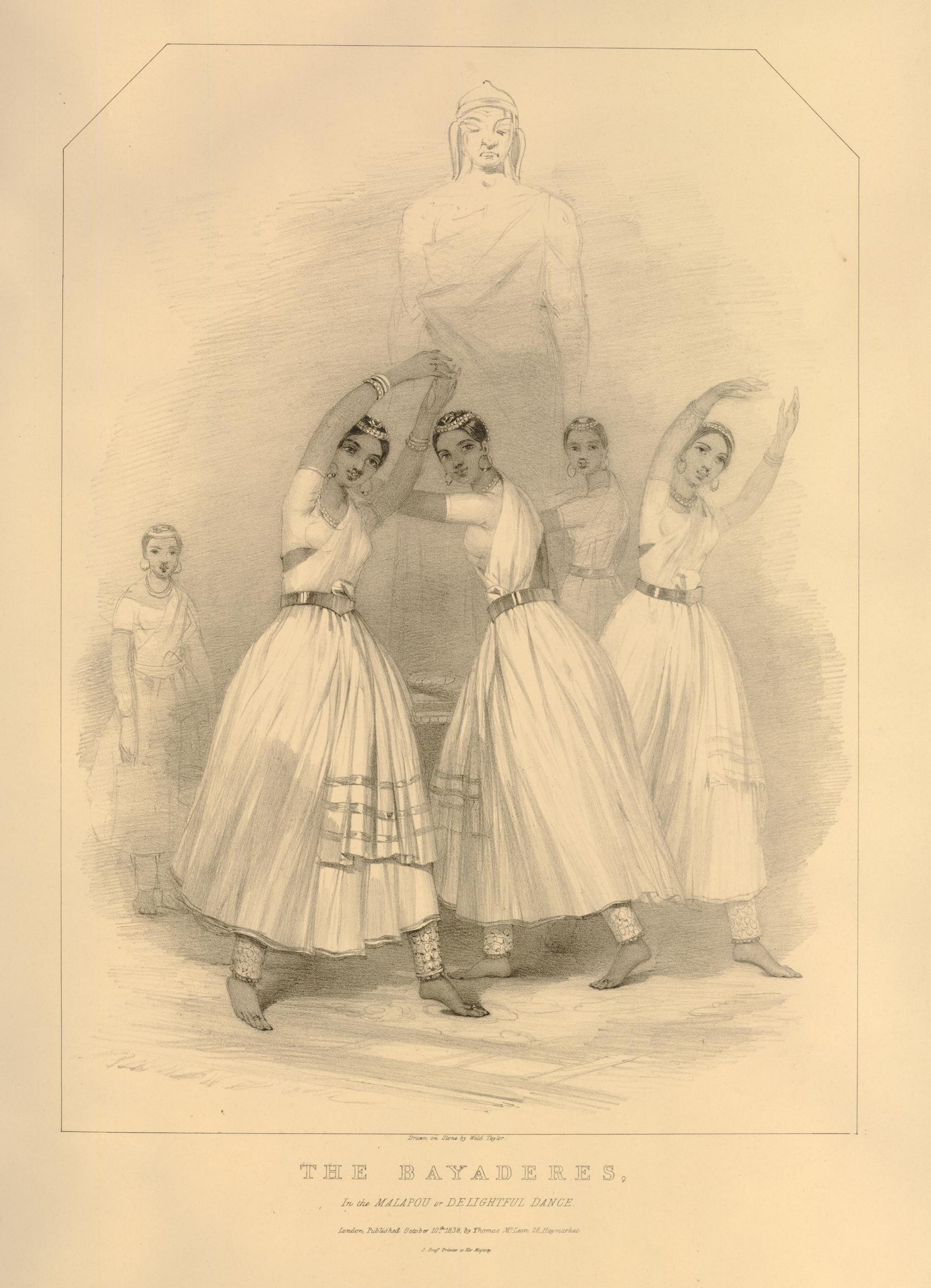
The Bayaderes, / In the Malapou or Delightful Dance.
Print made by: Weld Taylor Printed by: J Graf Published by: Thomas McLean
- Source:
- Wikimedia Commons
- Rights:
- Public domain — free to use, share and adapt.
- Recorded as:
- public_domain
This work reveals how European artists and audiences understood non-Western dance not as practice but as spectacle—refined, beautiful, and fundamentally foreign. It documents the bayadere craze that shaped European ballet and dance imagery throughout the nineteenth century, influencing how classical Indian dance was perceived abroad and contributing to persistent Orientalist tropes. For historians of dance, it is essential evidence of how colonial-era visual culture shaped the circulation and interpretation of non-European forms.
What you are looking at
A lithograph presenting four young women in classical pose executing the Malapou, a dance described as delightful. They wear white muslin skirts with dark horizontal stripes at the hem, fitted at the waist with metal belts, paired with short-sleeved white bodices and headdresses suggesting Indian dress. Their arms are raised in unified, graceful arcs above their heads—three with the same curved line, one with arm extended differently—and their bodies lean subtly backward in unison, creating an image of synchronized, ritualized movement. A fifth, smaller figure stands apart at the left in plainer dress, perhaps a child apprentice or attendant. Behind the dancers looms a large pale statue of an androgynous or feminine Indian deity in classical repose, rendered in the neoclassical style then current in European art. The composition is spare and formal: the figures occupy the center of the page against a wash of neutral tone, contained within a simple rectangular border line. The lithographic medium gives the whole a delicate, sketch-like quality with soft shading.
The dancing
Four adult dancers move in near-perfect synchronization, their bodies tilted back at the same angle with weight seemingly distributed through their stance. Each raises both arms overhead in a continuous arc, the palms open and fingers extended, creating a visual rhythm across the group. The posture suggests a processional or ritualized formation rather than partner work: the dancers are arranged in a loose line, not in contact with one another, each isolated in her own frame. The uniformity of gesture and the upward lift of the arms convey formality and control; there is no indication of rapid footwork or ground-based energy. The small figure to the left appears stationary, observing or waiting.
The dance depicted
This is presented as the Malapou or "Delightful Dance," identified in the title as an Indian dance. The work represents European Orientalist fantasy of Indian dance as practised by bayaderes (temple dancers or courtesans in the European imagining). The four dancers embody the classical Indian devadasi tradition as understood and romanticized by early-nineteenth-century Europe, though rendered here in a deliberately graceful and non-sensual register—the raised arms and backward lean evoke a spiritualized or aestheticized version of temple dance rather than any erotic interpretation. The synchronization and formal spacing suggest this is understood as a courtly or ceremonial form, not a social dance. Without access to historical performance records, it is impossible to verify whether the posture and gesture bear any relation to actual Malapou practice, but the image clearly reflects European conventions for depicting non-Western dance as both exotic and morally refined.
How it was made
This is a lithograph, a print technology that allowed mass production and wide circulation. Lithography's tonal range and ability to render soft transitions in light and shadow are evident in the delicate modeling of the figures' bodies and faces and in the atmospheric wash behind them. The medium was popular for theatrical and ethnographic imagery in the 1830s and made such works accessible to middle-class audiences without commissioning an original painting. The soft, almost dreamy quality of the rendering—the pale line-work, the gentleness of the shading—suggests this was aimed at a cultivated, leisured audience interested in dance, the arts, and the colonial world.
About this work
This 1838 lithograph documents a European fantasy of Indian classical dance as it circulated in visual culture at the height of the Romantic era. It presents four dancers executing the Malapou in synchronized, formalized poses under the gaze of an Indian deity—a composition that simultaneously exoticizes and spiritualizes non-Western dance for a European viewer. The bayadere, or temple dancer, was a subject of intense fascination in early-nineteenth-century European art, literature, and theater, and this print participates in that broader cultural conversation, encoding ideas about beauty, ritual, and cultural difference that were inseparable from the imperial context in which European knowledge of Indian dance was produced. As such, it is a valuable artifact of the history of how dance has been seen, represented, and consumed across power differentials.
How to look at it
Notice the absolute synchronization of the four dancers and the formality of their spacing—this is a vision of Indian dance as ordered, controlled, and spiritualized rather than sensual or improvisatory. The raised arms and tilted bodies create a graceful upward momentum, an effect characteristic of European artistic conventions for rendering 'noble' or 'elevated' movement. The presence of the statue transforms the scene from mere spectacle into something ceremonial: the dancers are positioned as if in service to or reverence of the deity, framing non-Western dance as religiously significant. The tiny fifth figure at the left—barely realized—is worth attending to as well: she may represent the hierarchy within dance practice, or simply the artist's way of suggesting an ongoing world of dancers beyond the frame.
The artist
Weld Taylor is recorded as the maker (likely the lithographer who drew the design on stone). J. Graf is credited as printer and Thomas McLean as publisher. McLean was an active London publisher of theatrical and satirical prints in the early nineteenth century, suggesting this circulated within a market for entertainment and cultural imagery rather than in scholarly contexts. Beyond these attributions, little is known of Taylor's practice or other works.
The period
The 1830s saw intense European fascination with Indian dance and culture, mediated through colonial encounter and Orientalist aesthetic ideology. The bayadere appeared on the Parisian ballet stage (most notably in Auber's opera *La Muette de Portici*, 1828) and became a standard subject for painters and printmakers seeking to depict exotic beauty. This was the era of Romantic ballet, when European choreographers began incorporating non-Western movement vocabularies and costumes as markers of difference and fantasy. At the same time, lithographic printing was transforming the circulation of images, making such works affordable and widely available to middle-class audiences. The formal neoclassical style of the deity in the background reflects the ongoing hold of neoclassicism on European art, even as Romantic imagery dominated new subject matter.
Where it lives
The work is recorded in Wikimedia Commons. It is a published lithograph from a London printer, and thus would have circulated as a commercial print in the 1830s, accessible to anyone willing to purchase it. The recording in Wikimedia suggests it is held in a public collection, though the specific holding institution is not provided in the catalogue record.
Dance in this work
Questions about this work
What is a bayadere?
In European Orientalist usage, a bayadere is a temple dancer or courtesan from India, often rendered in art as a figure of exotic grace and mystery. The term derives from the Portuguese *bailadeira* (female dancer) and the French *bayadère*. European artists and audiences of the Romantic era were fascinated by the bayadere, who became a stock character in ballet and visual culture, though European depictions bore little relation to the actual practice of devadasi dancers or other Indian classical forms.
Is this based on real Indian dance?
Likely not in any direct sense. The posture, costume, and composition reflect European artistic conventions and fantasies about India more than historical knowledge of Malapou dance practice. This is Orientalism—the European imagination of the Orient—rendered as ethnographic documentation. It would be a mistake to treat this image as evidence of how the Malapou was actually performed, though it is invaluable evidence of how Europeans imagined and represented Indian dance.
Why is there a statue in the background?
The statue frames the dancers as participants in a spiritual or religious ritual rather than mere performers for entertainment. The presence of the deity elevates the dance, suggesting it is a sacred rather than secular practice. This was a common strategy in European Orientalist art: by positioning non-Western dance within a temple or religious setting, artists could render it as morally refined and spiritually significant, appealing to educated audiences who might otherwise see such dance as frivolous or improper.
Who would have seen this print?
Lithographs were relatively affordable and widely distributed in the 1830s, so this would have reached middle-class audiences interested in theater, art, and exotica. It may have hung in homes, circulated in periodicals, or been sold by print-sellers in London. It participated in a broader cultural conversation about colonial India and Romantic aestheticism.
More dance artwork





