49 works in this view — arrow keys or swipe to move between them.
Dance in Art
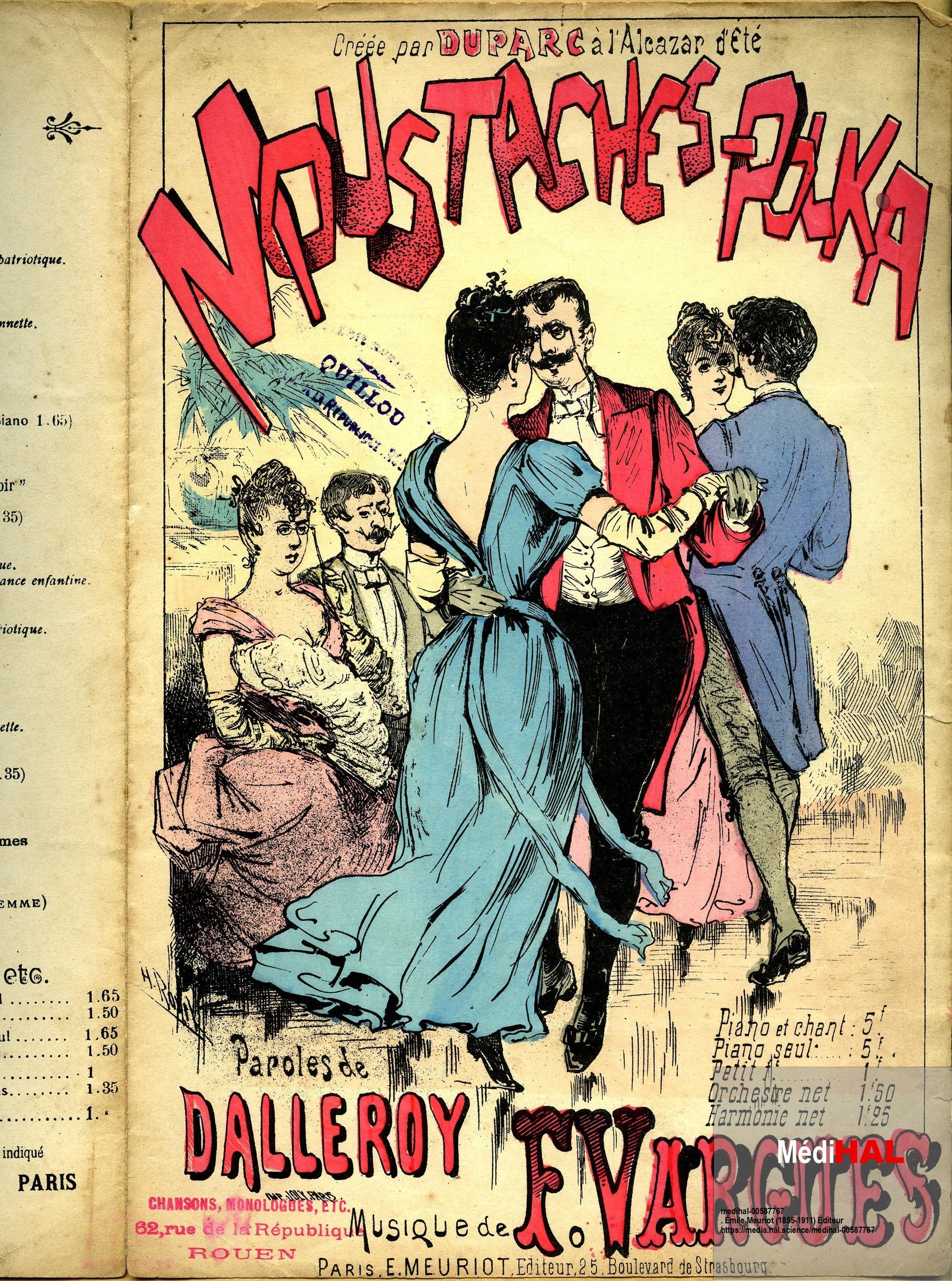
Moustache-Polka - créée par Duparc -illustration couleurs H Royet (Hyacinthe Royet 1862-1926)- (MédiHAL 587767)
Éliane Daphy / Institut Interdisciplinaire d'Anthropologie du Contemporain / National Center for Scientific Research
- Source:
- Wikimedia Commons
- Rights:
- Public domain — free to use, share and adapt.
- Recorded as:
- public_domain
This lithograph offers direct evidence of how polka culture circulated in late 19th-century Paris: not primarily as a ballroom dance but as comic theater and music-hall entertainment. It documents the role of advertising and popular graphics in shaping audience taste and attendance, showing that dance history includes the visual marketing and theatrical framing that made certain dances culturally visible.
What you are looking at
This is a color lithograph advertising sheet for a popular song-dance number titled *Moustache-Polka*. The composition depicts a lively social gathering of six well-dressed figures in a parlor or entertainment venue. At the center stands a mustachioed man in a red jacket and dark trousers, his mustache exaggerated and prominent. He is surrounded by fashionably dressed women in elaborate gowns—one in a striking blue dress dominates the foreground, her body angled toward the man, while others in pale pink and cream silks cluster nearby. The figures display animated postures suggesting movement and flirtation: the central woman leans in with her arm around the man's shoulder, her head tilted, while the others gesture and turn. The color palette is vibrant—reds, blues, pinks, and creams—with touches of caricature in the male figure's exaggerated facial hair. Small inset details at upper left show a scene in nature, possibly the Alcazar d'été (summer venue) where the piece debuted. The overall tone is comic and theatrical, capturing the Belle Époque taste for witty, music-hall entertainment.
The dancing
Six figures are shown in animated social proximity rather than in any formal dance configuration. The central male figure stands with his arms engaged with those around him, his posture open and somewhat comic due to his grotesquely oversized mustache. The women surrounding him adopt varied poses—one presses close with her arm linked, another reaches or gestures, a third stands in profile—all suggesting the playful, flirtatious energy of a social entertainment. There is no classical dance frame or hold visible; instead, the composition captures a moment of parlor-based interaction and banter, with bodies angled toward one another in conversation-like engagement rather than synchronized movement.
The dance depicted
The *Moustache-Polka* was a novelty song-dance number created by and starring the performer Duparc at the Alcazar d'été in Paris. The polka itself—a Central European dance in lively duple meter—was wildly popular in Paris during the late 19th century as a social and music-hall staple. This particular piece appears to have been a humorous sketch or song-and-dance routine built around the comic conceit of the male lead's absurd facial hair. The image does not depict the polka's characteristic hopping, turning step-pattern, but rather the social and comedic theatrical context in which the piece was performed—suggesting this was more cabaret entertainment or comic pantomime than ballroom dance. The lithograph functioned as both advertisement and souvenir, distributed to promote performances and sheet music sales.
How it was made
This is a color lithograph, a technique ideal for rapid mass production and affordable distribution to music-hall audiences. Lithography allowed the flat, bold color blocking and bold outlines visible here—bright reds and blues applied with minimal shading, emphasizing the comedic and theatrical nature of the subject. The technique was economical enough to make advertising sheets a standard promotional tool for music publishers and theater venues in the 1890s. The combination of hand-drawn illustration by Hyacinthe Royet with commercial printing allowed for wide circulation among the popular audiences who would attend Duparc's performances or purchase the published sheet music.
About this work
The *Moustache-Polka* is a Belle Époque entertainment print documenting a popular music-hall novelty number created by the performer Duparc. It captures not a moment of actual polka dancing but rather the theatrical and comedic social milieu from which the piece emerged—a parlor scene of flirtation and banter centered on an absurdly mustachioed male figure. The work sits at the intersection of dance history, entertainment marketing, and visual culture, exemplifying how commercial lithography documented and promoted the vibrant music-hall and café-concert scene of 1890s Paris. It belongs in a dance gallery as evidence of how polka—a Central European court and ballroom dance—had been transformed into comic theatrical entertainment for popular audiences, stripped of its dance-floor function and repackaged as cabaret spectacle.
How to look at it
Attend first to the composition and the energy of the figures: notice how the artist has organized the scene around the comic focal point of the man's mustache, with the surrounding figures' poses radiating outward in gestures of surprise, delight, and engagement. The color—particularly the vivid blue of the leading woman's gown and the red of the male figure's jacket—creates visual movement and theatrical excitement. The lithographic technique, with its flat color and strong outlines, deliberately exaggerates the comedic aspects of the scene, rejecting realistic representation in favor of caricature and jest. This was a commercial image meant to catch the eye in a shop window and communicate in an instant: 'This is entertainment, spectacle, and fun.'
The artist
Hyacinthe Royet (1862–1926) was a prolific French illustrator specializing in popular entertainment subjects. His work appeared frequently on song and theatrical advertising sheets during the height of the café-concert era. Royet's style was well-suited to commercial lithography: his line is bold and economical, his color sense vivid and legible at small scale, and his figure drawing capable of capturing both likeness and caricature—essential skills for marketing material meant to attract audiences and amuse potential buyers of sheet music.
The period
The 1890s saw the apogee of Parisian music-hall and café-concert culture, a vibrant entertainment industry that drew from all social classes. The polka, which had entered European dance culture in the 1840s as a fashionable ballroom dance, had by the 1890s become thoroughly domesticated and subject to comic treatment on stage. Publishers like Émile Meuriot (1855–1911) built substantial businesses producing and distributing illustrated sheet music covers and promotional materials. The color lithograph print, economical and reproducible, was the ideal medium for this market: a single image served as advertisement, collectible souvenir, and cover art for the published score. The wit and visual sophistication lavished on such commercial work reflects the era's belief that popular entertainment deserved serious artistic attention.
Where it lives
The work is held in MédiHAL (Hal Archive Multimedia), a French digital repository, catalogued as item 587767. It is identified as a printed advertisement and/or cover art associated with published sheet music, distributed by E. Meuriot (publisher, 25 Boulevard de Strasbourg, Paris) in 1891. The record notes variant formats available: piano and vocal arrangement, solo piano reduction, small-format and orchestral versions.
Dance in this work
Questions about this work
Was the Moustache-Polka actually a polka dance, or just a funny song?
It was marketed as both. The underlying piece was structured as a polka—a lively duple-meter dance tune—but as performed by Duparc at the Alcazar d'été, it appears to have been staged as a comic theatrical sketch or song-and-dance routine built around a visual gag (the exaggerated mustache) rather than as an opportunity for audience members to dance. The sheet music would have allowed pianists to play the polka rhythm for dancing, but the theatrical performance was entertainment to watch, not participate in.
What was the Alcazar d'été?
The Alcazar d'été (Alcazar of Summer) was one of Paris's major music halls and entertainment venues, operating in the late 19th and early 20th centuries. It hosted cabaret performances, song-and-dance acts, and variety entertainment, drawing audiences from across the city. It was part of the flourishing café-concert and music-hall culture that made Paris famous for popular entertainment during the Belle Époque.
Who was Duparc?
Duparc was a performer and creator associated with the Parisian music-hall scene. Beyond the credit given on this sheet, little is widely documented, but his creation of and starring role in the Moustache-Polka indicates he was a successful entertainer with enough reputation to draw audiences and justify a commercially published sheet music release with a high-quality illustrated cover.
How were these lithographs used?
Primarily as marketing material and point-of-sale items. The sheet would have been displayed in music shops, distributed at the theater, and sold alongside or separately from the published score. Many people collected them as inexpensive color prints. They functioned much as concert posters and album covers do today—creating anticipation, establishing visual brand identity, and serving as affordable souvenirs of beloved entertainers.
More dance artwork





