49 works in this view — arrow keys or swipe to move between them.
Dance in Art
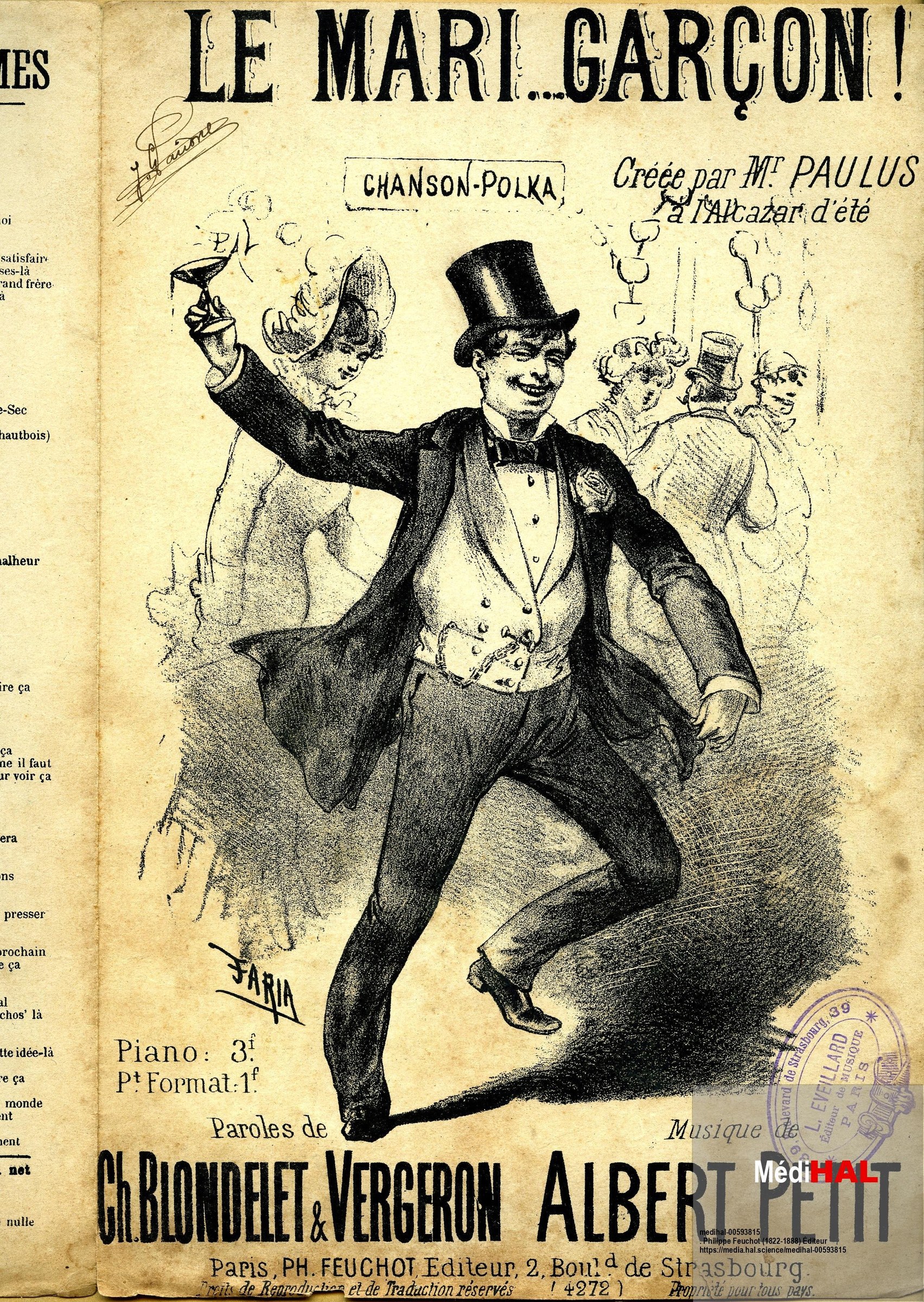
Le mari Garçon ! Chanson-Polka créée par Paulus à l'Alcazar d'été -illustration Faria- (MédiHAL 593815)
Éliane Daphy / Institut Interdisciplinaire d'Anthropologie du Contemporain / National Center for Scientific Research
- Source:
- Wikimedia Commons
- Rights:
- Public domain — free to use, share and adapt.
- Recorded as:
- public_domain
This image preserves the look of a vanished performance tradition—the French music hall performer-singer, whose art depended on the fusion of dance, comedy, and vocal skill. Paulus was a major star of his time, and this engraving shows how his fame was marketed and how polka, a ballroom staple, was transformed into theatrical spectacle. The work is rare visual evidence of how popular dance moved from the ballroom to the stage and how it was consumed as commercial entertainment.
What you are looking at
A theatrical male dancer in formal evening dress dominates the composition, caught mid-leap or bound step with one leg extended high behind him and arms spread in exuberant gesture. He wears a black tailcoat, white waistcoat, and top hat—the costume of a gentleman rather than a professional dancer. His face is animated, mouth open in what may be song or speech. Behind him, a crowd of smaller figures in top hats and formal dress watches from a box or balcony, their faces sketched in lighter detail. The setting appears to be a theater or music hall, suggested by the architectural framing. The engraving uses strong black line work against cream stock, with cross-hatching for shadow and depth. The composition is energetic and diagonal, the dancer's body twisting upward in a movement that reads as both comic and virtuosic.
The dancing
The principal figure executes a high bound or jump with marked knee lift, his back leg extended and bent at the knee, his weight seemingly airborne. His arms are flung open—one raised, one extended—in a pose of expansive joy or theatrical abandon. His posture and movement suggest neither classical ballet training nor the rigid frame of ballroom dance, but rather the loose, exaggerated physicality of music-hall or vaudeville performance. The onlookers in the background are static and secondary, establishing audience rather than participating in the action.
The dance depicted
This is a song-polka created and performed by the singer and comedian Paulus at the Alcazar d'été (an open-air summer theater in Paris). The image captures not a ballroom dance but a theatrical dance-song number, a common form of entertainment in late 19th-century French music halls. The polka itself was a ballroom dance, but when adapted to the stage and performed in a song-act, it became a vehicle for physical comedy and vocal performance. The exaggerated movement and formal street clothes suggest a comedic impersonation—the humor lies in a gentleman executing high, frisky movements in a dance not typically performed in such gymnastic fashion. Paulus was celebrated for his comic gifts and his ability to sing while dancing, and this image captures that blend of music and movement.
How it was made
This is an engraving or possibly a wood engraving, printed and mass-produced as sheet music cover art or theatrical publicity. The signature 'FARIA' (Cândido de Faria) identifies the artist. The technique of black line and cross-hatching on pale stock allowed rapid reproduction and wide circulation—this was a commercial print made to advertise the song and performance, affordable and collectible. The bold, economical line work is well-suited to capturing movement and character in a single frozen moment. The publisher Ph. Feuchot and the ownership marks indicate this passed through multiple collectors, suggesting the print held value as both entertainment ephemera and art.
About this work
This is a theatrical song-sheet engraving advertising a polka-song performance by the celebrated French comedian Paulus at the Alcazar d'été, with music by Albert Petit and lyrics by Blondelet and Vergeron. The image captures the performer mid-movement in his signature exuberant style—a gentleman in formal dress executing high, comic leaps and bounds to illustrate the title's humorous scenario of a "married boy." The work belongs to the tradition of 19th-century music-hall and vaudeville publicity, where the sheet music cover served as both advertisement and collectible art. It documents a specific performance tradition that bridged theatrical dance, comic acting, and popular song, and provides visual evidence of how the polka was adapted and performed in the context of music-hall entertainment.
How to look at it
Note the moment the artist chose: not a posed formal stance, but a moment of explosive release—the dancer airborne, his body at full extension, his face animated. This is the instant of peak energy and emotion, when the comedy and the physicality are simultaneous. The artist captures movement through exaggeration of proportion and line, not through freeze-frame accuracy; the long, thin legs and the open spread of the arms emphasize the vigor and the spirit rather than anatomical precision. The formal costume makes the informal, exuberant movement more comic—the gentleman is breaking decorum, and that is the joke.
The artist
Cândido de Faria was a commercial graphic artist working in Paris in the late 19th century. He specialized in theatrical and music-hall publicity, creating expressive, economical engravings for sheet music covers and theater programs. His work captures movement and character with sharp observation and wit, suited to the quick, dynamic world of entertainment ephemera. He was part of a large community of commercial artists whose work has been largely forgotten but whose output documented the daily life and pleasures of urban audiences.
The period
The 1890s were the height of the Parisian music hall—the Belle Époque—when theater-goers could see singers, dancers, acrobats, and comedians in the same evening. The polka had been a fashionable ballroom dance since the 1840s, and by the 1890s it was a standard item in both ballroom and stage repertoire. Theatrical dance in this period was not yet professionalized as classical ballet; popular entertainment mixed sung dialogue, physical comedy, and dance steps in fluid combination. Paulus himself was a star attraction, known for his versatility and his ability to hold an audience through charm and skill. Sheet music covers like this one were a major form of visual publicity, cheaper and more durable than posters, and they circulated widely through homes and shops.
Where it lives
This engraving is a mass-produced sheet music cover, published by Ph. Feuchot (a major Parisian music publisher located at 2 Boulevard de Strasbourg). The copy shown bears the stamp of L. Eveillard, another Paris music publisher, indicating it passed into a collection. Such prints were widely circulated and sold, making them relatively common objects among collectors of theatrical ephemera and music history.
Dance in this work
Questions about this work
Who was Paulus?
Paulus (Jean-Paul Habrans, 1845–1908) was a celebrated French music-hall performer, singer, and comedian of the Belle Époque. He was known for his ability to sing while moving with acrobatic energy, his comic timing, and his social satire. He performed regularly at major Parisian venues including the Alcazar and the Eldorado, and his recordings and sheet music made him one of the first mass-media entertainment stars of the phonograph era.
What is a polka-song?
A polka-song (chanson-polka) is a theatrical song set to polka rhythm and choreography. Unlike the formal ballroom polka danced by couples, the music-hall version was a solo or small ensemble performance where the polka rhythm and basic movement vocabulary provided a framework for comic acting, singing, and improvisation. The polka's bouncy 2/4 time and its associations with frivolity made it ideal for satirical and humorous theatrical pieces.
What does the title mean?
"Le mari garçon!" plays on the double meaning of 'garçon' in French—both 'boy' and 'waiter' or 'young man.' The pun suggests a husband who behaves like a boy or a waiter, evoking comedy around masculine role-play and domestic behavior. Without the full lyrics, the exact satirical target is not fully clear, but the title hints at social and gender comedy typical of music-hall entertainment.
Why is the dancer wearing a tailcoat?
The formal dress is part of the comedy. Music-hall performance often involved impersonation and role-play; a gentleman in full evening dress executing high, vigorous dance movements is inherently funny because it violates social expectations of formal composure. The costume also made the performance accessible to audiences who could recognize and mock the conventions of bourgeois masculinity.
More dance artwork





