49 works in this view — arrow keys or swipe to move between them.
Dance in Art
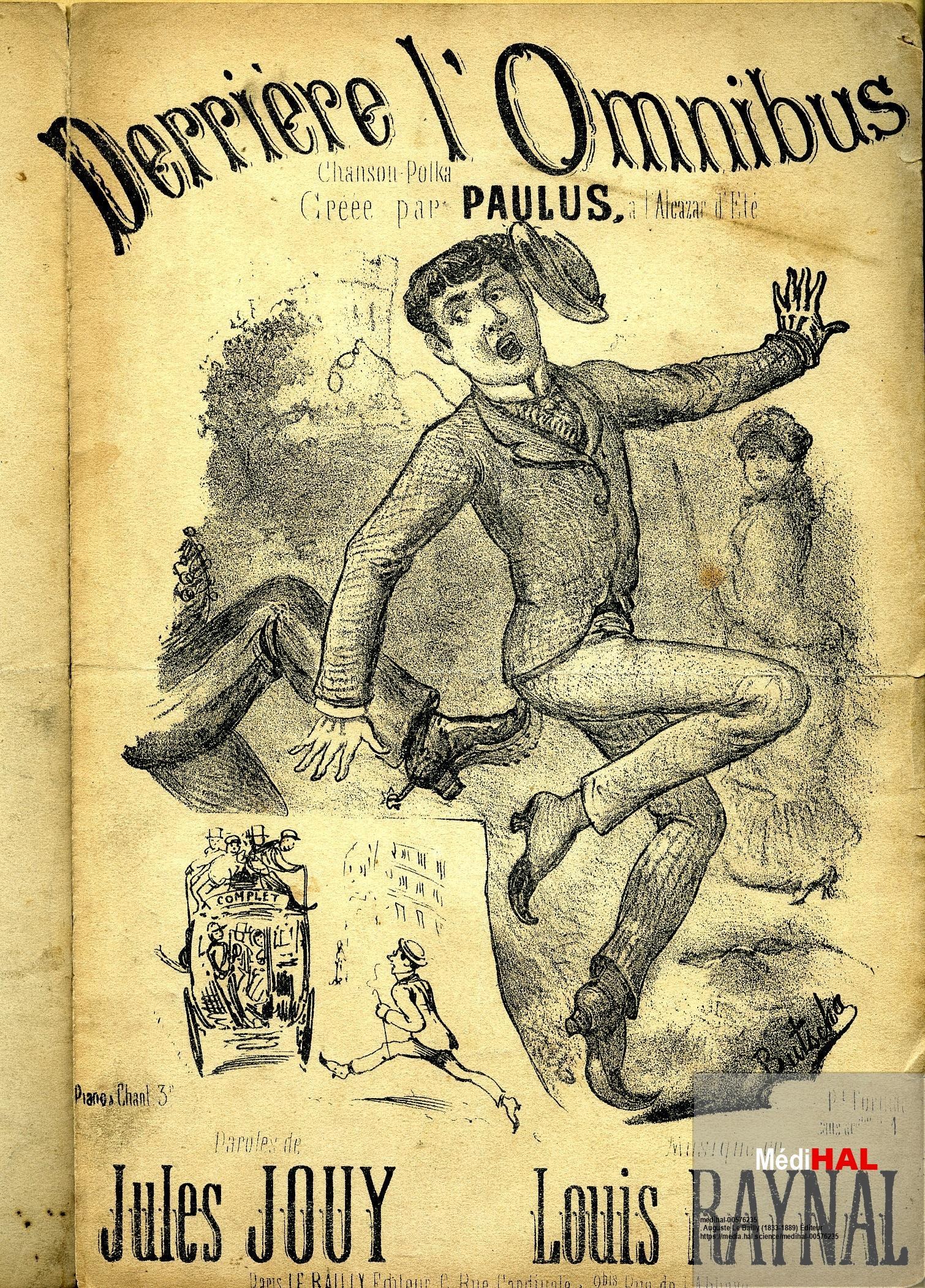
Derrière l'omnibus - chanson polka créée par Paulus à l'Alcazar d'été -illustration Émile Butscha (1847-1887)- (MédiHAL 576235)
Éliane Daphy / Institut Interdisciplinaire d'Anthropologie du Contemporain / National Center for Scientific Research
- Source:
- Wikimedia Commons
- Rights:
- Public domain — free to use, share and adapt.
- Recorded as:
- public_domain
This image is a rare window into how nineteenth-century popular dance—the polka—was actually performed outside the ballroom, in the music halls and cafés-concerts where most people encountered it. It shows the polka not as a formal social dance but as a vehicle for theatrical personality and physical comedy, and it documents a real performer (Paulus) and a real cultural moment. For historians of dance and the urban popular cultures of the belle époque, it is documentary evidence of performance practice and aesthetic values that left almost no other trace.
What you are looking at
This is the cover illustration for a popular song published in 1884, a chanson-polka by the performer Paulus. The composition is a lively street scene centered on a stout man in a dark jacket and cap, captured mid-leap or exuberant gesture with one arm flung wide and one leg extended. He dominates the foreground, his body twisted in dynamic movement. Behind and around him are smaller figures—a woman in a long dress at left, another figure at right—and a building facade suggesting an urban setting. At bottom left sits a barrel marked "COMPLET," and below the main figure is a sheet of musical notation. The illustration is rendered in black ink with fine cross-hatching that creates volume and shadow, typical of engraved or etched popular song covers of the era.
The dancing
The central male figure is captured in a moment of vigorous, exaggerated movement—his weight lifted, one leg bent high, arms open in a expansive gesture that reads as comic exuberance rather than ballroom refinement. The posture is asymmetrical and playful, with the torso twisted away from the line of the legs. The smaller background figures are less clearly defined but appear to be onlookers or co-dancers, watching or joining in. The overall frame is loose and gestural rather than formally composed, suggesting street entertainment or theatrical burlesque rather than technical precision.
The dance depicted
This is visual documentation of a polka as performed in 1880s Parisian music hall culture, specifically the staging by Paulus, a celebrated entertainer and singer of the period. The polka is evident from the catalogue record, and the image captures the dance as it existed in popular entertainment—energetic, comedic, and emphasizing high-spirited movement and physical exuberance over technical form. The figure's high leg lift, open arm position, and overall buoyancy are consistent with the fast, bouncing character of the polka, a dance that had migrated from Central Europe to become a staple of Parisian café-concert and vaudeville stages by the 1870s-80s. The theatrical context (this is a song cover, not a ballroom manual) suggests the polka was performed with comic intent and personality.
How it was made
This is an engraving or etching (the record indicates illustration by Émile Butscha), printed as the cover of a popular song sheet. The fine hatching and linear detail characteristic of 19th-century engraving allowed for wide reproduction and circulation at low cost, making this a commercial product intended for a mass music-hall and middle-class home piano audience. Song-sheet covers were a primary medium of dance documentation in this period, reaching far more people than theater reviews or photographs. The technique required the artist to capture movement in a single frozen moment, which Butscha has done with attention to exaggerated gesture and comic timing rather than anatomical precision.
About this work
This is a French popular song cover from 1884 documenting the polka as it was performed in Parisian music halls, specifically by the celebrated performer Paulus. The work belongs to the tradition of French chanson-polka, a hybridization of the Central European dance with French song and theatrical comedy. It is evidence of how the polka, by the 1880s, had become not a ballroom dance but a vehicle for popular entertainment—comic, physical, and tied to personality and character rather than to formal technique. The image and its wide circulation (as part of a published song) tell us how ordinary Parisians encountered and understood the polka: not as a partner dance to be learned but as a spectacle of physical abandon and humor performed by a star.
How to look at it
The viewer should attend to the exaggeration and comic timing in Butscha's rendering: the lifted weight, the sprawling arm, the face caught in an open-mouthed expression of joy or abandon. This is not a technical demonstration of the polka but a capture of performance personality—the moment when the audience laughs. The smaller background figures and the urban setting anchor the image in the real world of Paris street life and music halls, rather than the abstract space of a ballroom manual. The sheet music at bottom serves as a reminder that this is fundamentally an image advertising a song; the dance is inseparable from the music and from Paulus's celebrity.
The artist
Émile Butscha (1847–1887) was a French illustrator and engraver active in the 1870s and 1880s, specializing in song-sheet covers and popular theatrical imagery for Parisian publishers. His work was part of the commercial graphic culture of the Third Republic, producing affordable, lively illustrations for the burgeoning music-hall and café-concert industry. Butscha's style is characterized by energetic line work, caricatural exaggeration, and an ability to capture movement and personality in a single figure—all essential to the marketing of performers and songs in this period.
The period
The 1880s saw the polka at the height of its popularity in Paris, no longer the novelty it had been in the 1840s but a fully naturalized element of popular entertainment. The rise of the café-concert and music hall as distinctly modern urban leisure spaces created demand for spectacular, personality-driven performance. Paulus (1847–1893) was a star of this world—famous for comic songs, energetic stage presence, and an ability to embody character in motion. The polka of this era had become increasingly theatrical and less ballroom-oriented; it was a dance performed *for* an audience rather than *with* one. Song-sheet covers like this one were the primary means of marketing performers and disseminating knowledge of songs and dances to a middle-class home market.
Where it lives
This is a published song-sheet cover issued by the Paris publisher Auguste Le Bailly in 1884, with text by Jules Jouy and music by Louis Raynal. The image was deposited with the legal deposit system (Bibliothèque Nationale de France), which is how it is dated. It is a mass-produced commercial object intended for wide circulation among piano-playing households and music-hall patrons.
Dance in this work
Questions about this work
Who was Paulus and why is he dancing on a song cover?
Paulus (Paul-Jean Habans, 1847–1893) was a celebrated French singer and comedian famous for comic chansons in the café-concerts and music halls of Paris. Song-sheet covers featured the performer or a scene from the song to advertise it for home purchase and performance. Paulus was a star of the new popular entertainment industry, and his image and performances were widely marketed.
Is this a real depiction of how the polka was danced, or is it exaggerated?
It is both. The basic movement—the leg lift, the bouncing energy, the open arm position—reflects the actual polka. But Butscha has exaggerated the gesture and expression for comic effect, and he has frozen a theatrical moment rather than showing the dance as it would be learned or performed in a ballroom. This tells us that by 1884, the polka in popular entertainment was deliberately stylized and comedic.
What does the barrel marked 'COMPLET' mean?
This is likely a reference to a specific venue or a comic prop within the song narrative. Without access to the lyrics, we cannot be certain, but it suggests the image illustrates a specific moment or joke within the song, not the polka in general.
Why was the polka still popular in the 1880s if it had been a dance fad in the 1840s?
The polka survived because it adapted. In the ballroom it remained a standard social dance, but in the music halls and cafés-concerts of Paris, it became a vehicle for theatrical performance and comedy, tied to celebrity performers like Paulus. This cover documents that theatrical, entertainment-focused version.
More dance artwork





