49 works in this view — arrow keys or swipe to move between them.
Dance in Art
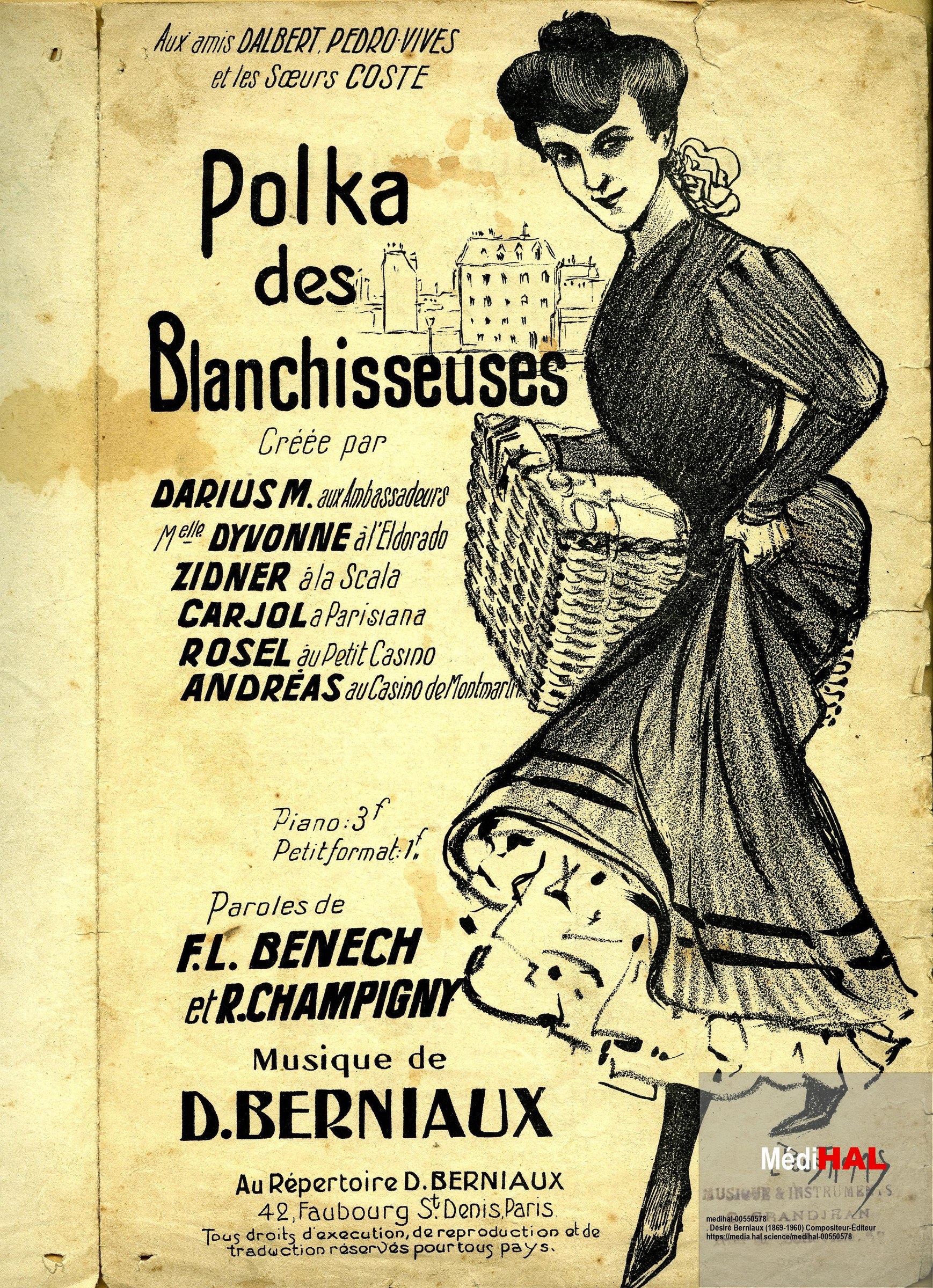
Polka des blanchisseuses créée par Darius M -Darius Meyer dit Darius M (1871-1929)-, Mlle Dyvonne, Zidner, Carjol, Rosel, Andréas (6 artistes) -illustration Léon Pousthomis- (MédiHAL 550578)
Éliane Daphy / Institut Interdisciplinaire d'Anthropologie du Contemporain / National Center for Scientific Research
- Source:
- Wikimedia Commons
- Rights:
- Public domain — free to use, share and adapt.
- Recorded as:
- public_domain
The polka was central to 19th-century dance culture across Europe, yet popular versions like this are often invisible in dance history, which has traditionally focused on ballet and concert dance. This artifact shows how working people encountered dance—not as audience members at the Opéra, but as performers, singers, and purchasers of sheet music in a commercialized leisure industry. The naming of six different performers and venues reveals an entire parallel dance world organized around variety theater and popular song.
What you are looking at
This is a cover or promotional sheet for a popular song-dance published in Paris in 1906. A young woman in fashionable Edwardian dress stands center-right, wearing a dark jacket with leg-of-mutton sleeves and a long skirt trimmed with lace or ruffles at the hem. She holds a large woven laundry basket, the object that defines the subject: this is the Polka des Blanchisseuses, the Laundresses' Polka. Her pose is elegant and posed rather than caught mid-movement, with her body turned slightly, one hand on her hip and the other resting on the basket. Behind her, rendered in lighter lines, is a Parisian streetscape with tall apartment buildings suggesting the working-class quarters where laundresses lived and worked. The overall composition is a commercial one: the image functions as advertisement and souvenir simultaneously, naming the performers, the venues where they danced it, the composers and lyricists, and the publisher's address in the Faubourg Saint-Denis.
The dancing
Only one figure is depicted, and she is posed rather than actively dancing. Her stance is upright and dignified, with weight balanced evenly, the body angled to display both the jacket and skirt. There is no suggestion of the vigorous footwork or turning characteristic of polka dancing. The image is a portrait of the song rather than a document of the dance itself—the figure serves as an emblem of the working woman and the laundry trade rather than as a representation of movement or partnered dancing.
The dance depicted
The polka was one of the dominant social dances of the late 19th and early 20th centuries, a fast, lively couple dance in 2/4 time. This version—the Polka des Blanchisseuses—appears to have been a character or novelty polka, likely performed in the music halls and café-concerts of Paris (the Ambassadeurs, Eldorado, Scala, Parisiana, and Petit Casino are all named as performance venues). The inclusion of the laundry basket and the title indicate a dance with a occupational or comic theme, typical of café-concert entertainment. The composer Darius M. is credited with creating it, and it was performed by six named artists across different Parisian venues. The image gives us no information about the actual choreography or movement vocabulary, but the song's publication in the magazine Paris qui chante in September 1906 confirms it was a commercial entertainment hit.
How it was made
This is a printed sheet music cover, likely a chromolithograph or similar lithographic process to judge from the fine detail of the line work and the subtle tonal gradations in the woman's jacket and the city background. The illustration is by Léon Pousthomis, whose elegant line style was well-suited to commercial music publishing. The small format (noted as petit format) and the bright legible typography make this a product designed for affordable mass circulation—it would have been sold at music shops and performed by singers and pianists at home. The technique allowed for high-quality reproductive imagery at a price point accessible to a broad public, which was essential to the business model of popular song publishing.
About this work
This is a commercial music publishing artifact from belle époque Paris, the cover of a popular polka choreographed and performed in the city's café-concerts. It documents not the dance itself but the commodification of dance in urban entertainment: the same choreography was performed by different dancers in different venues, the song was published and sold, and the image was reproduced and distributed. The polka was a social dance, but this image captures the moment when such dances became also commercial spectacles, branded products with named stars, composers, and venues. The image of the laundress—dignified but unmistakably working-class—shows how popular dance themes drew on the lives and labor of the city itself, aestheticizing and romanticizing occupational identity. For dance historians, it is evidence of the thriving café-concert dance scene and the role of music publishing in disseminating both music and choreography.
How to look at it
This is not an image of a polka in progress, so do not expect to see the characteristic bounding rhythm or partnered hold. Instead, look at how the figure is styled and posed: the fashionable dress and confident stance present the laundress not as a documentary subject but as a theatrical character, an archetype. The basket is the key prop that anchors the theme. The background cityscape is rendered much more lightly, indicating the function of this image as a portrait of a song rather than a scene. The typography and layout function like a modern movie poster, assigning names and venues and drawing the eye to the title. A viewer should recognize this as a piece of entertainment marketing, not a record of actual movement.
The artist
Léon Pousthomis was a French commercial illustrator and graphic designer active in the early 20th century. His work appeared frequently in Parisian music publishing, particularly for popular songs and operettas. His style is characterized by elegant, economical line work and an ability to capture fashionable dress and urban settings. He worked in the tradition of Belle Époque commercial art, designing covers and promotional materials for a mass market. His illustrations helped define the visual identity of Parisian popular entertainment.
The period
The polka had dominated European ballrooms since the 1840s and remained a staple of both social dancing and theatrical performance through the early 20th century. By 1906, it had become a fixture of café-concert entertainment in Paris, where it was performed as novelty numbers with occupational or comic themes. Popular song publishing was booming; the magazine Paris qui chante, in which this song was published, was part of a vast industry producing illustrated sheet music for affordable home consumption. Edwardian fashion is evident in the woman's dress—the exaggerated sleeves and high-waisted silhouette date the image precisely to 1900–1910. The image captures the moment when industrializing cities created both a laboring population (the laundresses) and a leisure industry (the café-concerts) that made entertainment of that labor.
Where it lives
This sheet music cover comes from the collection of the Médiatèque de la Cité de la Musique or similar institutional repository (the digital identifier MédiHAL 550578 indicates a French academic collection). It was accessed via Wikimedia Commons. As a published commercial object, it would have had a wide circulation in Paris and possibly beyond; many copies likely survive in public and private collections.
Dance in this work
Questions about this work
Is this showing an actual polka dance in progress?
No. This is a sheet music cover, not a scene from a dance performance. The figure is posed to display her fashionable dress and the symbolic laundry basket; there is no active movement. To learn how the polka was actually danced, you would need to look at photographs, film, or instructional sources.
Who was Darius M. and why did six different dancers perform his polka?
Darius M. was a choreographer and performer active in Parisian café-concerts. In the early 20th-century music-hall system, a successful choreographed number could be licensed or taught to other performers at different venues; the same dance would be performed by different artists, creating star vehicles and extending the financial reach of a single composition. This democratized dance entertainment but also fragmented authorship and created competition.
What is a café-concert and why were they important to dance?
Café-concerts were informal entertainment venues in late 19th and early 20th-century Paris, combining food, drink, and live performance. Unlike the formal Opéra, they were frequented by working and middle-class audiences and featured variety acts—songs, dances, monologues. They were a primary venue for popular dance and an important source of income for dancers and choreographers.
What was the social position of laundresses, and why were they a subject for entertainment?
Laundresses were a visible, recognizable working-class occupation in urban Paris—predominantly female, physically demanding, low-paid. Making entertainment of occupational types was a standard strategy of popular theater: the figure was both a real social presence and a comic or sentimental character. The image aestheticizes labor while keeping the subject visibly marked as working-class.
More dance artwork





