49 works in this view — arrow keys or swipe to move between them.
Dance in Art
Korea-Gojong Imin Jinyeondobyeong-02
Unknown court painters
- Source:
- Wikimedia Commons
- Rights:
- Public domain — free to use, share and adapt.
- Recorded as:
- public_domain
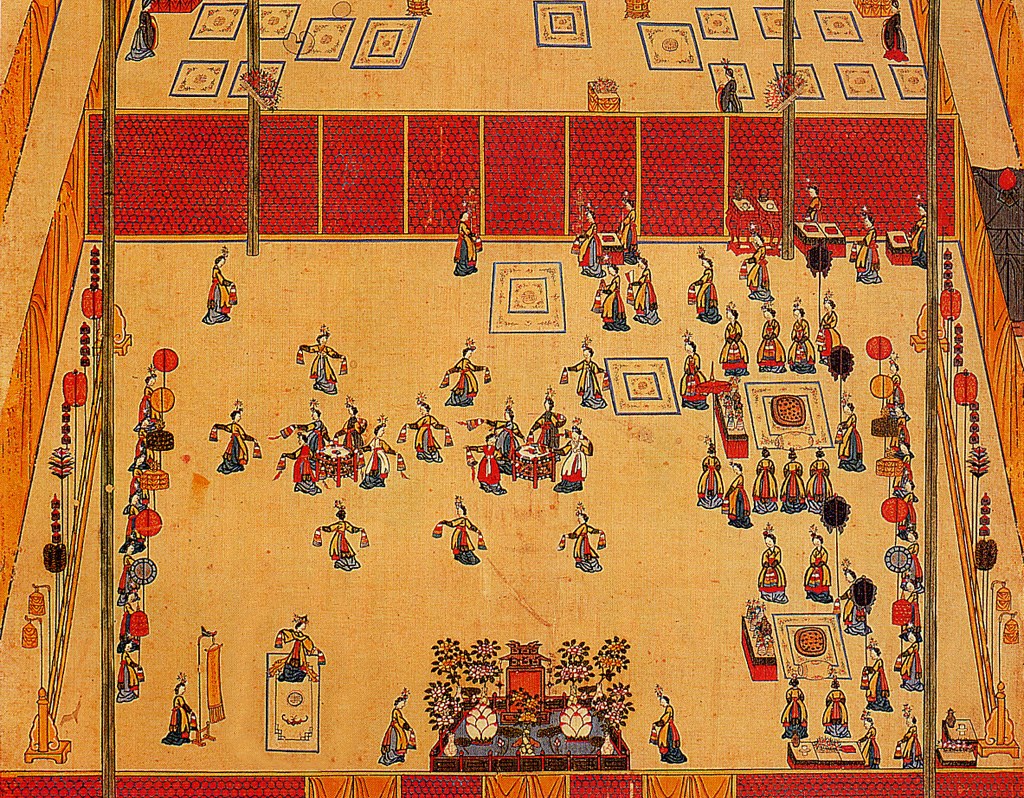
This painting is evidence that mugo and drum dance remained central to Korean imperial ceremony at the very end of the court's independence. The work demonstrates how East Asian court painting functioned as historical record and state document, freezing a moment of political and cultural significance in which dance was present but not foregrounded—a rare window into the social function of court dance in a specific, documented moment.
What you are looking at
This is a bird's-eye view of an official court ceremony, painted on silk in the Korean literati tradition. The composition is organized as a horizontal scroll divided into registers. The upper third shows a red-latticed pavilion or viewing platform with small figures seated or standing within it; the walls are rendered in vermillion with regular geometric divisions. Below stretches a spacious courtyard in warm ochre, populated by dozens of figures in formal court dress arranged in deliberate groupings. At the center-bottom, a raised dais or altar structure with ornamental trees and a red roof is surrounded by standing attendants. The sides are bordered by decorative elements—hanging lanterns rendered as red circles, and tall vertical ornaments that may represent banners or ceremonial standards. The entire scene is framed by architectural elements suggesting a fortified palace enclosure. The perspective flattens figures and eliminates shadow, consistent with court documentation painting rather than Western perspectival convention.
The dancing
Most figures appear in profile or frontal stance, wearing official robes with full sleeves in earth tones, reds, and blues. The posture is formal and restrained—no dynamic movement is visible. Some figures hold objects, possibly fans or ceremonial implements. Groups cluster in loose formations around the central dais; there is no evidence of partnered movement or the interlocking positions of a structured dance. The scale of each figure is consistent within spatial zones, with smaller figures toward the back edges of the courtyard. This is arranged observation rather than kinetic choreography.
The dance depicted
The catalogue identifies this as depicting *mugo* (drums dance), and the composition is consistent with a formal court presentation rather than a performance in the modern sense. Mugo was a ritual drum dance performed at state occasions and feasts in the Korean royal court. However, the image does not show the characteristic arm movements, group formations, or individual dancers in action that would identify mugo unambiguously. The scene instead documents the *occasion* of performance—the imperial feast for Emperor Gojong in 1902—with the likely mugo performers distributed among the assembled courtiers. The flattened perspective and documentary intent make it impossible to reconstruct the actual choreography from this image alone.
How it was made
This is painted on silk in opaque pigment (gouache or mineral pigment typical of Korean court painting). The technique is tempera-like, allowing fine linear detail and brilliant color saturation without atmospheric perspective. The composition uses a continuous narrative or aerial-view format common in Korean and East Asian royal documentation, in which a single scene unfolds across the surface to record all significant participants and the architecture of the occasion. This mode of painting served both as record and as gift or tribute document, circulated among officials and archives rather than displayed as easel art. The formality and completeness of detail suggest official court patronage.
About this work
This is a court documentation painting from the reign of Emperor Gojong of Korea, created in 1902 to record an imperial feast. The work is not a narrative or romantic image of dance but a formal inventory of an official ceremony in which ritual music and dance (likely mugo) played a ceremonial role. The painting's value lies in what it reveals about the *context* of court dance in late Joseon Korea—the hierarchies of viewing, the architectural frame of performance, the integration of dance into state ritual—rather than in depiction of movement itself. For historians of Korean court culture and the relationship between dance and political authority, the painting documents a specific moment in the transition from traditional court ritual to the modern Korean state, executed just three years after the Russo-Japanese War and nine years before Japan's annexation of Korea.
How to look at it
Attend first to the organization of space: the painting shows how the court conceived of itself hierarchically and spatially. The red pavilion at the top is the place of authority (likely where the Emperor and senior officials sat); the courtyard below is where assembled attendants stood. The dais at center-bottom is the focus of the ceremony. This aerial view is not naturalistic; it is a *diagram* of social order. Look also at the precision of the architectural framing—the palace walls, the latticed windows, the geometric divisions—which indicates that the *setting* of the ceremony was as important as the ceremony itself. Finally, search for the dancers: they are likely among the standing figures in the courtyard, but without movement or distinctive dress, they are not visually distinguished from other courtiers, suggesting that in this context, dance was integrated into ritual rather than staged as spectacle.
The artist
The painting is attributed to unknown court painters (*dobyeong* painting was typically a collaborative workshop product under imperial direction rather than a named artist's creation). Court painting of this scale and subject required a team of specialists trained in the literati and institutional styles of the Joseon court. The *dobyeong* (folding screen) format was standard for official commemorative works and diplomatic gifts.
The period
In 1902, Korea was in rapid crisis. The Russo-Japanese War (1904–05) was imminent, and Japanese colonial pressure was mounting; Korea would lose its independence entirely in 1910. The decision to commission a formal record of an imperial feast in the traditional court painting mode represents a final assertion of Joseon court ritual and cultural authority at the moment of its extinction. Mugo and other court dances were part of a ceremonial system that dated back centuries; this painting is among the last visual records of that system in practice. By contrast, Western and Japanese influence on Korean culture was accelerating, and within a decade, many traditional court rituals would cease.
Where it lives
The work is recorded as a folding screen painting (*dobyeong*) from the Korean imperial court, dated to 1902. The title translates as 'Painting Screen Folder Illustrating the Feast for Korean Emperor Gojong in Imin Year'—*imin* (임인) referring to 1902 in the East Asian zodiacal calendar. The source is Wikimedia Commons; no museum collection or accession number is recorded.
Dance in this work
Questions about this work
Where is the dance in this painting?
The dance is present but not visually foregrounded. Mugo and other court dances were performed as part of the imperial feast, but in this documentary painting, the performers are likely distributed among the assembled courtiers and are not distinguished by pose or costume. The painting prioritizes the *occasion* and the *architecture* of ceremony over individual movement.
Why does the painting look so flat and arranged?
This is the aerial or bird's-eye-view format used in East Asian court painting to document state occasions comprehensively. It allowed the artist to show all participants, the full layout of the palace, and the hierarchy of the event in a single image. This is not a limitation of skill but a deliberate documentary convention designed for official record and diplomatic circulation.
What is mugo?
Mugo is a ritual drum dance performed in the Korean royal court, typically at state ceremonies and feasts. Dancers moved in coordination with court musicians, and the dance was part of the ceremonial system that expressed imperial authority and cultural continuity. By 1902, mugo was an ancient tradition, performed for over a thousand years.
Why was this painting made in 1902?
The painting commemorated an imperial feast and served as an official record. Such paintings were also gifts of state, presented to senior officials or foreign dignitaries as tokens of imperial regard. In 1902, creating such a record was an assertion of continued court authority and cultural tradition at a moment when Korea's political independence was under severe threat.
More dance artwork





