49 works in this view — arrow keys or swipe to move between them.
Dance in Art
Dancers
Edgar Degas (French, 1834–1917)
- Medium:
- pastel with charcoal on tracing paper mounted on paper and backed with gray board
- Collection:
- Drawings
- Source:
- Cleveland Museum of Art
- Rights:
- Public domain — free to use, share and adapt.
- Recorded as:
- CC0
This work demonstrates how thoroughly Degas revolutionised the representation of dance in art by choosing to paint the unglamorous moments dancers inhabited, and by applying rigorous formal innovation (the pastel technique, the cropped composition, the off-centre framing) to make those moments visually compelling. For historians of ballet, it is crucial evidence of how dancers actually prepared their bodies and spent their working time offstage.
What you are looking at
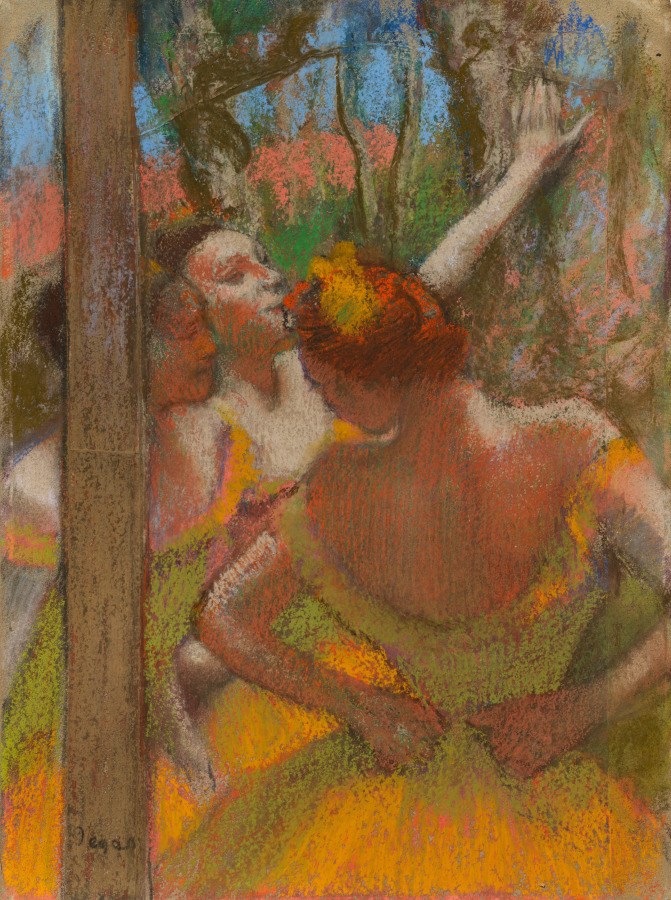
Three ballet dancers occupy the shadowed wings of a theatre, caught in a moment of private preparation rather than public performance. The nearest figure, in the foreground left, stretches upward with one arm extended toward a wooden beam or support, her body angled in a classic dancer's reach. Behind her, two other dancers in similar warm-up poses create a composition of vertical lines and extended limbs. The space is rendered in Degas's characteristic palette of powdery yellows, oranges, pinks, and rust reds, with deep shadows and green accents suggesting the theatre's backstage architecture. The wooden structural elements—vertical posts and a horizontal beam—frame the figures and anchor them in a specific, confined space. The painting captures not a choreographed moment but the unglamorous reality of dancers' bodies in labour, their costumes and flesh dissolved into the vibrant, rough texture of layered pastel.
The dancing
Each dancer's weight appears shifted into a stretch or reaching position rather than a held balance. The foreground figure reaches upward with her arm extended, torso elongated, suggesting a hamstring or side stretch at the barre (though no barre is visible). The two background figures adopt similar vertical reaches, creating a visual echo of preparation. Their bodies are substantial and earthily rendered, without the attenuated grace of some ballet imagery; Degas emphasises the muscularity and effort required. The poses are asymmetrical and naturalistic—this is not a formation or ensemble positioning, but three individuals each engaged in her own physical preparation.
The dance depicted
These are almost certainly ballet dancers, identifiable by the context (wings of a theatre), the style of their warm costumes, and the character of their stretching—the upward reaches and hamstring work typical of ballet conditioning. The work depicts rehearsal or pre-performance preparation rather than choreography itself. Degas made over 1,000 works on ballet subjects and famously preferred such private, unglamorous moments to curtain calls. The painting offers insight into what ballet dancers actually did offstage: isolated, individual stretching and conditioning work that the paying audience never witnessed.
How it was made
Pastel with charcoal on tracing paper mounted on paper and backed with board, employing Degas's signature late technique of layering transparent and opaque pastel to build colour and texture. The 'powdery' surface visible in the image results from this method of applying multiple layers of varying opacity, creating a vibrant, almost granular appearance. This technique allowed Degas to build colour from underneath, to adjust and revise, and to achieve the particular atmospheric quality of theatre lighting without the slower drying time of oil paint. The work was portable and could be worked on repeatedly—essential for an artist who often drew from backstage access at the Paris Opéra.
About this work
This is a late work by Edgar Degas exploring his central obsession: the ballet dancer at rest. Unlike romantic-era ballet imagery that celebrates the dancer as ethereal performer, Degas shows dancers as working bodies, stretching and conditioning in the anonymous space behind the curtain. The pastel medium—built up in translucent layers to create a trembling, vibrant surface—was Degas's chosen vehicle for this subject across four decades of work. The painting belongs to the tradition of realist observation applied to theatrical labour, the body as matter rather than metaphor. It remains remarkable for its refusal of sentimentality and its insistence on the mundane physical reality of the art form.
How to look at it
Notice the composition: none of the three dancers is centred; the nearest figure is cut off by the left edge of the frame. This creates a sense of accidental observation, as if the viewer has stumbled upon a private moment rather than been invited to witness a composed scene. Attend to the colour: the dominant warm palette (yellows, oranges, rust, pink) is broken by cool blue accents (sky glimpsed through the theatre structure, shadows) and green—the warm and cool tones vibrate against each other in a way that suggests both the artificial lighting of the theatre and the physical exertion of the dancers' bodies. The rough, grainy texture of the pastel surface is not a limitation but a deliberate choice that mirrors the texture of worn fabrics, skin, and effort.
The artist
Edgar Degas (1834–1917) was a French Impressionist painter and sculptor who gained access to the Paris Opéra and made ballet his primary subject, producing over 1,000 works in the medium across his career. Unlike Impressionist contemporaries, Degas worked from memory and careful observation rather than en plein air, and his compositions are marked by unusual cropping and viewpoints derived from photography and Japanese prints. He developed distinctive pastels techniques late in his career—this work dates to 1891, when he was experimenting with layering and heating pastel to create rich, densely worked surfaces. His preference for rehearsal over performance, for physical labour over romantic spectacle, fundamentally altered how dancers and choreographers understood their own profession.
The period
In 1891, ballet was still dominated by the Romantic legacy of the mid-19th century, but the form was evolving. The Russian Imperial Ballet was beginning its ascendancy under directors like Marius Petipa, and reformers like Michel Fokine were pushing toward modernist abstraction. In the visual arts, Impressionism was established but contested; Degas's late work in pastel belongs to a post-Impressionist moment when the movement's innovations were being consolidated and challenged. The painting captures ballet at a moment of professional consolidation—dancers were increasingly trained in systematic technique and subject to disciplined daily practice in purpose-built studios, yet the art form was still imagined by the public through Romantic iconography. Degas's insistence on showing the physical reality of that training represents a distinct artistic position.
Where it lives
The work is held in the Drawings collection of the Cleveland Museum of Art. As a work on paper (tracing paper), it occupies the category of drawing or print rather than painting, though the scale and labour involved in its creation far exceed most traditional definitions of drawing.
Dance in this work
Questions about this work
Why did Degas paint so many ballet dancers?
Degas had privileged access to the Paris Opéra through his social connections and could observe dancers in rehearsal, dressing rooms, and performance. But his obsession was not romantic: he was interested in the body in motion and at rest, in the geometric compositions created by multiple dancers in space, and in capturing the fugitive moment. Ballet provided an endlessly renewed subject for exploring movement, anatomy, light, and composition.
Is this a finished work or a study?
By Degas's late practice, the distinction between study and finished work was uncertain. This pastel on paper mounted on board appears to be a complete work intended for exhibition or collection, not a preparatory sketch. Degas often worked iteratively across many sheets, reworking the same subject, so 'finished' may not be the right category.
What dance are they doing?
They are not dancing; they are stretching and conditioning before or after rehearsal or performance. This is the work's point: it shows the physical labour behind the art form, not the art form itself. The upward reaches are typical of ballet warm-up, designed to lengthen the muscles and prepare the body for the demands of choreography.
Why is the surface so rough and grainy?
Degas built this pastel in multiple layers, sometimes heating the pastel to fuse layers together, creating a dense, textured surface that catches light differently across the work. This technique allowed him to work back into the image repeatedly and achieve subtle colour transitions impossible in a single layer. The texture is not a flaw but a sophisticated formal choice.
More dance artwork





