49 works in this view — arrow keys or swipe to move between them.
Dance in Art
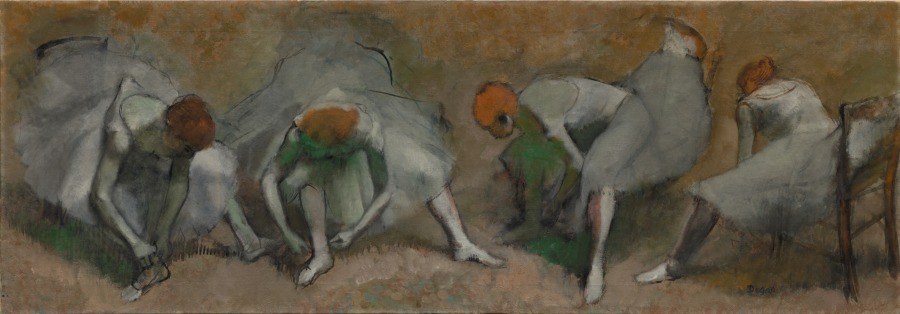
Frieze of Dancers
Edgar Degas (French, 1834–1917)
- Medium:
- oil on fabric
- Collection:
- Modern European Painting and Sculpture
- Source:
- Cleveland Museum of Art
- Rights:
- Public domain — free to use, share and adapt.
- Recorded as:
- CC0
For historians of dance, this work documents the shift from theatrical representation to the study of actual bodies in motion—a shift that modernism itself was undergoing in 1890. For artists, it demonstrates how photography and sequential vision could revolutionize the representation of movement without abandoning painting's scale and presence. For dancers, it offers a rare moment of recognition: the studio pose, the fatigue, the body in process rather than in performance.
What you are looking at
Five female figures in white undergarments occupy a shallow, undefined space against a muted brown ground. Each bends forward from the hips in a near-identical pose—torso folded, arms hanging, head bowed—as though caught in the same moment of movement or rest. Their reddish-brown hair and pale skin read against the neutral background with minimal modeling; the setting offers no stage, studio, or landscape to anchor them. The paint is applied with striking spontaneity: thin washes, visible drips, and areas of bare canvas create a sketch-like quality despite the substantial size of the work. Degas has even added circular shapes in the foreground with his thumb, leaving tactile evidence of his hand. The repetition suggests sequential movement or multiple exposures of a single body rather than a group scene.
The dancing
All five dancers assume an identical forward bend with the torso nearly parallel to the ground, knees slightly flexed, and arms released downward in a posture of exhaustion or preparation. Their heads hang heavily; no face is fully visible. The consistency of the pose across five figures—varied only in the precise angle of the head or minor shifts in arm placement—emphasizes the mechanical repetition of the movement rather than individual expression. The quality of weight and gravity is palpable: these are bodies surrendering to fatigue or the demands of the choreography.
The dance depicted
The work depicts ballet, almost certainly the daily labor of rehearsal or class rather than performance. The pose resembles the recovery or preparation phase between combinations—the moment a dancer catches breath, stretches the spine, or resets before exertion. The white undergarments (chemises or rehearsal wear) and bare feet confirm the studio context. The repetition of the pose across five separate figures strongly suggests Degas's engagement with sequential photography, particularly the work of Eadweard Muybridge, whose studies of human locomotion and posture revolutionized how artists could study movement. This is not a narrative ballet or a moment of theatrical spectacle, but rather an attempt to atomize and repeat a single physical state—a modernist strategy applied to the dancer's body.
How it was made
Oil on fabric, likely canvas, applied with radical spontaneity. The thin, watery passages, visible drips, and large areas of unpainted ground create the appearance of a large-scale sketch rather than a finished composition. This technique—often associated with preparatory work—was provocative when presented on a six-foot canvas in 1890. The material handling suggests Degas was less interested in illusionistic representation than in the gesture of painting itself: the immediacy of the medium mirrors the immediacy of observation from life. The work's sketchiness and the evidence of the artist's thumb-work create an aesthetic of authenticity and directness, as though capturing raw, unmediated experience.
About this work
This is a pivotal work in the history of dance imagery: a six-foot painting presenting not a climactic moment of ballet but the quotidian physicality of the rehearsal studio. By repeating a single pose across five figures, Degas merges two revolutionary sources—direct observation from life and the sequential-image technologies of modern photography—to defamiliarize the dancer's body. The painting rejects narrative, spectacle, and finish in favor of repetition, exhaustion, and the material evidence of artistic process. It belongs in a dance collection not as a record of choreography but as a document of how modernist art learned to see the body in time.
The work represents a radical democratization of the dancer as subject. In theatrical iconography, the ballerina is spectacle—the body at its moment of triumph or beauty. Here, Degas gives us the body stripped of narrative or display, repeated like a photograph or a scientific diagram, bent in a posture that reads as neither graceful nor triumphant but profoundly material and vulnerable. The painting insists that this—the fatigue, the preparation, the raw physicality—is what deserves the scale and attention of serious art.
How to look at it
Attend first to the repetition: not five dancers in a group, but one pose insistently repeated, as if the eye is scanning a photograph or a sequence of frames. Notice the pose itself—the total collapse of the torso, the hang of the arms—and recognize it as a moment of neither beauty nor spectacle in the theatrical sense, but of physical necessity and candor. Look at how Degas has painted: the thinness of the paint, the visible edge between painted and unpainted canvas, the circular marks made by thumb. This is a painting that flaunts its own making as much as it documents the dancer's fatigue. The neutrality of the ground forces you to attend to the body alone, without narrative or setting to mediate the encounter.
The artist
Edgar Degas (1834–1917) spent more than four decades studying dancers in Paris, particularly at the Opéra and in rehearsal studios. His interest was not primarily in spectacle but in the body in labor—the repetitive movements of training, the geometry of the studio, the candid moment. Degas's late work became increasingly experimental: he embraced pastel, printmaking, and sculptural studies of the dancer's form. His fascination with photography and sequential imagery intensified in his final decades; he collected Muybridge's photographs and used them as reference material. This work sits at the intersection of that photography-informed practice and an increasingly abstract, modernist approach to composition. Degas's dance subjects were not incidental to his art; they were his primary vehicle for exploring how modern vision—scientific, photographic, fragmentary—could be integrated into painting.
The period
In 1890, ballet in Paris was undergoing significant change. The Romantic era had given way to the Opéra's more academic and commercial aesthetics; choreography was becoming increasingly fragmented and spectacular. Simultaneously, photography and the cinema—still in its infancy—were transforming how artists understood movement and time. Muybridge's photographic studies, published in *Animal Locomotion* (1887), circulated widely among artists and were explicitly concerned with revealing the true geometry of human motion beneath the conventions of academic figure drawing. In fine art, Impressionism was waning, and Modernism was consolidating: artists like Degas were moving toward flattened composition, visible process, and the embrace of the sketch as a finished statement. The theatrical ballet world and the avant-garde art world were on divergent paths; Degas occupied a rare position at their intersection, using the ballet as a subject through which to explore modernist vision.
Where it lives
The work is held in the Modern European Painting and Sculpture collection at the Cleveland Museum of Art (CMA). Degas's dance paintings are distributed across major museums worldwide; they form a substantial portion of his oeuvre and are among his most frequently studied works.
Dance in this work
Questions about this work
Is this one dancer or five?
The catalogue record suggests it may be a single dancer seen from four different viewpoints, though the pose is so identical across all five figures that Degas is more likely using repetition as a compositional and conceptual strategy. The repetition is the point: it mirrors the repetitive labor of ballet training and echoes photographic sequence. Whether or not the same model was sketched multiple times, the painting presents the pose as a repeated unit, not five distinct individuals.
Why does the painting look unfinished?
Degas deliberately chose a sketch-like technique even for a large canvas. The thinness of the paint, the visible drips, the unpainted ground, and the thumb-made marks are all intentional formal choices. In 1890, this was radical: such rawness was acceptable in preliminary work but shocking on a six-foot exhibition piece. Degas was asserting that the sketch—the moment of direct observation—was complete in itself, and that finish and polish were not necessary markers of artistic value.
What are the dancers wearing?
White chemises or rehearsal undergarments, typical of the ballet studio. The bare feet and minimal costume indicate this is not a performance scene but a documentation of the studio, where dancers trained and where Degas often sketched. The costume also emphasizes the body itself: there is no tutú, no stage ornament, only flesh and the simplest covering.
How does this relate to photography?
Degas owned and studied photographs by Eadweard Muybridge, whose sequential images of human and animal motion were revolutionary. This painting adopts the grammar of photographic sequence—the repetition of a pose across multiple frames—translating photography's way of seeing into painting. Rather than a single, decisive moment, Degas presents movement as a series of nearly identical states, as a photograph might if you extracted five frames from a sequence.
More dance artwork





