49 works in this view — arrow keys or swipe to move between them.
Dance in Art
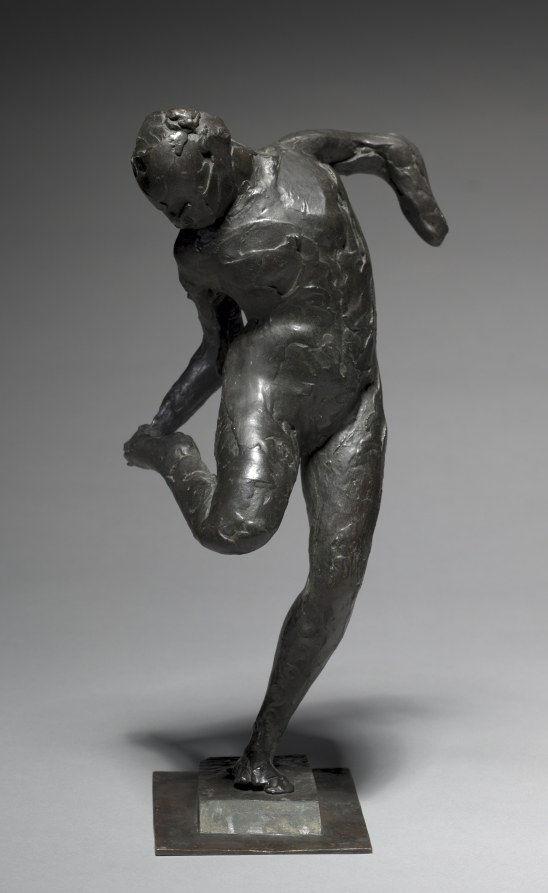
Dancer Looking at the Sole of her Right Foot
Edgar Degas (French, 1834–1917)
- Medium:
- bronze
- Collection:
- Modern European Painting and Sculpture
- Source:
- Cleveland Museum of Art
- Rights:
- Public domain — free to use, share and adapt.
- Recorded as:
- CC0
Degas created around 150 small sculptures, nearly half of them dancers, yet kept most hidden from public view. This work demonstrates why: it treats the dancer's body as a site of investigation into balance, weight, torsion, and self-awareness—not as spectacle. For anyone interested in how dancers actually move and think about their own bodies, this sculpture cuts past the public image of ballet to the studio truth.
What you are looking at
A bronze sculpture of a female nude figure in a moment of intimate self-examination. The dancer is captured mid-movement, balanced on one leg with the body twisted in a spiral. Her right leg is lifted high and drawn back, the sole of her foot angled toward her gaze as she looks down and back. Her left arm extends forward for balance, while her right arm curves along her body. The figure stands on a rectangular bronze base. The surface bears the visible marks of hand-modeling—fingerprints and tool marks visible across the anatomy, particularly on the torso and limbs, creating a tactile, unfinished quality despite the permanence of bronze. The lighting in this photograph emphasizes the musculature and the sculpture's three-dimensional form, with clear shadows defining the concave spaces between the body and the extended limbs.
The dancing
A single female dancer executed in the contrapposto tradition but pushed into an extreme torsion. Her weight rests entirely on the standing leg, creating a dramatic diagonal line through the torso as she turns to observe her own foot. The lifted leg is drawn high and back, the knee bent and the foot flexed, sole upturned toward the viewer. The arm positions—one forward, one trailing—suggest both balance and the sculptural principle of creating multiple viewpoints around the figure. This is anatomically precise figure work, demonstrating sophisticated understanding of how a body distributes weight and creates counterbalance.
The dance depicted
The pose captures a deliberate moment of inspection, likely drawn from the dancer's own studio practice—the act of checking foot position, alignment, or the extension of a specific muscle. This is not a step or a movement within a choreography but rather the private gesture that precedes or follows formal dance. The subject belongs to theatrical ballet training, where the scrutiny of one's own body is central to the practice. The extreme torsion and the choice to make the self-examination the subject rather than the movement itself suggests interest in the interior life of the dancer—the critical eye turned inward.
How it was made
This is a bronze cast of a work originally modeled in wax, the medium Degas preferred for sculpture. The visible fingerprints and tool marks are not deterioration but intentional preservation of the modeled surface—marks left by the artist's hands during the work's creation. Casting in bronze captured these impressions permanently, creating a texture at odds with traditional bronze's usual smooth finish. This hybrid of finish and sketch-like surface suggests the work was meant to preserve the immediacy of the original modeling and to resist the polishing that would erase the artist's physical intervention.
About this work
This is a late-career work by Edgar Degas, one of his wax sculptures cast in bronze after his death. It depicts a female dancer in a private moment, examining the sole of her own foot—a pose drawn from life in the rehearsal studio rather than from the stage. The work exemplifies Degas's decades-long fascination with dancers in unguarded moments and with the physical sensations and private rituals of dance practice. It belongs among his other sculptures of dancers, nearly all of which concern the body in isolation, off-stage, and often engaged with its own scrutiny or recovery. The visible fingerprints and modeling marks distinguish this from conventional bronze sculpture and assert the artist's hand as part of the work's meaning.
How to look at it
Notice the extreme torsion of the torso—the sculptor has made the twist of the spine as the subject, not merely incidental to the pose. Watch how the head follows the gaze downward, creating a spiral that pulls the eye through the figure's whole body. The fingerprints are not flaws to ignore but central to the work: they are proof of the artist's hand, a democratization of sculpture that values the moment of making as much as the finished form. This is a work about process, both the process of dance (inspection of one's own technique) and the process of sculpture (the artist's hand visible in every curve).
The artist
Edgar Degas (1834–1917) was a French painter, draughtsman, and sculptor obsessed with the visual truth of movement and the human body in effort. Though famous for his paintings of ballet rehearsals and performances, he created most of his sculptures in private, as autonomous studies. He worked from live models, often dancers, and favored wax as a medium because it allowed him to build form incrementally and capture gesture in its full complexity. His sculptures were largely unknown until after his death, when nearly 150 were cast in bronze from the wax originals.
The period
By 1896, when this work was made, Degas was in his sixties and increasingly interested in the raw physicality of the body rather than the composed beauty of performance. This coincides with broader late-19th-century shifts toward modernism: the rejection of finish and polish in favor of the sketch-like or the raw; the interest in the working body rather than the idealized form; and the tension between sculpture's traditional role as public monument and its emerging role as intimate studio investigation. Degas's fingerprints left in the bronze surface anticipate 20th-century sculpture's embrace of the artist's trace.
Where it lives
The work is held in the Modern European Painting and Sculpture collection at the Cleveland Museum of Art. It is one of a series of bronze casts made from Degas's original wax sculptures; the casting history of Degas sculptures is complex, with multiple editions produced under different circumstances after the artist's death.
Dance in this work
Questions about this work
Why can you see fingerprints in a bronze sculpture?
Degas modeled this work in wax, leaving impressions of his hands as he shaped the form. When the wax model was cast in bronze, those impressions were captured permanently in the metal. Rather than smoothing away these marks as many sculptors would, Degas preserved them—or allowed them to be preserved—as evidence of the hand's work.
What dance position is this?
This is not a named step or position but rather a studio moment—a dancer inspecting her own foot, likely checking extension, turnout, or alignment. It belongs to the daily practice of ballet rather than to choreography. Degas frequently chose such private, functional moments over the formal positions or movements of performance.
Why did Degas make sculptures if he was a painter?
For Degas, sculpture offered something painting could not: the ability to build form in three dimensions and to rotate around a figure, exploring it from every angle. He used sculpture primarily as a private tool for understanding anatomy and movement, not for exhibition. His sculptures were largely unknown until decades after his death.
Is this a finished work?
Yes and no. The visible tool marks and fingerprints might suggest incompleteness, but Degas valued these traces of the making process. In his late work especially, he resisted traditional polish and finish, preferring to preserve the evidence of how the work came into being.
More dance artwork





