49 works in this view — arrow keys or swipe to move between them.
Dance in Art
Dancer at Rest
Edgar Degas (French, 1834–1917)
- Medium:
- charcoal
- Collection:
- Drawings
- Source:
- Cleveland Museum of Art
- Rights:
- Public domain — free to use, share and adapt.
- Recorded as:
- CC0
Degas transformed the way artists understood and represented dance, moving away from idealized theatrical scenes toward the unglamorous reality of dancers' bodies and working lives. This intimate study of a dancer at rest exemplifies that shift and offers insight into his working method—how he built compositions from careful observation of living dancers rather than imagination or convention.
What you are looking at
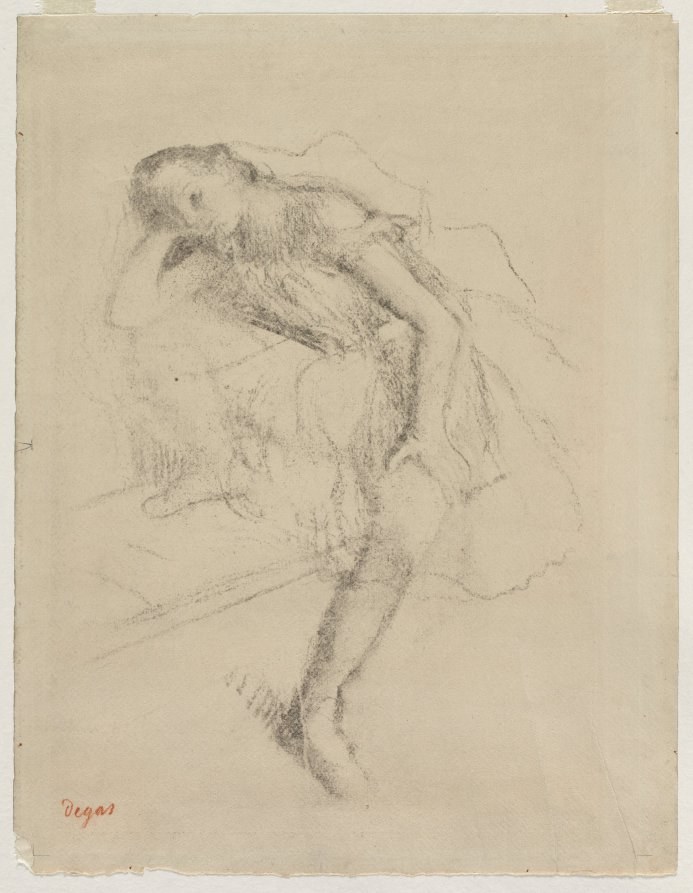
A single female dancer is captured in a moment of rest or transition, her body angled sharply backward in a pose of languorous repose. She is shown from approximately the waist up, her head tilted back, one arm raised and bent, the other across her body. The figure is rendered in soft charcoal with careful attention to the musculature and weight of the relaxed form. The dancer wears what appears to be a simple, loose garment—possibly a practice dress or tunic—that drapes naturally with her body's orientation. The composition is intimate and informal, focusing entirely on the dancer's physical state rather than any theatrical setting. The background is blank, rendered only in the pale tone of the paper, which emphasizes the figure's isolation and introspection.
The dancing
The dancer's body is deeply arched, with her weight seemingly supported on one leg while the other appears extended or relaxed. Her raised arm and tilted head suggest a moment between movements—neither fully at rest nor in active motion. The pose conveys a quality of exhaustion or deliberate pause, with the musculature softly modeled to show the effort of sustaining even this languid position. There is a single figure only, studied in isolation.
The dance depicted
This drawing most likely depicts a ballet dancer, based on the refined treatment of the body and the informal moment of rest that appears consistent with 19th-century ballet practice. The pose does not illustrate a specific technique or established ballet vocabulary; rather, it captures a dancer between steps—a moment of recovery or contemplation. Such studies were common in the preparation of ballet compositions and in the artist's practice of observing dancers in rehearsal and backstage settings.
How it was made
This is a charcoal drawing on paper, a medium that allows for soft modeling of form and rapid notation of movement. Charcoal's tonal range and ability to suggest rather than define anatomy made it ideal for life studies and working drawings. The technique here is loose and observational rather than finished; the artist has focused on capturing the essential weight and posture of the figure rather than rendering every detail. Such drawings were typically made from life in studios or theaters and were often used by artists as reference material for larger compositions.
About this work
This is a casual study of a ballet dancer in a moment of rest, rendered in charcoal by Edgar Degas during the 1890s. The work belongs to the artist's extensive practice of observing dancers in unguarded moments—offstage, in rehearsal, and between performances. Degas was uniquely invested in capturing not the polished spectacle of ballet but the physical reality of the dancers' bodies and labor. This small drawing, without narrative or theatrical context, exemplifies that commitment: it is a pure study of bodily exhaustion and the pose of temporary recovery, the kind of moment that rarely appears on stage but defined the daily experience of professional dancers.
How to look at it
Notice the pose's asymmetry and the sense of the body's weight shifting through it. The artist chose a moment that is neither a formal ballet position nor fully relaxed, but rather the unstable poise of someone recovering from effort. Observe how the charcoal models the torso and the angle of the neck; this reveals the artist's deep knowledge of bodily mechanics. The blank background throws all attention onto the figure's internal state—exhaustion, perhaps, or concentration—rather than any external drama.
The artist
Edgar Degas (1834–1917) was a French painter and sculptor who made dancers his primary subject from the 1870s onward. He attended performances, visited rehearsal studios, and gained access to backstage areas of the Paris Opéra, where he observed and sketched dancers obsessively. He was interested in movement, anatomy, light, and the labor of dance—not in sentimentality or spectacle. His thousands of drawings, pastels, and paintings of dancers form the most comprehensive artistic record of professional ballet practice in the 19th century. Degas worked across many media and scales, from finished paintings to quick charcoal notations; this drawing is characteristic of his working practice.
The period
In the 1890s, ballet was firmly established as the dominant form of theatrical dance in Europe, centered on the Paris Opéra. The Romantic era had given way to a more technical, virtuosic style. Degas had been observing and depicting dancers for nearly two decades by this point, and his approach had become increasingly informal and psychological. In visual art, charcoal drawing remained a primary tool for artists working from the live model, both for finished independent works and as preparatory study. Degas's interest in candid, unposed moments reflected broader late-19th-century shifts toward realism and the representation of modern life.
Where it lives
This drawing is held in the Drawings collection at the Cleveland Museum of Art. It represents the kind of working study—modest in scale, informal in execution—that Degas produced in great quantity and that museums have preserved as evidence of his creative process.
Dance in this work
Questions about this work
Is this a finished work or a sketch?
It is best understood as a finished study rather than a preliminary sketch. While executed with apparent spontaneity, the drawing is complete in its own right—a self-contained observation of a single moment. Degas often exhibited and valued such studies independently, treating them as finished artworks rather than merely preparatory material.
What type of dancer is this, and what is she doing?
She appears to be a ballet dancer, based on the refined treatment of anatomy and the informal moment of study typical of Degas's ballet practice. The pose suggests a moment between movements—rest, recovery, or a pause in rehearsal. It is not a specific ballet step or position, but rather a candid observation of the body in transition.
Why did Degas draw so many dancers?
Degas was fascinated by the human body in motion and under strain. Dancers offered him a subject through which to explore anatomy, movement, light, and labor. He was committed to depicting the reality of dancers' professional lives rather than the theatrical fantasy presented on stage, and this required constant observation and study.
More dance artwork





