49 works in this view — arrow keys or swipe to move between them.
Dance in Art
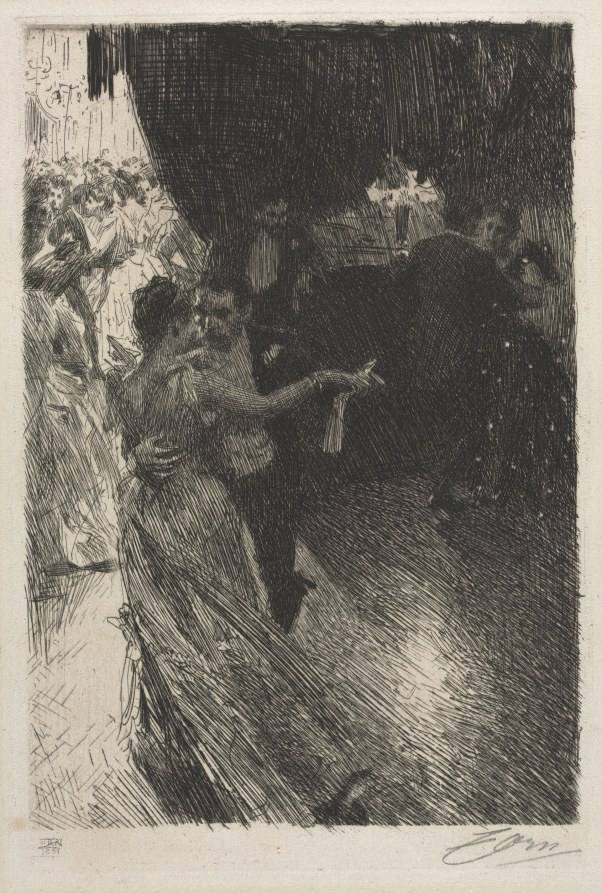
The Waltz
Anders Zorn (Swedish, 1860–1920)
- Medium:
- etching and drypoint
- Collection:
- Prints
- Source:
- Cleveland Museum of Art
- Rights:
- Public domain — free to use, share and adapt.
- Recorded as:
- CC0
The waltz was the defining social dance of the 19th century, and its representation in fine art—especially in the intimate scale of a print—testifies to its cultural centrality. This work captures not just the steps or the music, but the sensual, physical intimacy that made the waltz both celebrated and controversial in its era. For dance historians, it documents how the waltz was understood and visualized at the moment of its greatest refinement and social dominance.
What you are looking at
A couple dances in an interior space rendered in deep shadow and cross-hatching. The woman, in the foreground left, wears a long dress with a full skirt caught mid-swirl, her upper body leaning back in the man's arms. The man, seen from behind and rendered in heavy shadow, holds her in a close frame. The background is nearly black, with only hints of architectural detail—a doorway or window at upper left admits pale light that catches the woman's face and dress, leaving the rest of the scene in dramatic chiaroscuro. The etching technique emphasizes the play of light and dark, with the couple isolated as the only brightly lit element in an otherwise obscured interior.
The dancing
The couple is in a closed ballroom hold, with the man's right hand at the woman's back and her left hand resting on his shoulder or arm; her right hand appears to rest in his left. Their bodies are tilted away from each other in the characteristic opposition of the waltz, the woman's torso canted backward, her weight on a single leg, suggesting forward motion. The woman's skirt billows in a wide arc, indicating either a recent or ongoing turn. The man's frame is solid and commanding, rendered in shadow; the woman's face and neck catch the light, emphasizing the intimacy and formality of the dance.
The dance depicted
This is almost certainly a waltz, as the title confirms and the visual evidence supports. The closed frame, the slight counter-balance of the bodies, and the woman's swirling skirt are all hallmarks of the Waltz as danced in the ballroom culture of the late 19th century. The woman is captured mid-turn or in the flowing momentum of the three-beat phrase. This is social or theatrical ballroom waltz, performed indoors in an urban or aristocratic setting, a moment of courtship, display, or intimate public socializing that defined the era's elite culture.
How it was made
This is an etching and drypoint, a printmaking technique that allowed for subtle tonal variation through careful line work and selective wiping of the plate. The artist has used dense parallel hatching (cross-hatching) to build up shadow and model form, a technique visible in the man's clothing and the dark background. Drypoint, which creates a burr that holds ink, adds warmth and richness to certain passages, particularly the woman's illuminated face and dress. The technique was well suited to intimate domestic circulation and allowed for multiple impressions from a single plate, making the work accessible to collectors and dealers of fine prints.
About this work
This etching and drypoint depicts a moment of social waltz in an interior, capturing the dance as a form of intimate public performance. The artist has chosen a moment of motion—the woman's skirt mid-turn—and rendered it with attention to the physical relationship between the dancers and the emotional tenor of the embrace. The use of dramatic chiaroscuro isolates the couple from their surroundings, suggesting both the privacy of the dance and its public significance as a marker of social status and courtship ritual. The work belongs to a rich tradition of late 19th-century fascination with modern social dance, particularly the waltz, as a subject worthy of fine artistic attention.
How to look at it
Attend to the moment the artist chose: not the beginning of a turn or a static pose, but the middle of movement, where the woman's skirt is already swirling and the couple's bodies are in counter-balance. Notice how the light finds only the woman's face and the dress in motion; the man's face remains hidden, his body absorbed into shadow. This creates a psychological asymmetry—we see the woman's experience of the dance more clearly than the man's, and the darkness around them suggests both the intimacy of the moment and its isolation from the world. The contrast between the delicate, mobile woman and the solid, dark man reflects a visual convention of the period about gender and social position in the dance.
The artist
Anders Zorn (1860–1920) was a Swedish painter, printmaker, and sculptor of international renown. He was known for his ability to capture contemporary social life with psychological acuity and technical brilliance, working in oil, watercolor, and especially etching and drypoint. Zorn was fascinated by the human figure in motion and in social contexts, and his prints in particular were highly sought after and widely circulated. He traveled extensively in Europe and America, and his work reflects the cosmopolitan leisure culture of the Gilded Age.
The period
By 1891, the waltz had evolved from a somewhat scandalous court dance into the dominant social dance of the European and American middle and upper classes. The Viennese Waltz in particular had become the standard of elegant ballroom culture. The late 19th century saw an explosion of interest in capturing modern leisure, social intimacy, and the body in motion, reflected in both fine art and the burgeoning illustrated press. Printmaking, especially etching, was a prestigious medium for artistic expression, and the subject of contemporary social dance—especially in the ballroom—was rich territory for artists interested in psychology, elegance, and modern life.
Where it lives
The work is held in the Prints collection at the Cleveland Museum of Art. As an etching and drypoint, it represents the kind of fine print that was actively collected and exhibited in American and European museums by the early 20th century.
Dance in this work
Questions about this work
Is this the famous 'Waltz' by Zorn?
Without seeing the full catalogue record or any signature details, I cannot confirm its fame or prior attribution history. Zorn made multiple works on the theme of social dance and courtship. This work's title and date (1891) are documented in the catalogue record provided.
What is the dress style telling us?
The woman's dress is consistent with 1880s–1890s fashion: a fitted bodice and a full skirt with pronounced volume at the hem. The style is ballroom evening wear, indicating this is not casual or theatrical dance, but rather the fashionable social waltz of elite circles. The precise cut and fabric would have been expensive and new.
Why is the man in shadow?
This is both a technical choice (etching with drypoint allows selective emphasis through lighting) and an artistic convention of the period. Men were often rendered as stable, commanding, and less visually expressive; women as graceful, illuminated, and emotionally available. The shadow around the man emphasizes his role as the lead and frame for the woman's display.
Could this be a different dance?
The closed ballroom frame, the woman's skirt in a swirl, and the title 'The Waltz' all support waltz identification. No other common ballroom dance of the era would be represented with quite this visual and physical vocabulary, though the Waltz's variants (Viennese Waltz, slow Waltz) are not visually distinguishable in a single frozen moment.
More dance artwork





