49 works in this view — arrow keys or swipe to move between them.
Dance in Art
Dancers in a Pavilion
Jean-Baptiste Pater (French, 1695–1736)
- Medium:
- oil on canvas
- Collection:
- European Painting and Sculpture
- Source:
- Cleveland Museum of Art
- Rights:
- Public domain — free to use, share and adapt.
- Recorded as:
- CC0
For historians of early modern dance, this painting is essential: it shows us how the minuet was understood by its contemporaries—not as a technical exercise but as theater, courtship, and social display. For art historians and dancers alike, it demonstrates the rococo equation between beauty, leisure, and social order, and how that equation was encoded in the body. The work also illustrates the circulation of elite cultural forms: Pater's recombination of Watteau's motifs shows how these idealizations of aristocratic life were mass-produced for wealthy collectors.
What you are looking at
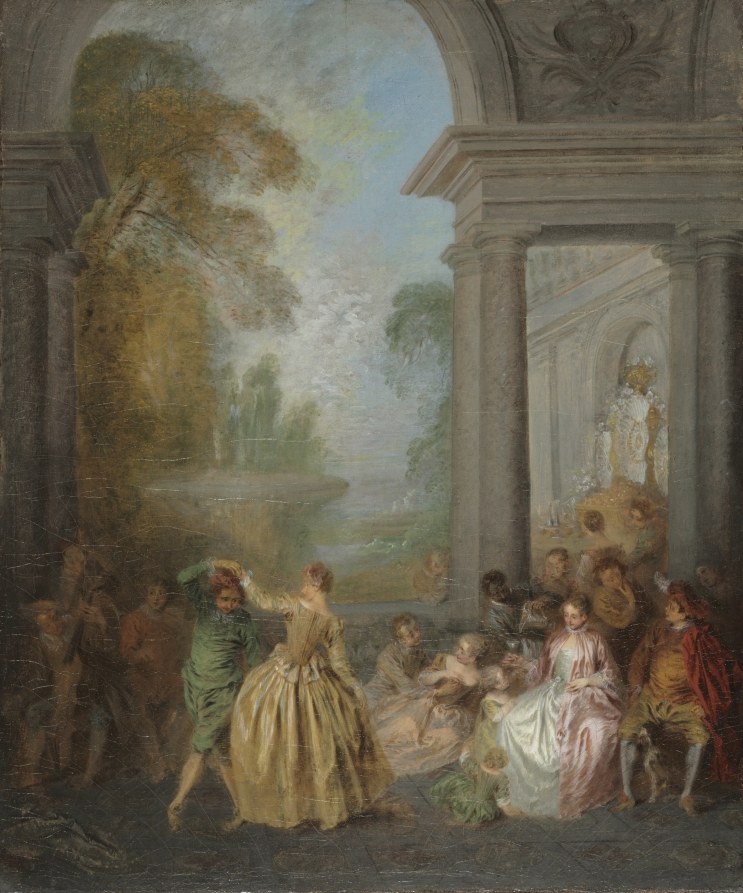
A elegant outdoor pavilion frames an aristocratic fête galante, where courtiers in pastel silks and satins gather to watch a dance. The architecture—twin columns supporting an arched entablature adorned with relief sculpture—creates a stage for the performance. Beyond, a distant landscape of water, willows, and pale sky recedes into soft golden-green haze. In the foreground, a couple at center performs while musicians and onlookers cluster in small groups to either side. The light is diffuse and luminous, characteristic of early morning or late afternoon, casting no sharp shadows. The composition balances symmetry with graceful asymmetry: the dancers occupy the visual center, but attendants—some seated, some standing in animated conversation—distribute attention across the frame. The whole scene breathes aristocratic leisure and amorous possibility.
The dancing
The dancing couple stands in an upright, formal posture with measured spacing between them—the man's arm extended to the woman, her posture poised and receptive. Both wear elaborate court dress and move with restrained elegance; their bodies are vertical, their limbs do not fly or stretch dramatically. The surrounding figures stand or sit in attitudes of relaxed observation: some gesture in conversation, others gaze at the dancers or into the middle distance. The overall impression is of controlled, decorous movement rather than exertion or passion; this is a performance conducted according to strict social protocol.
The dance depicted
The painting depicts the minuet, which by the early 18th century had become the dominant dance of European court society. The existing catalogue record identifies this correctly. The minuet was danced by a single couple in the center of a room or pavilion while others watched—exactly what we see here. The formal dress, the restrained arm positions, the upright carriage, and the social context all confirm this identification. The minuet was prized for its opportunities for controlled flirtation: the couple moved through prescribed patterns with dignity and grace, maintaining physical distance while displaying themselves to an appreciative audience. The image captures the minuet as a theatrical act of courtship, not a dance of explosive joy but of studied elegance.
How it was made
This is an oil painting on canvas, executed in the manner of the French rococo of the 1720s. Pater's technique employs loose, feathery brushwork particularly in the foliage and sky, while the figures retain sharper definition. The palette is dominated by soft greens, golds, cream, and pale blues, with warm flesh tones and rich silk colors providing accent. The paint is applied thinly in places, allowing the warm ground to show through, which contributes to the luminous, dreamlike quality of the scene. Oil on canvas allowed for this scale and subtlety of atmospheric effect; the work was clearly made for a patron of considerable wealth and sophistication.
About this work
This is a *fête galante*—a rococo genre scene depicting aristocratic leisure, music, and dance in idealized garden or pavilion settings. Pater was Antoine Watteau's student and the most prolific painter of the genre after Watteau's death in 1721; the catalogue record notes that this work is a pastiche combining motifs from several of Watteau's compositions, which was Pater's common practice. The minuet at its center is not documentary but emblematic: it represents the minuet as an ideal social performance, a ritual through which courtiers displayed rank, taste, and refinement. The painting was created for and circulated among the French aristocracy and wealthy collectors who saw in these scenes a vision of their own pleasures and aspirations.
The work belongs in a gallery of dance art because it captures a historically specific moment in European dance history—when the minuet dominated social dance, when dance was a primary vehicle for courtship and status, and when the visual arts celebrated dance as a marker of civilization itself. It is also a document of how dance looked to the eye of the early 18th century: not a record of actual movement but an idealization of grace, measure, and mutual admiration.
How to look at it
Observe how the artist has frozen the minuet at the moment when the couple is closest but not touching—the woman slightly elevated, the man's arm extended in an attitude of respectful address. This is the instant of maximum visual and social tension. Notice how every other figure in the scene is oriented toward the dancing couple: the eye is trained to look at dance as spectacle, not as participation. Look at the architecture: the pavilion frames the dancers as if they were on a stage, and the landscape beyond suggests this is a performance within a performance—a highly artificial and precious moment. The soft, golden light and the delicate palette are not accidental; they signal that this is an idealization, not a record.
The artist
Jean-Baptiste Pater (1695–1736) was the sole formal student of Antoine Watteau, the inventor of the *fête galante* genre. Pater entered Watteau's studio around 1713 and remained there until Watteau's death in 1721; the two had a famously difficult relationship, but it gave Pater both his artistic training and his commercial niche. After Watteau's death, Pater became the primary painter of *fêtes galantes* for the Parisian art market, producing hundreds of small-scale paintings for collectors. He was admitted to the Académie Royale in 1728 and achieved considerable financial success. While Pater's works are sometimes dismissed as inferior copies of Watteau's originals, they were highly valued in their time and offer their own insights into rococo taste and the conventions of aristocratic self-representation. He died at 41.
The period
The early 18th century saw the minuet at the height of its cultural prestige. It had emerged in 17th-century France and spread throughout European courts as a marker of sophistication and rank; by the time Pater painted this work, it was essentially the only dance of the aristocracy. Socially, it served as a ritual of courtship and status display, performed before an audience rather than as participatory group dance. Artistically, the *fête galante* was a new genre that had emerged in France around 1710 with Watteau's breakthrough works; it represented a decisive break from the grand historical and mythological subjects that had dominated academic painting, and instead elevated aristocratic leisure to the status of high art. The rococo style more broadly—with its emphasis on elegance, intimacy, sensuality, and the pleasures of the moment—was the perfect visual language for these scenes of refined amusement.
Where it lives
The work is held in European Painting and Sculpture at the Cleveland Museum of Art (CMA). It is typical of the small-scale rococo paintings on canvas that Pater produced for wealthy collectors in the 1720s–1730s, part of a vast output of *fête galante* scenes that supplied the market demand for images of aristocratic pleasure.
Dance in this work
Questions about this work
How do we know this is a minuet?
The formal dress, the single couple dancing in the center with others watching, the restrained posture, the pavilion setting, and the social context all point to the minuet. The catalogue record identifies it explicitly, and the visual evidence supports this. The minuet was the standard dance of 18th-century courts, and Pater's image conforms to what we know about how it was performed and valued.
Was Pater copying Watteau?
The catalogue record notes that this work is a 'pastiche of several works by Watteau.' This was Pater's standard practice: he recombined motifs from his teacher's paintings to create new compositions that appealed to collectors who wanted Watteau-like scenes but could not afford or find originals. This was not considered fraudulent at the time; it was an accepted form of artistic production and commerce.
Is this a real event or an idealization?
It is an idealization. The *fête galante* genre depicts aristocratic life not as it was actually lived but as the aristocracy wished to imagine itself—graceful, leisured, refined, amorous, and free from care. The soft light, the harmonious composition, the elegant dress, and the orderly landscape all contribute to this fantasy. Real minuets took place in much more crowded, artificially lit rooms.
Who was the audience for these paintings?
Wealthy Parisian collectors and aristocrats who enjoyed seeing images of their own world refined and idealized. These were typically small paintings meant for private rooms, not public display. They were luxury objects that affirmed the taste and status of their owners.
More dance artwork





