49 works in this view — arrow keys or swipe to move between them.
Dance in Art
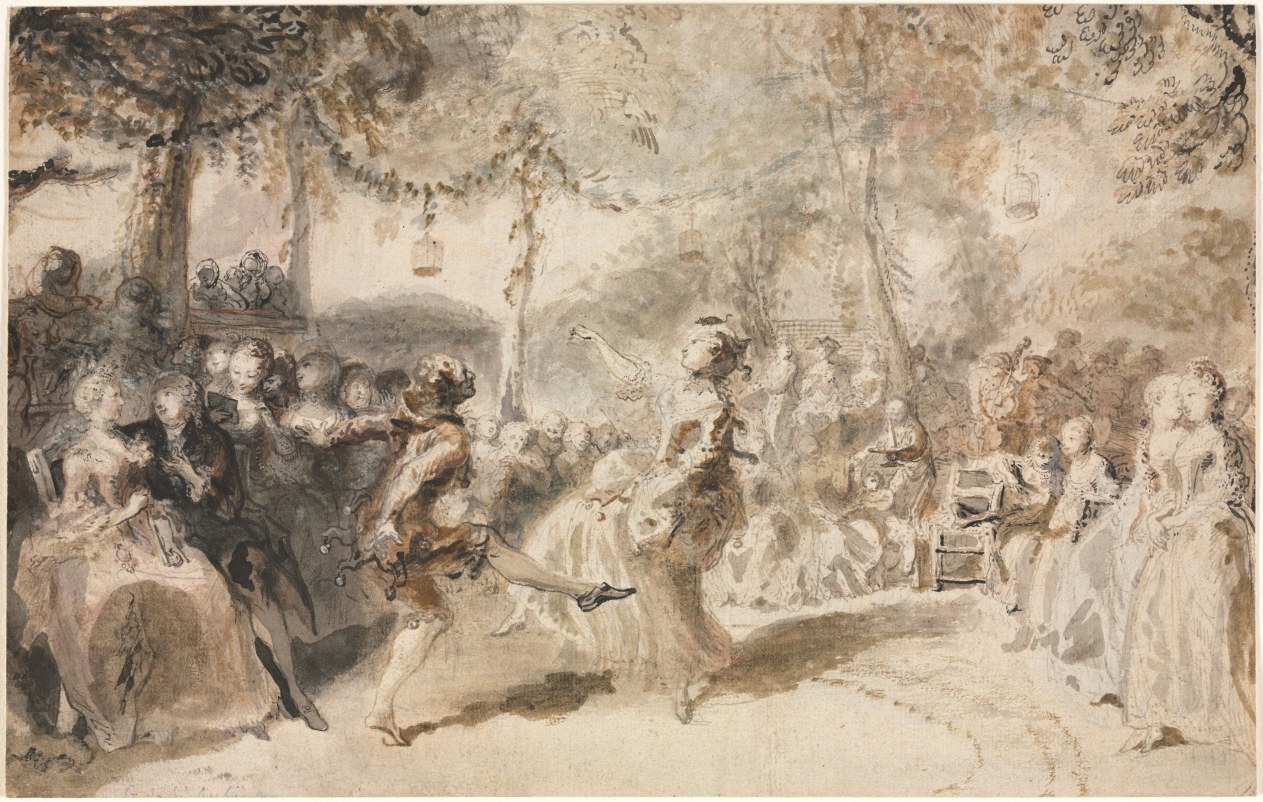
Costumed Dancers Performing in a Garden Tavern
Gabriel de Saint-Aubin (French, 1724–1780)
- Medium:
- brush and brown and gray wash, with gouache, watercolor, and traces of graphite
- Collection:
- Drawings
- Source:
- Cleveland Museum of Art
- Rights:
- Public domain — free to use, share and adapt.
- Recorded as:
- CC0
The image captures a now-vanished genre of outdoor theatrical entertainment and reveals the sharp distinction 18th-century culture maintained between social and theatrical dance. For historians, it documents the persistence of commedia dell'arte and pantomime traditions in French popular entertainment well into the Enlightenment. For dancers, it demonstrates how completely different the conventions of display were when performance, not participation, was the goal—a reminder that 'dance' in historical art can mean radically different things depending on context and audience.
What you are looking at
A crowded outdoor garden entertainment in the 18th century, likely a guinguette or pleasure garden tavern. The composition is divided between spectators on the left and dancers at center-right, with a small orchestra visible on the far right. The entire scene is framed by tall trees with hanging lanterns and floral swags strung between them, creating an intimate nocturnal garden atmosphere. Two prominent dancers occupy the center ground: one figure in a jester-like costume with bells leaps into the air with exaggerated lifted legs, while a companion in similar dress performs nearby. The crowd—elegantly dressed women in light silks and men in fashionable coats—clusters on tiered seating and stands, watching intently. The light is soft and warm, rendered in washes of brown and gray, with the pale ground and costumes luminous against deeper shadow. The sketch technique captures rapid movement and social animation: figures are loosely rendered, overlapping, some barely indicated, creating a sense of lively disorder and spontaneous entertainment.
The dancing
The two principal dancers display highly theatrical, exaggerated movement quite unlike social dancing of the period. The figure on the left has both legs raised sharply and symmetrically, the body lifted vertically in a pose that suggests acrobatic or comic pantomime rather than ballroom propriety. The companion dancer is in a similarly elevated position with pronounced lifted legs. Neither performer shows the closed holds, restrained frames, or controlled weight distribution expected of 18th-century social dance partners. The costumes—irregular-hemmed jackets decorated with round bells—reinforce the theatrical, carnivalesque character. The assembled figures around them are mostly stationary observers, in profile or three-quarter view, underscoring the performers' display function.
The dance depicted
This depicts a theatrical or comic performance dance, not a social couple dance. The exaggerated, high-kicking postures, jester-like costumes with bells, and acrobatic quality point toward commedia dell'arte or pantomime-influenced entertainment. Such comic dances were performed at pleasure gardens and outdoor entertainments in France during the mid-18th century, often as part of mixed theatrical programs. The setting—a guinguette with orchestra, audience seating, and decorated trees—confirms this as a public entertainment rather than a social dance lesson or ball. The artist emphasizes the performers' display of virtuosity and humor through extreme bodily extension and costume exaggeration, capturing a moment of performative spectacle rather than participatory social dancing.
How it was made
The work is executed in brush and brown and gray wash with gouache, watercolor, and graphite—a mixed-media sketch technique characteristic of rapid, on-the-spot or studio notation of theatrical scenes. This combination allowed the artist to work quickly, layering transparent washes for atmospheric effect while using darker strokes for definition and detail. The technique produces a soft, luminous quality particularly in the foliage and costumes, while maintaining crisp accents in the performers' outlines and gestures. Such sketches served as records of performances, studies for larger compositions, or finished works for collectors of theatrical imagery. The medium's immediacy and spontaneity suit the subject: the loose handling conveys movement and social animation without photographic finish.
About this work
This is a sketch of a comic theatrical performance in an 18th-century French pleasure garden, capturing a moment of spectacular, acrobatic entertainment. The work documents not a ballroom social dance but a staged comic display—the kind of mixed entertainment that drew crowds to guinguettes and outdoor taverns in the decades before the French Revolution. The exaggerated lifted legs, jester costumes, and animated audience reveal contemporary attitudes toward different registers of dance: the socially acceptable restrained movements of the ballroom sharply contrasted with the uninhibited, virtuosic display of theatrical performers. This is social history as much as dance history: a record of how and where people entertained themselves, and what kinds of bodily display were permitted in different contexts.
How to look at it
Attend first to the contrast in the bodies: the spectators are seated or standing still, their bodies vertical and contained, while the performers leap and extend with uninhibited vigor. This visual contrast—stillness versus explosive movement—is the composition's organizing principle. Notice too how the artist uses wash and shadow to suggest the evening garden atmosphere and to create depth: the dark trees frame and enclose the scene, the hanging lanterns punctuate the foliage, and the pale ground recedes. Look at the barely-indicated faces in the crowd: Saint-Aubin suggests presence and attention through minimal means—a few lines for a profile, a suggestion of a hat—which makes the high definition of the central dancers' costumes and gestures even more emphatic. The irregularity of the sketch technique itself—the loose washes, the varying density of line—conveys the spontaneity and social informality of the scene.
The artist
Gabriel de Saint-Aubin (1724–1780) was a French draughtsman, painter, and engraver best known for his rapid, witty sketches of Parisian social and theatrical life. He worked in a deliberately loose, sketch-like style—a conscious choice that distinguished his work from the formal finish of academic art. Saint-Aubin was prolific, producing drawings and prints documenting everything from salon exhibitions to street scenes to theatrical performances. His sketches were highly valued by collectors for their immediacy and social observation; they functioned as a form of visual journalism, capturing the texture of Parisian life across class and venue. He was also an accomplished engraver and printmaker, skills that informed his linear, notational approach to drawing.
The period
In the 1750s, when this work was made, the pleasure garden or guinguette was a thriving institution in the outskirts of Paris and other French cities. These venues offered music, dancing, food, and theatrical entertainment to a broad middle-class audience seeking recreation outside the city proper. Simultaneously, the theatrical world was energized by new forms of comic entertainment influenced by commedia dell'arte and pantomime traditions, which remained popular despite academic dismissals. In the realm of fine art, there was growing interest in scenes of contemporary life and social amusement—a shift away from exclusively historical or mythological subjects. Saint-Aubin's sketches of such scenes were both documents of this cultural moment and reflections of it: they record the vitality and heterogeneity of public entertainment while celebrating the sketch itself as a legitimate artistic medium.
Where it lives
The work is held in a drawings collection and comes from a single institutional source (cma, likely the Cleveland Museum of Art). It is catalogued as a finished sketch or study, typical of the way 18th-century European drawing collections preserve such works.
Dance in this work
Questions about this work
Is this the same as the social dancing shown in other 18th-century art?
No. Social dancing of the period—minuets, contredanses, quadrilles—was restrained, with controlled weight, closed holds, and small contained movements. What is shown here is theatrical performance dance, designed for spectacle and comic effect. The exaggerated lifted legs would have been shocking in a ballroom and impossible within the protocols of social dance.
What are the bells on their costumes?
The bells (grelots) are associated with the jester or fool tradition in commedia dell'arte and medieval costume. They signal that the performers are playing comic or foolish characters, not themselves. The irregular-hemmed jackets reinforce this: they are costume, not everyday dress.
Where were guinguettes?
Guinguettes were outdoor taverns and pleasure gardens located in the countryside just outside major cities, especially Paris. They became popular in the 18th century as affordable entertainment venues for the middle classes, offering food, drink, music, and theatrical performances in a semi-rural setting. Many were located in villages along the Marne or Seine rivers.
Why did Saint-Aubin sketch theatrical scenes?
Saint-Aubin was interested in documenting contemporary Parisian life across all social levels and venues. His sketches served multiple purposes: they were saleable finished works for collectors, studies for prints, records of performances, and a form of visual journalism. The rapid sketch style suited both his temperament and the lively subject matter.
More dance artwork





