49 works in this view — arrow keys or swipe to move between them.
Dance in Art
Grotesque Dancers Performing
Unknown artist
- Medium:
- gum tempera, ink, and gold on paper
- Collection:
- Indian and Southeast Asian Art
- Source:
- Cleveland Museum of Art
- Rights:
- Public domain — free to use, share and adapt.
- Recorded as:
- CC0
This image is rare evidence of how pre-modern courts documented and displayed non-classical dance and unfamiliar bodies, and the ideological work such display accomplished. For historians of South Asian dance, it preserves a record of performer types and ritual specialists whose own traditions left few written traces. It also demonstrates how the Mughal court used visual representation to consolidate its cosmopolitan authority—a politics of inclusion that was also a politics of spectacle and subordination.
What you are looking at
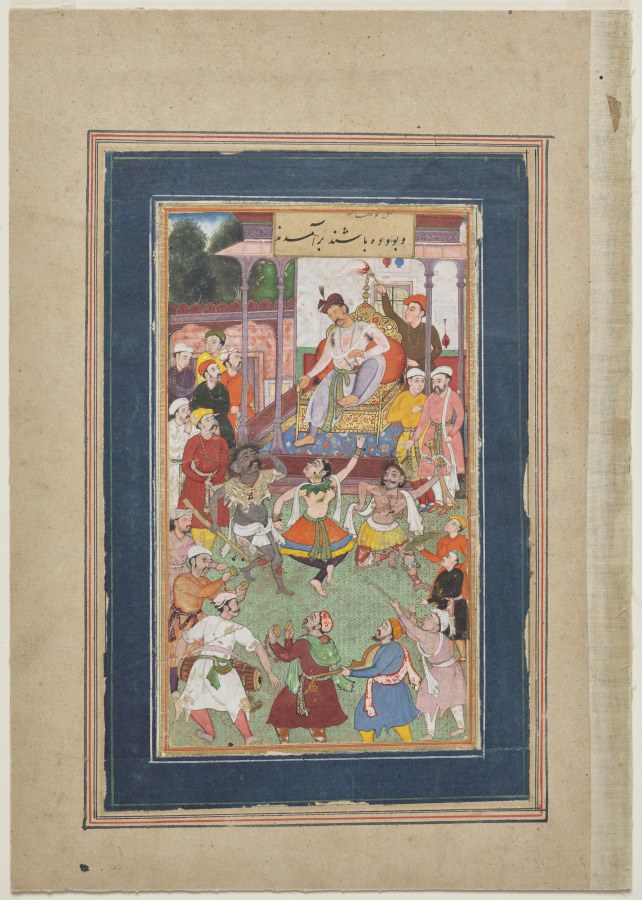
A densely populated court scene unfolds across a verdant ground plane, with a palace or pavilion structure rising behind. A figure of apparent rank sits elevated within, attended by courtiers. Below, a heterogeneous assembly gathers—musicians occupy the foreground with instruments, while in the central and right portions of the composition, performers execute their art. The painting employs the characteristic Mughal palette: rich jewel tones in dress (reds, blues, yellows, golds), set against the pale paper ground and framed by dark blue borders with gilded rules. Gold leaf enriches details throughout. The style of architecture, dress, and figural rendering aligns with sixteenth-century Mughal manuscript painting.
The dancing
The central dancers move with exaggerated, distorted postures that deviate markedly from courtly or classical restraint. One figure wears a tiger skin and displays an unusual morphology—dark skin, animal ears, and pronounced facial features suggesting a non-human or liminal being. Another dancer, described as female, sports a collar of leaves. A male figure to the right bears horns and bells, carrying what appears to be a bone-headed club or ritual object. Their stances are splayed and unbalanced, bodies twisted into positions that suggest ecstatic, uncontrolled movement rather than trained technique. The grouping is asymmetrical; figures overlap and interact at varying spatial depths, some in profile, some frontally presented.
The dance depicted
This depicts court entertainment at the Mughal court, likely from the reign of Akbar, known for his deliberate inclusion of performers from across his empire and beyond. The 'grotesque' dancers are probably not comic turns but rather depictions of tribal peoples, shamanic or ritual specialists, or mythological forest spirits—categories of otherness that fascinated the Mughal court. The exaggerated, untrained quality of movement and the animal attributes and costumes suggest these are not practitioners of classical dance technique but rather representatives of unfamiliar traditions. The orchestra below indicates this is a formal court performance, yet the dancers themselves are positioned as exotic or marginal figures. Whether actual tribal performers or imaginative constructions, they represent an early Mughal engagement with performative difference and the visual documentation of unfamiliar bodies and movement practices.
How it was made
Gum tempera, ink, and gold on paper, characteristic of Mughal manuscript illumination. This was not a painting made for an easel or wall, but a folio page from an album or illustrated manuscript—likely a bound or loose-leaf format intended for intimate viewing by the court and its attendants. The technique allowed fine detail, brilliant color, and the strategic deployment of gold leaf to direct attention and confer value. The careful composition within rectangular borders, the division of space into foreground (musicians) and background (performance and patronage), and the use of flattened perspective are all consistent with Persian and Mughal pictorial conventions. The work was made for a literate, elite audience with access to the imperial atelier.
About this work
This is a documentary record of courtly entertainment during the Mughal period, preserved as a manuscript illumination. It captures a moment when the expanding Mughal empire deliberately sought out and displayed cultural difference: performers from beyond the Indic and Persian mainstream were brought to court, their movement, costume, and embodied alterity rendered for imperial viewing and collection. The painting does not attempt to beautify or elevate these figures; instead, it renders their exoticism with frank attention to their animal attributes, darkened skin, and unconventional postures. In doing so, it inadvertently documents both the performative and the political work of difference in the sixteenth-century Mughal court—difference displayed, controlled, and aestheticized for elite consumption.
How to look at it
Attend first to the lower register: the musicians and their instruments establish the frame. Then trace upward to the performers themselves, noting their distorted and asymmetrical postures, and the specific costumes and animal attributes that mark them as other. Observe how the artist uses overlapping and spatial compression to convey crowding and liveliness. The elevation of the figure on the platform above indicates hierarchy of viewing and witnessing—this performance exists for the imperial gaze. Notice the strategic use of gold leaf to catch light and direct attention to key figures. The painter has chosen a moment of active movement, with bodies in mid-gesture and mid-dance, capturing dynamism rather than stillness.
The period
This work dates to the reign of the Mughal emperor Akbar (r. 1556–1605), a period of aggressive cultural synthesis and imperial expansion. Akbar's court deliberately cultivated diversity: he patronized Sanskrit poets alongside Persian scholars, commissioned translations, and famously welcomed religious and cultural practitioners from across Asia. Courtly painting flourished during this era, with the imperial atelier developing a distinctly Mughal style that merged Persian compositional conventions with Indian figural traditions and subject matter. Dance at the Mughal court encompassed both classical courtly forms (including Persian and Indian traditions) and entertainment by traveling performers, ascetics, and those positioned outside normative society. This painting sits within a broader sixteenth-century interest in the documentation of the exotic and the unfamiliar—what scholars have termed the 'curiosity' culture of early modern courts across Eurasia.
Where it lives
Held in the Indian and Southeast Asian Art collection at the Cleveland Museum of Art. This is a folio from an unidentified manuscript, likely an album of court scenes or a illustrated narrative work created within the Mughal imperial atelier or a closely affiliated workshop.
Dance in this work
Questions about this work
Are these dancers enslaved or coerced performers?
The historical record is unclear, but Akbar's court was known to employ performers from diverse backgrounds, some of whom held status and were highly valued. Others may have been acquired through conquest or trade. The image itself does not provide evidence of explicit coercion, but it does mark these figures as subordinate to the royal viewer. The painting documents what was displayed, not the conditions of performance or the agency of the performers themselves.
What do the animal features signify?
The horns, elephant ears, and tiger skin most likely mark these figures as representing forest spirits, shamanic practitioners, or tribal peoples—categories that occupied a liminal space between human and non-human in Mughal and earlier South Asian cosmology. They may also reference the yakṣas and other supernatural beings of Sanskrit literature, familiar to the court's educated viewers. The features mark them as culturally and cosmologically distinct, not merely as entertainers.
What kind of dance is this?
This is not a classical or trained dance form recognizable in surviving South Asian or Persian dance traditions. It appears to represent either actual tribal or shamanic performance practices, or Mughal imaginative reconstructions of such practices. The splayed stances, twisted postures, and unbalanced weight suggest ecstatic or ritual movement rather than codified technique. The painting documents a moment when the Mughal court was interested in collecting and displaying performative otherness.
Why is this painting called 'Grotesque Dancers'?
The title reflects a European scholarly framework applied retrospectively to the work. 'Grotesque' refers to the distorted, exaggerated, and non-naturalistic rendering of the bodies and faces—a departure from both Mughal courtly portraiture and idealized figuration. However, the term carries a dismissive connotation that may not reflect how the Mughal court itself understood these performers. A less loaded title might be 'Court Entertainment with Exotic Performers' or simply 'Palace Scene with Dancers.'
More dance artwork





