49 works in this view — arrow keys or swipe to move between them.
Dance in Art
Spring Dancers (Manzai)
Miyagawa Chōshun (Japanese, 1683–1753)
- Medium:
- hanging scroll; ink and color on paper
- Collection:
- Japanese Art
- Source:
- Cleveland Museum of Art
- Rights:
- Public domain — free to use, share and adapt.
- Recorded as:
- CC0
Manzai dancers were working artists whose performances are otherwise barely documented in visual sources. This painting is direct evidence of how they moved, what they wore, and the two-person configuration of their art. For anyone studying Japanese vernacular dance, seasonal festival culture, or the relationship between painting and performance in the Edo period, this scroll is primary source material.
What you are looking at
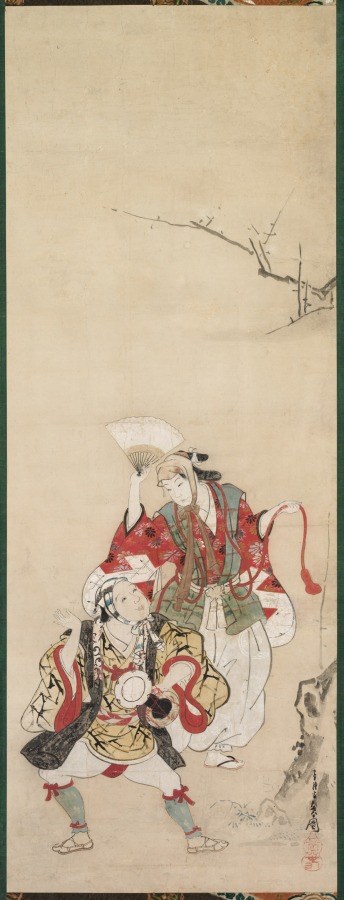
Two figures in festive attire occupy the lower half of a vertical composition, set against a cream-colored ground. The figure on the left wears a red patterned garment with white panels and holds an open fan aloft in their right hand; their posture is dynamic and forward-leaning, weight shifted onto bent legs. The figure on the right, also in red and white costume with decorative elements, gestures expressively with raised arms. Both wear what appear to be bells or ornamental attachments at the ankles. A bare, upright branch or small tree limb extends from the upper right of the composition into the upper third of the scroll, its spare geometry contrasting with the densely patterned costumes below. The palette is restrained—reds, whites, blacks, and flesh tones—with careful use of wash to suggest volume and movement in the drapery.
The dancing
Both figures are captured mid-action, with pronounced flexion in the legs suggesting active weight shifts rather than static poses. The left figure's raised fan and forward tilt suggest an opening gesture or flourish; the right figure's upraised arms indicate celebratory or emphatic movement. Neither figure maintains a balletic frame or closed partner hold. The poses are asymmetrical and lively, with attention to the torsion of the torso and the expressiveness of the limbs. The costume details—particularly the ankle ornaments—suggest percussion or rhythmic accompaniment is integral to the movement.
The dance depicted
Manzai, the dance form depicted here, was a form of street entertainment and seasonal celebration in Edo-period Japan, performed by wandering comic dancers often working in pairs. The two-figure composition, the festive dress, and the dynamic asymmetrical poses are consistent with documented descriptions of manzai as a lively, comedic performance that combined dance, acrobatics, and satirical gesture. The spring setting (indicated by the catalogue reference and the bare branch) places this within the context of New Year and early-spring celebrations, when manzai dancers performed to bring good fortune. The specific movements shown—the fan work, the raised arms, the bent-knee stance—suggest a performance style that was improvisatory, partner-responsive, and rooted in popular rather than court tradition. This is not classical dance but vernacular celebration.
How it was made
This is a hanging scroll painted in ink and color on paper in the Japanese tradition. The technique allows for a vertical, contemplative format that emphasizes the figures' relationship to negative space and to the natural element (the branch) above. The delicate washes and controlled brushwork characteristic of Edo-period painting are evident in the modeling of the garments and the careful gradation of tone. The use of color is selective—the reds are opaque and assertive, while flesh tones and whites are rendered in thinner wash—suggesting a hierarchy of visual emphasis. As a hanging scroll, this work would have been displayed in a domestic or semi-public setting and seen by viewers standing before it, inviting sustained looking at the details of costume and gesture.
About this work
This is a record of a living popular tradition captured in the refined medium of brush and ink. Miyagawa Chōshun, a painter known for genre scenes and courtly subjects, has documented a moment of street entertainment—the manzai dancers who performed for seasonal good fortune in early modern Japan. The work sits at the intersection of high and low culture: it is painted with the technical sophistication of the literati tradition, yet it depicts the exuberant, comedic performance of ordinary people. The composition privileges gesture and costume over narrative or setting, asking the viewer to recognize and appreciate the specific character of manzai movement.
The scroll is valuable precisely because it treats vernacular dance as worthy of artistic attention. Unlike many paintings of the period that record aristocratic entertainments or classical forms, this work documents a transient, improvisatory practice that left little other record. The two figures, caught in a moment of energetic performance, preserve something of the vitality and social function of spring celebrations in the early modern Japanese calendar.
How to look at it
The scroll asks you to register the specific physical character of manzai movement. Look at the legs: both dancers are in a deep flexion, weight forward, suggesting quick weight shifts and the lightness needed for the acrobatic tricks that were part of the form. The fan in the left figure's hand is not decorative but functional—it is being used to gesture, to punctuate, to frame the body. The bent elbows and raised arms of both figures convey energy and expressiveness. The costume details—the patterning, the bells—are not incidental; they would have produced sound and movement as the dancers performed. The bare branch above is not merely a seasonal marker but a compositional anchor that directs attention downward to the figures and their gesture.
The artist
Miyagawa Chōshun (1683–1753) was a Japanese painter active during the height of the Edo period, known for his depictions of courtesans, beauties, and genre scenes. He worked in the ukiyo-e (pictures of the floating world) tradition and was also accomplished in hanging scroll painting. His practice bridged two registers: he created both woodblock prints for popular consumption and more refined paintings on paper and silk for elite patrons. His attention to costume detail, human gesture, and the texture of silk and metal reflects his engagement with both high and popular culture. His willingness to paint manzai dancers alongside more conventional subjects suggests an interest in the full range of Edo society.
The period
In the early 18th century, when this scroll was painted, manzai dancing was a well-established form of seasonal street performance in Japan, associated particularly with New Year and spring celebrations. The Edo period saw an explosion of genre painting documenting urban and popular entertainments, reflecting both the growth of cities and the development of a visual culture that found aesthetic value in everyday life. At the same time, spring remained a season charged with cosmological significance in the Japanese calendar, a moment for renewal and the propitiation of good fortune. Painting such moments was one way the literati and merchant classes engaged with and documented the culture of the streets and seasons.
Where it lives
The work is held in the Japanese Art collection at the Cleveland Museum of Art and is catalogued as a hanging scroll. It represents the type of genre painting created for domestic display in the homes of educated merchants and minor nobility during the Edo period.
Dance in this work
Questions about this work
What were manzai dancers?
Manzai were wandering comic performers in Japan, often working in pairs or small groups. They performed at celebrations, particularly during New Year and spring festivals, combining dance, acrobatics, satirical gesture, and comedy to entertain crowds and celebrate seasonal transitions. The form was vernacular and improvisatory, rooted in popular rather than court culture, and performers were often of low social status but culturally significant in marking important moments in the community calendar.
Why is this painting significant?
Manzai performance is poorly documented in surviving sources, making visual records like this scroll rare evidence of how the dancers actually moved and dressed. The work shows that even an elite artist of Chōshun's caliber found this street entertainment worthy of the refined medium of hanging scroll painting. It is primary source material for anyone studying Japanese vernacular dance, festival culture, and the intersection of high art and popular entertainment in the Edo period.
What do the costumes tell us?
The layered, patterned garments in red and white were typical of festive dress in early modern Japan. The bells or ornamental attachments visible at the ankles suggest that sound—produced by the dancers' movement—was an integral part of the performance. The costume was not merely decorative but functionally connected to the dance itself, producing visual and auditory effects as the performers moved.
More dance artwork





