49 works in this view — arrow keys or swipe to move between them.
Dance in Art
Dancers and Musicians from Phrygia
Unknown artist
- Medium:
- schist
- Collection:
- Indian and Southeast Asian Art
- Source:
- Cleveland Museum of Art
- Rights:
- Public domain — free to use, share and adapt.
- Recorded as:
- CC0
This is one of the few surviving sculptural records of ancient dance movement, and the only clear documentation of Phrygian ritual dance known to survive. For dance historians, it provides evidence that the raised-arm, forward-leaning posture associated with ecstatic religious experience in the ancient Mediterranean was a real, codified movement practice—not a modern invention or a literary exaggeration. The coordination of music and dance visible here also demonstrates the integral relationship between these arts in ritual performance.
What you are looking at
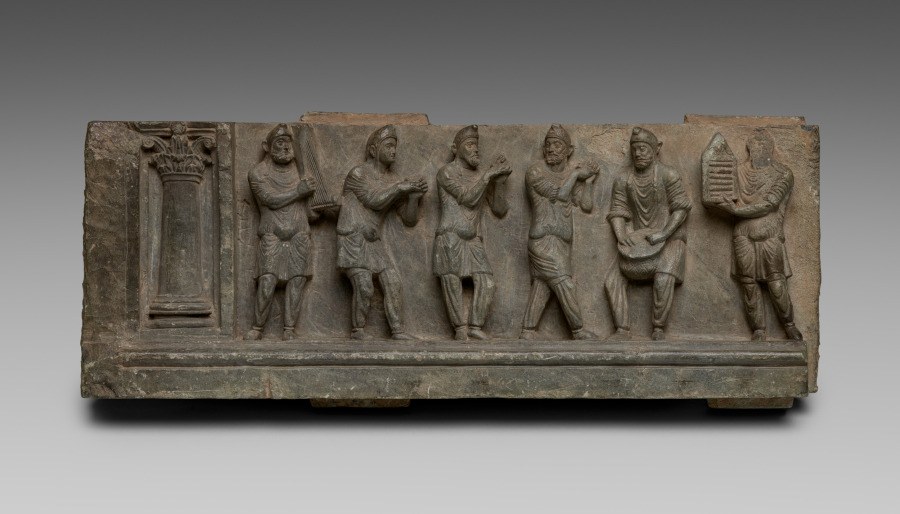
This schist relief carving presents a processional scene of six figures arranged in a frieze across the panel, accompanied by architectural framing. At the far left stands a fluted column or pilaster, establishing the formal setting. The five figures to its right are dressed in distinctive Phrygian costume: baggy, loose-fitting tunics paired with fitted trousers tied or gathered at the ankles, and each wears a characteristic peaked or pointed cap. Three of the central figures are shown in dancing postures, with arms raised and bent, bodies angled in dynamic poses suggesting movement. To their right, a musician plays what appears to be a stringed lyre-like instrument, held at chest height with arms raised to play. An adjacent figure beats a drum held between his legs in a vertical position. The rightmost figure raises an object—possibly a torch, staff, or ritual object—that remains unidentified. The relief is carved in low to medium relief, with careful attention to the parallel folds of drapery and the musculature of the legs and torso. The stone surface shows weathering consistent with ancient Roman or Hellenistic work.
The dancing
The three dancing figures display what appears to be a coordinated or processional movement rather than paired dancing. Each raises both arms upward and outward in a similar frame, with elbows bent at roughly 90 degrees, creating a gesture suggestive of joy, celebration, or invocation. The torsos lean forward slightly in some figures, indicating weight shift or the start of stepping movement. The legs are rendered in profile or three-quarter view, showing the full length of the baggy trousers; the stance suggests the dancers maintain an upright, grounded posture rather than a lifted or springing gait. The musician and percussionist are positioned within the same frieze but are clearly differentiated from the dancers by their fixed stance and focus on their instruments. The overall composition suggests a procession or ritual procession in which music and dance occur together.
The dance depicted
The dance depicted here is almost certainly a sacred or ceremonial dance associated with ancient Phrygian culture, likely connected to the worship of Cybele or other Anatolian deities whose cult practices involved music, dance, and procession. The raised-arm gesture and the forward-leaning posture are consistent with ecstatic or devotional dance traditions documented in Phrygian and broader Anatolian religious practice. The frieze format—musicians and dancers together in a processional line—suggests this represents a public ritual or festival event. The specific movements are consistent with global-middle-eastern and sacred-ceremonial traditions, though the exact style cannot be named with certainty. The presence of both stringed and percussion instruments indicates the music was integral to the choreography, not incidental accompaniment.
How it was made
This is a schist relief carved in low to medium relief, a durable stone well-suited to architectural revetment and long-term preservation. The technique allowed the sculptor to render fine detail in the folds of drapery and the contours of the body while maintaining legibility at a distance. The presence of tenons above and below the panel indicates this was one of a series of decorative plaques fitted into a larger architectural structure—most likely a stair riser or dado course—using dry masonry or a light adhesive. This placement suggests the work was intended for public viewing within a civic or religious building, and the survival of the stone over two millennia confirms the durability of the medium and the skill of execution.
About this work
This ancient relief carving documents a Phrygian ritual dance and its musical accompaniment, frozen in the moment of performance. The work is a primary source for understanding the movement vocabulary and social context of ecstatic or devotional dance in pre-Christian Anatolia and the eastern Mediterranean. It demonstrates that professional or skilled dancers existed in antiquity and that their movements were considered worthy of monumental commemoration alongside the figures of musicians and priests. The work sits at the intersection of archaeology, art history, and dance history, offering concrete visual evidence of a dance tradition that left no written notation and few other surviving images.
How to look at it
Observe the consistent arm position across the three dancing figures—the raised, bent-elbow frame repeats across the frieze, suggesting this is a prescribed or learned movement, not spontaneous gesture. Note how the forward lean of the torso is echoed in all three dancers, indicating synchronized weight shift. Look at the drummer and the lyre player: their stillness and focused posture contrast sharply with the dancers' raised arms and dynamic lean, emphasizing that music-making and dancing were distinct but coordinated roles. The architectural framing (the column at left) grounds the scene in a civic or religious building, suggesting this was a formal, sanctioned performance rather than informal social dancing.
The period
This work dates to the Roman Imperial period or possibly the Hellenistic era, when Phrygian cultural identity was preserved and displayed in monumental art despite the region's incorporation into larger empires. The worship of Cybele and associated ecstatic dance practices were well documented by Greek and Roman writers (notably Lucian of Samosata), and this relief provides visual corroboration of practices that had been performed for centuries in the region. In the context of Roman sculpture, the inclusion of such scenes in public or domestic architecture reflects Roman interest in and respect for the religious and cultural traditions of conquered territories, and a broader fashion for depicting exotic or foreign peoples and practices.
Where it lives
The work is held in the Indian and Southeast Asian Art collection of the Cleveland Museum of Art, catalogued as a Roman or Hellenistic period object from Anatolia. The inclusion in an Asian art collection may reflect the work's geographic origin in what is now Turkey, or an older accession practice that grouped Anatolian and Asian works together.
Dance in this work
Questions about this work
What was Phrygian dance like?
This relief is one of the few surviving images of it. Phrygian ritual dancers raised both arms with bent elbows and leaned the torso forward in a gesture associated with ecstatic religious experience, particularly in the worship of Cybele. The movement appears coordinated and repeated, suggesting a learned choreography performed by skilled practitioners rather than spontaneous individual expression. The dancers performed in procession alongside musicians, indicating music was integral to the ritual.
Is this a real dance or a sculptor's invention?
Almost certainly a real dance. Ancient writers including Lucian of Samosata describe Phrygian ecstatic dances in the cult of Cybele in detail, and their accounts match the postures shown here. The relief's placement in a public or religious building suggests it documented an actual practice, not a fantasy. The repetition of the raised-arm pose across three figures also implies a learned, codified movement rather than individual improvisation.
Who were these dancers?
They were likely priests, priestesses, or cult specialists dedicated to the worship of Cybele or another Anatolian deity. In Phrygian and broader Anatolian religious practice, ecstatic dance was a sacred performance, not a social or entertainment form. The prominence given to their image on a public monument suggests they held ritual authority within their community. The baggy costume and peaked cap marked them as ethnically Phrygian and visually distinguished them as ritual specialists.
Why are the musicians shown separately?
The musician and percussionist occupy the same frieze as the dancers but maintain a distinct, focused posture directed at their instruments. This suggests that in Phrygian ritual performance, music and dance were understood as related but separate roles. The musician plays a stringed lyre while the percussionist beats a drum held vertically—two different instrumental families supporting the same ritual event.
More dance artwork





