49 works in this view — arrow keys or swipe to move between them.
Dance in Art
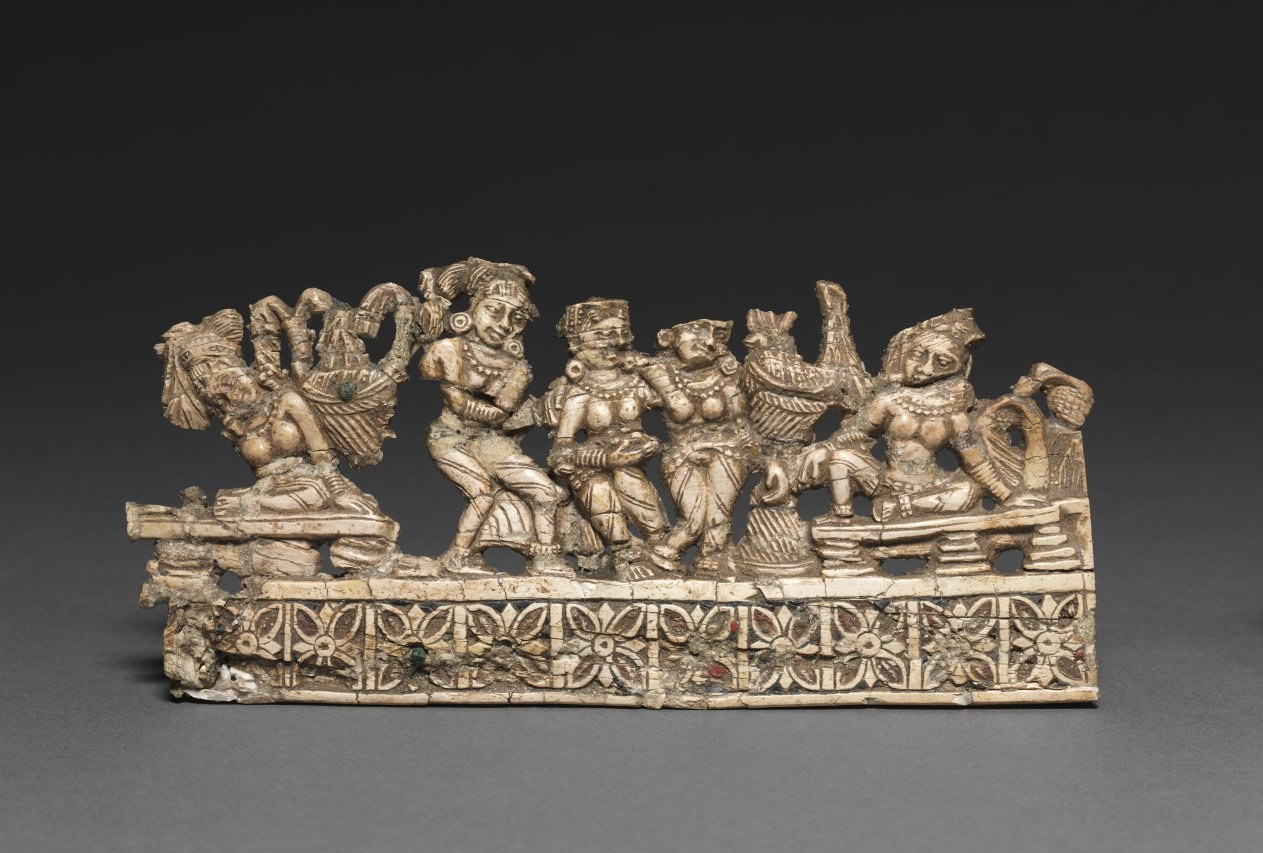
Ladies Entertained by Dancers
Unknown artist
- Medium:
- ivory
- Collection:
- Indian and Southeast Asian Art
- Source:
- Cleveland Museum of Art
- Rights:
- Public domain — free to use, share and adapt.
- Recorded as:
- CC0
For dance historians, this piece provides rare visual evidence of how entertainment dancing was organized and valued in ancient South Asian courts, including the presence of professional performers and the aesthetic conventions used to depict them. For art historians and traders, it demonstrates the cosmopolitan luxury market of the Silk Road and the technical mastery of Indian craftspeople whose work was traded across continents.
What you are looking at
This ivory relief carving presents a processional scene of entertainment and courtly life, likely depicting musicians and dancers in service to a royal or aristocratic patron. Six figures occupy a shallow stage defined by an ornamental base with repeating floral motifs. At left, a musician plays a wind instrument while seated or kneeling. To his right, a standing figure in elaborately pleated garments holds what may be a musical instrument or ceremonial object. The central group shows three figures in close interaction—two appear to be engaged in dance or intimate gesture while a third observes or participates. At right, another musician or servant sits with similar formal posture. All figures wear intricately carved clothing with deep pleats, beaded ornaments, and jewelry suggesting wealth and status. The carving exploits the ivory's cream tone against deep shadow in the recessed areas, creating strong visual rhythm across the frieze. The figures are arranged not in a unified line but in overlapping clusters that suggest movement and conversation rather than formal procession.
The dancing
The bodies are rendered with attention to three-dimensional form despite the shallow relief: torsos curve, heads turn in different directions, and limbs project into space. The central pair show close physical proximity and curved spinal posture that could suggest dance movement, though the relief's shallow depth prevents reading precise footwork or weight transfer. The standing figures maintain formal upright frames with arms bent and held close to the body, typical of courtly bearing in South Asian art. The seated musicians have engaged, attentive postures. The carving style emphasizes ornamentation—elaborate jewelry, textile patterns, and headdresses—over anatomical accuracy, which is consistent with decorative arts meant to display wealth and craftsmanship rather than document actual movement.
The dance depicted
This carving most likely depicts entertainment in a royal or elite South Asian court, possibly from the Kushan or Satavahana period based on the Begram context. The scene appears to show musicians and dancers in a domestic or courtly setting rather than religious or ceremonial dance. The close physical proximity of the central figures and their curved posture suggest intimate social dance or possibly erotic entertainment, which was a documented feature of elite household entertainment in ancient India. However, the shallow relief and ornamental intention of the piece mean it prioritizes costume, status, and narrative scene over the specific vocabulary of any identifiable dance form. The carving tells us that professional musicians and dancers were valued performers in wealthy households and traveled or were maintained as part of a patron's retinue.
How it was made
This is a carved ivory relief, likely a decorative facing for wooden furniture (such as a box, chair, or table leg) rather than a standalone artwork. The technique requires removing background material to create figures that project only slightly into space—a shallow relief that demands careful compositional planning and skilled use of the chisel. Ivory's fine grain allows intricate detail work visible in the textile patterns, jewelry, and facial features. The piece was probably created in an urban workshop in northwest India (the Begram deposit suggests trade connections spanning the Silk Road). As applied decoration for furniture, the carving would have been seen in close range and good indoor light, allowing viewers to admire the fine detail. The fact that only the ivory facing survives—the wooden core has disintegrated—is typical of decorative arts from this period and region.
About this work
This ivory relief is a fragment of decorated furniture created in South Asia during the period of Silk Road trade (likely 1st–2nd century CE) for wealthy patrons or for export to foreign markets. It depicts a scene of courtly entertainment: musicians and dancers in elaborately pleated and jeweled dress arranged in an ornamental composition. The carving exemplifies the luxury goods that circulated along trade routes from Rome to China, where similar pieces were discovered at the Begram archaeological site in Afghanistan alongside Chinese lacquer and Roman glass. The work documents both the sophistication of South Asian decorative arts and the existence of professional dancers and musicians as valued members of elite households. Its survival as ivory veneer—separated from its wooden backing—is a reminder of the fragility of ancient furniture and the way carved ornament can outlast its structural purpose.
How to look at it
Examine the carved relief from close range to appreciate the fine surface detail: the parallel pleats in the garments, the incised jewelry, the delicate facial features. Notice how the shallow relief uses shadow strategically—deep recesses under the pleats and between figures create visual separation and suggest spatial depth. Look at the central pair: their curved posture and proximity to each other reads as a moment of intimate interaction, though the ornamental style prevents identifying a specific dance form. The base frieze of repeating floral motifs frames and grounds the scene, emphasizing that this is decorative work meant to embellish a functional object. The arrangement of figures—clustered rather than symmetrical—suggests the artist prioritized narrative liveliness over formal balance.
The period
This carving was created during the height of trade on the Silk Road, when Roman, Chinese, Indian, and Central Asian merchants and craftspeople exchanged goods across vast distances. South Asian ivory carving was highly prized in foreign markets; Indian workshops produced decorated furniture, boxes, and vessels for export alongside domestic commissions. In India itself, the period saw the flourishing of courtly culture under dynasties such as the Satavahanas and the Kushans, who maintained elaborate households with musicians, dancers, and other entertainers. The entertainment depicted here—secular, courtly, and professional—reflects the sophisticated aesthetic life of urban elites. Begram, where this piece was found alongside other luxury goods, was a major trade hub in Afghanistan, and the deposit there suggests either a merchant's warehouse or a wealthy household that collected imported luxuries.
Where it lives
This fragment is held in the Indian and Southeast Asian Art collection at the Cleveland Museum of Art. It is documented as having been found at Begram in Afghanistan, a major archaeological site yielding a deposit of luxury goods from the 1st–2nd century CE, suggesting it was either a merchant's collection or part of a wealthy household's furnishings.
Dance in this work
Questions about this work
How do we know this shows dancers rather than just courtly figures?
The curved spinal posture of the central figures, their close physical proximity, and the presence of musicians strongly suggest entertainment or dance activity rather than a formal gathering. However, the shallow relief and ornamental intention of the carving prevent us from reading specific dance steps or styles. The scene documents the context and value of dance in elite households rather than providing technical information about how it was performed.
What does Begram tell us about this object?
Begram was a major trading hub in Afghanistan on the Silk Road, and the deposit where this carving was found contained luxury goods from Rome, China, and India, suggesting active international trade in the 1st–2nd century CE. The presence of Indian ivory-faced furniture alongside Chinese lacquer and Roman glass shows that wealthy consumers across the ancient world valued these South Asian decorative arts, and that professional workshops in India produced work specifically for export.
Why is only the ivory surviving and not the wood underneath?
This carving was applied as a veneer or facing to wooden furniture—a box, chair, or table leg. Over centuries, the wood underneath decayed and was lost, leaving only the ivory facing. This is a common fate for ancient furniture, which is why carved ornament from this period often survives as isolated fragments. The ivory's durability and the fact that it was the valuable, visible layer meant it had a better chance of preservation.
Can we identify what kind of dance this shows?
No specific dance form can be identified from the carving. The ornamental style and shallow relief prioritize costume, status, and narrative scene over the technical details of movement that would allow precise identification. We can infer that this depicts secular, professional entertainment in a courtly setting, likely involving music and intimate social interaction, but not the particular steps, formations, or regional style of any named dance tradition.
More dance artwork





