49 works in this view — arrow keys or swipe to move between them.
Dance in Art
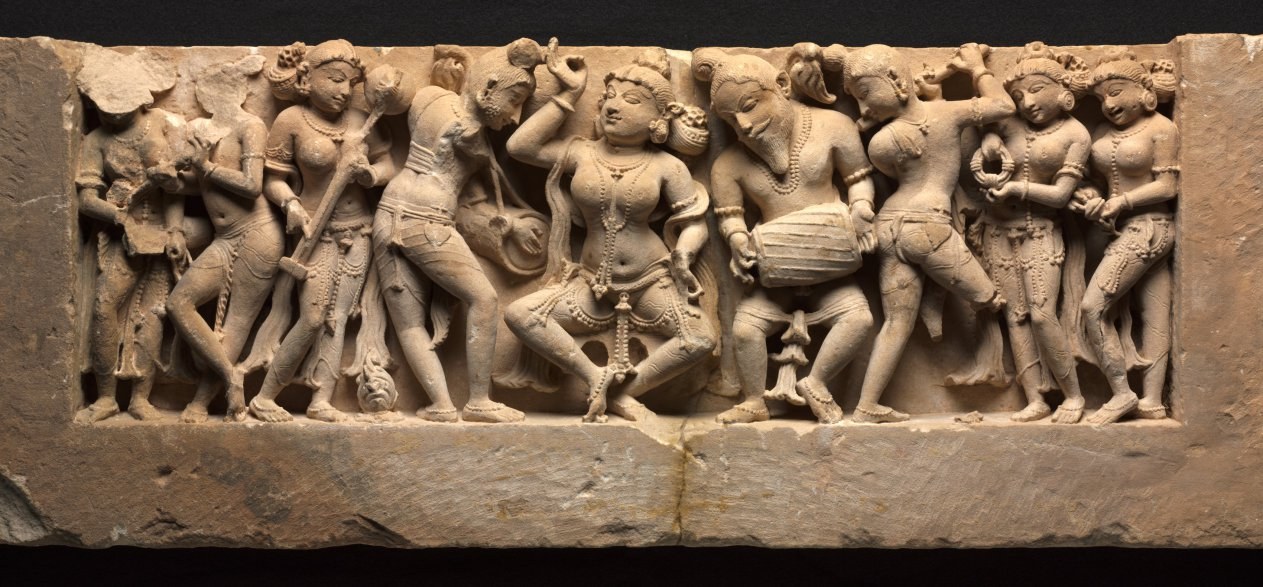
Frieze with Dancer and Musicians
Unknown artist
- Medium:
- sandstone
- Collection:
- Indian and Southeast Asian Art
- Source:
- Cleveland Museum of Art
- Rights:
- Public domain — free to use, share and adapt.
- Recorded as:
- CC0
This carving provides rare visual documentation of actual dance practice in 10th-century India, showing how dancers used their bodies in a devotional context. It is contemporaneous evidence of the integration of music, dance, and sculpture as complementary forms of worship, demonstrating that the classical Indian dance traditions were built on a living, embodied practice already centuries old by the medieval period.
What you are looking at
A horizontal stone frieze carved in high relief depicts a lively scene of music and dance in what appears to be a temple or sacred context. The composition is densely populated with figures arranged in a continuous narrative across the width of the stone. At the far left, a woman plays cymbals with her mouth open as if singing. To her right, musicians play various instruments—drums, stringed instruments—their bodies twisted and turning in animated poses. Center stage, a dancer strikes a dynamic pose, legs bent and torso arched, arms raised in a gesturing position that conveys both control and expressiveness. The dancer wears ornamental jewelry and a draped lower garment; other figures are similarly adorned with necklaces and bracelets. The background is minimally carved, allowing the figures to project dramatically forward. The shallow depth and crowded composition are characteristic of medieval Indian temple sculpture, where narrative clarity and divine significance take precedence over naturalistic spatial recession.
The dancing
The central dancer displays a pronounced contrapposto stance with weight shifted and knees bent, the torso angled and arms positioned to suggest fluid, continuous movement rather than a static pose. The musician figures around the dancer display varied arm positions and body angles—some leaning, some twisting—suggesting they are responding dynamically to the music and dance. All figures are carved in high relief, creating sharp shadows and emphasizing the three-dimensionality of their gestures. The dancers and musicians show no closed partner holds; instead, each figure appears to occupy its own spatial zone while participating in a shared performance.
The dance depicted
This frieze depicts a scene of devotional temple music and dance—a common subject in medieval Indian sacred architecture. The specific dance style cannot be securely identified from the image alone, as the carving style emphasizes narrative and symbolic content over technical precision in footwork or specific mudra sequences. However, the context (a sandstone temple frieze dated 968) and the loose, celebratory body language suggest this represents courtly or temple celebration rather than the codified classical traditions. The arrangement of dancers and musicians together indicates that music and dance were understood as integrated practices offered to the divinity, as the existing description notes. The poses suggest a tradition in which dancers moved with flexibility and expressive arm gestures while musicians provided accompaniment.
How it was made
Carved sandstone in high relief, typical of medieval Indian temple sculpture (9th–10th century). The technique involved subtractive carving from a single stone block, allowing the sculptor to create strong three-dimensional forms and dramatic chiaroscuro through shadow. High relief carves away background stone, making the figures project boldly and allowing them to be read from a distance and at an angle. This technique was labor-intensive and permanent, suitable for architectural decoration of temples and public structures where the work would be viewed by many devotees over centuries. The carved figures would have been visible in changing daylight, with shadows shifting across the relief throughout the day.
About this work
This sandstone frieze from a 10th-century Indian temple is a primary document of devotional music and dance practice in the medieval period. It shows dancers and musicians in animated, expressive poses arranged in a continuous narrative scene, their bodies rendered in high relief against minimal background. The work demonstrates that music and dance were understood as integrated sacred practices offered to the deity and as attractions for devotees alongside the sculpture and architecture of the temple itself. The loose, gestural quality of the bodies and the variety of poses suggest a dance tradition that valued expressiveness and flexibility over rigid codification. For dance historians and practitioners, the frieze is valuable evidence of how Indian bodies moved in sacred performance before the classical traditions were systematized in texts like the Naṭyaśāstra.
How to look at it
Notice the variety of body positions and the way the artist has carved each figure turning or bending differently, so that no two poses repeat across the frieze. The central dancer's arched torso and raised arms are the focal point; trace how the musician figures around the dancer reference and respond to that central action. Pay attention to how the shallow background and high relief force all figures into a shallow plane—they do not recede into depth but project forward, as if the dance and music are happening right at the surface of the stone, close to the viewer. The jewelry and ornaments are carved with as much care as the bodies, indicating their importance to the performance costume.
The period
The frieze dates to the 10th century, a period of flourishing temple construction and sculptural patronage across India, particularly under the Gurjara-Pratihara and Chola dynasties. Medieval Indian temples were monumental artworks that integrated architecture, sculpture, and performance: music and dance were commissioned as regular offerings to the deity, just as statuary and carved reliefs were. The classical Indian dance traditions—Bharatanatyam, Kathak, and others—were not yet formally codified in their later, strictly regulated forms; instead, temple dancers (devadasis) and court performers executed dances that were more fluid and variable than later classical practice. The Naṭyaśāstra, the foundational Sanskrit text on dramaturgy and dance, had been composed centuries earlier (possibly 2nd century CE), but its prescriptions were still being absorbed and interpreted in regional and local practice. Sculpture of this period often shows dance and music as pleasurable offerings to the divine, reflecting the integration of aesthetics and devotion in Hindu temple practice.
Where it lives
The work is part of the Indian and Southeast Asian Art collection at the Cleveland Museum of Art (CMA). It is catalogued as a stone architectural frieze and represents the type of devotional sculpture produced for temples during the medieval period in India.
Dance in this work
Questions about this work
What dance tradition is this showing?
The frieze does not depict a named classical dance style in the later sense. Instead, it shows devotional music and dance as practiced in 10th-century Indian temples—expressive, flexible, and integrated with music. The codified classical traditions of later centuries (Bharatanatyam, Kathak, etc.) were still developing during this period. The sculpture is evidence of the living dance practice that would eventually be formalized into those traditions.
Why are there so many figures?
The dense composition reflects the importance of music and dance as continuous, communal offerings to the deity. Medieval Indian temples often commissioned musicians and dancers to perform regularly, so the frieze may depict an actual temple practice: a full ensemble of dancers and musicians performing together as a form of worship. The crowded, lively arrangement conveys the abundance and celebration of the offering.
Can you identify specific dance moves?
The poses show expressive arm gestures, flexible torsos, and varied weight shifts, but the carving style does not preserve the kind of precise footwork detail that would allow identification of specific mudras or technical steps. The artist was interested in conveying the energy and variety of the performance rather than documenting technique. This is consistent with medieval Indian sculpture, which prioritized narrative and symbolic meaning over anatomical precision.
What does the jewelry tell us?
The necklaces, bracelets, and ornaments visible on the dancers and musicians were part of the performance costume and marked these figures as performers of high status engaged in a sacred function. The careful carving of the jewelry indicates its ritual and aesthetic importance to the dance and music practice.
More dance artwork





