49 works in this view — arrow keys or swipe to move between them.
Dance in Art
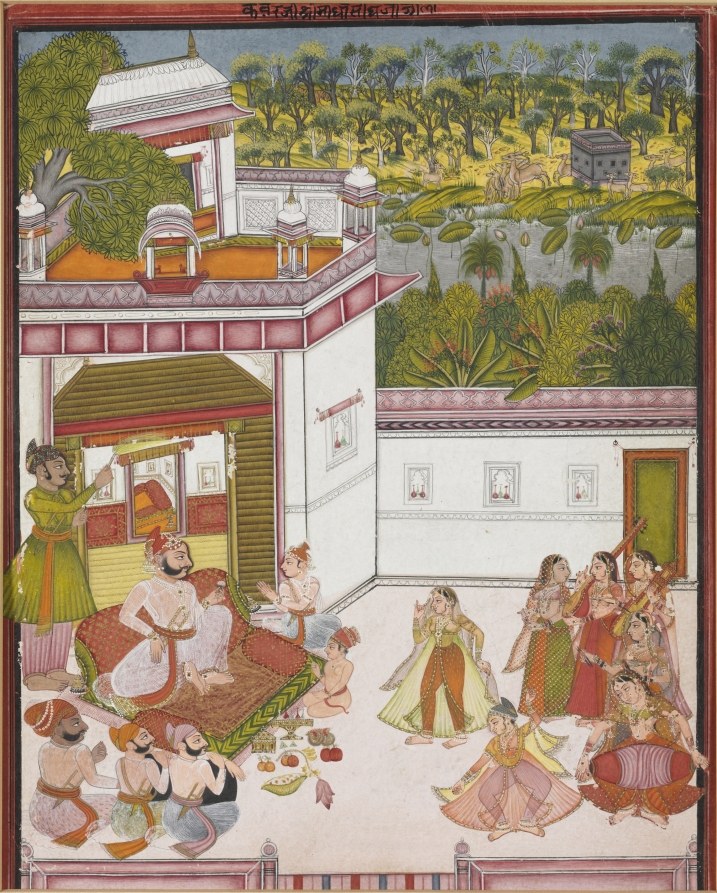
Maharaja of Kotah Listening to Music and Watching Dancers
Unknown artist
- Medium:
- Gum tempera, ink, and gold on paper
- Collection:
- Indian and Southeast Asian Art
- Source:
- Cleveland Museum of Art
- Rights:
- Public domain — free to use, share and adapt.
- Recorded as:
- CC0
This work is crucial for understanding how dance functioned in South Asian princely courts and how artists of the period visualized performance and courtship. It shows that even as European spatial conventions began to influence Indian court painters, the fundamental approach to depicting dance remained bound to hierarchy, formal ceremony, and the visual pleasure of costume and jewels rather than to the articulation of movement itself. The painting also documents the specific moment in Indian art when Mughal aesthetic traditions were being adapted and localized in the courts of Rajasthani princes.
What you are looking at
A Mughal-era palace courtyard scene, viewed as a cutaway architectural drawing that reveals both interior and exterior space simultaneously. In the foreground on a terrace, a maharaja reclines on cushions while attending a dance performance and banquet. He is attended by several courtiers and servants; women in bright silks and jewels stand in formation, some with hands raised in gestures of greeting or blessing, others in poses of formal attendance. The immediate ground is scattered with offerings of fruit and food. To the left, a palatial pavilion with a domed roof and red-and-white striped awning opens onto the terrace. The right side shows an open courtyard bordered by a crenellated wall, beyond which the landscape unfolds: a river populated with crocodiles and other wildlife, dense forests filled with deer and boar, and distant hills. The palette is rich in ochre, pink, gold, and green, with careful attention to the rendering of architectural detail—marble columns, niches, carved railings—typical of Mughal residential design. The composition employs a flattened perspective that treats foreground activity and distant landscape with equal clarity, a technique that blends Indian painting conventions with emerging European spatial representation.
The dancing
The female performers stand in a loose group in the courtyard, their bodies oriented toward the maharaja. Their postures suggest formal presentation rather than active movement: several have one arm raised or extended, palms open, in a gesture that may indicate namaskar (respectful greeting) or a pose of reverence. They wear fitted cholis (blouses), draped dupatas (scarves), and voluminous skirts in jewel tones—reds, greens, golds—along with heavy jewelry. The grouping is hierarchical and ordered rather than clustered; they do not appear to be executing synchronized steps but rather occupying a formal space of presentation. The maharaja's reclining posture is that of an authority receiving tribute or entertainment rather than a participant.
The dance depicted
This appears to document a Mughal court entertainment, likely a formal dance or nautch performance presented for the maharaja's pleasure. The women's upright, posed stances and the formal arrangement suggest a style of court dance associated with the Mughal nobility—possibly an early form of what would later be codified as Kathak, though the costume and setting do not display the specific attributes of classical Kathak as it developed. The raised palms and formal deportment suggest a performance of respect and honor rather than virtuosic movement. The artist has chosen to depict the moment of presentation—the dancers stationary before or during the performance—rather than a moment of active footwork or complex gestural vocabulary. This is a record of the social and ceremonial function of dance in the princely court rather than an illustration of its technical content.
How it was made
This is a gum tempera, ink, and gold miniature on paper—a format central to Indian court painting and manuscript illumination, particularly in the 17th and 18th centuries. The medium allowed for fine linear detail and the application of gold leaf for emphasis and richness, making such works precious objects suited to royal collections. Tempera dries quickly and does not allow for broad blending or chiaroscuro, which reinforced the flat, linear aesthetic and jewel-like color saturation visible here. The small scale and portable format suggest this was part of a bound manuscript or album (a Mughal *muraqqa*), circulating within elite court circles rather than displayed publicly. The technique required preliminary ink drawing followed by careful pigment application and final gold details—a labor-intensive process reflecting the status of both artist and patron.
About this work
This is a Mughal-era miniature painting depicting a maharaja receiving a formal dance performance in his palace courtyard. The work combines a cutaway architectural view—showing interior pavilion, courtyard, and distant landscape simultaneously—with detailed observation of court dress, ceremony, and the arrangement of performers and patron. The painting dates from 1815, a period when Rajasthani courts, particularly Kotah (Kota), synthesized Mughal architectural and aesthetic traditions with emerging European spatial techniques, as evidenced by the convincing recession of the interior space. The dancers are shown not in moment of kinetic movement but in formal presentation, their poses and deportment suggesting the courtly entertainment function of dance in princely Indian culture.
The work belongs in a gallery of dance imagery because it documents both the social status of dance in Mughal and post-Mughal India and the visual conventions by which court artists represented performance. It shows dance not as an autonomous art form but as one element in a larger ceremonial and sensory experience—part of a program that included food, wine, landscape, and the presence of the ruler. The flattened perspective and simultaneous representation of multiple spatial zones create a kind of visual inventory of the courtly world that makes dance legible as a privileged activity within it.
How to look at it
Attend first to the architectural structure of the image: the cutaway perspective allows you to see both the intimate interior ceremony and the vast landscape beyond, suggesting that the ruler's power extends from the private domestic space outward into conquered or controlled territory. Notice how the artist has rendered the receding space of the interior chamber with careful attention to the placement of figures and the diminution of architectural elements—a technique learned from European painting. Within that space, observe the formal, ceremonial stillness of the dancers: their bodies are not mid-movement but posed, their gazes directed toward or away from the maharaja in patterns of deference. The raised palms, the careful arrangement, and the wealth of costume suggest that this is a moment of formal presentation, not of dancing as we might understand it from the perspective of later classical forms. The painting asks you to see dance as one element in a larger orchestration of power, beauty, and courtly ceremony.
The period
By 1815, the Mughal empire had declined, and regional princely states including Kotah had become semi-autonomous polities under British suzerainty. Kotah maintained a vigorous court culture that drew on Mughal precedent while incorporating new influences. The early 19th century saw Indian court painters experimenting with European representational techniques—particularly the illusion of receding space and atmospheric perspective—while maintaining the miniature format and tempera medium of their training. This hybrid aesthetic appears in this painting's careful rendering of the interior chamber and the convincing depth of the landscape beyond the wall.
In this period, court entertainment including music and dance remained central to princely power and prestige, though the social and economic structures supporting such performances were shifting under British colonial administration. The nautch—the generic term for such court performances—was increasingly documented in writing and art by British observers, though Indian courts continued their own visual recording practices. This painting represents the local perspective: dance is presented not as exotic entertainment for outside consumption but as a fundamental privilege and pleasure of rulership.
Where it lives
The work is held in the Indian and Southeast Asian Art collection at the Cleveland Museum of Art. It is a miniature painting on paper, likely part of a larger album or manuscript associated with the court of the Maharaja of Kotah. The Cleveland Museum acquired this work as part of its systematic collecting of Indian court art in the late 20th century.
Dance in this work
Questions about this work
What kind of dance is being performed?
The image does not show recognizable steps or techniques of a specific classical Indian dance form. The formal, stationary poses and the courtly setting suggest a courtly entertainment or nautch—a general term for dance performance in Mughal and princely courts. These performances combined elements of what would later become Kathak, but also drew on Persian court dance traditions and local Rajasthani practices. The painting records the social occasion rather than the specific vocabulary of movement.
Why are the dancers just standing still?
The artist has chosen to depict the moment of formal presentation rather than active movement. In a court entertainment, there would have been moments of static display alternating with periods of movement. The raised palms and formal arrangement suggest ritual greeting or blessing—gestures of deference to the ruler—rather than steps or turns. The painting is interested in hierarchy and ceremony more than in the choreographic content.
How does the painter show space in this image?
The painting uses a cutaway or architectural cross-section view, common in Indian court painting, that shows interior and exterior simultaneously. However, within the interior space, the artist has applied European perspective techniques: the receding walls and ceiling of the chamber create a convincing illusion of depth, and the placement of figures suggests recession into space. This hybrid approach—traditional Indian compositional structure combined with European spatial rendering—was characteristic of early 19th-century Rajasthani court painting.
What do the women's costumes tell us?
The women wear fitted blouses (cholis), draped scarves (dupatas), and full skirts in bright silks—reds, greens, golds—along with heavy jewelry. These were the dress of privileged women in the court, and the richness of costume signals their status within the ceremony. The clothing is not specific to a particular dance form but rather indicates that these are women of the court performing an entertainment for their ruler. The bright, jewel-like colors were made possible by the tempera medium and the application of gold, which rendered the women as precious objects.
More dance artwork





