49 works in this view — arrow keys or swipe to move between them.
Dance in Art
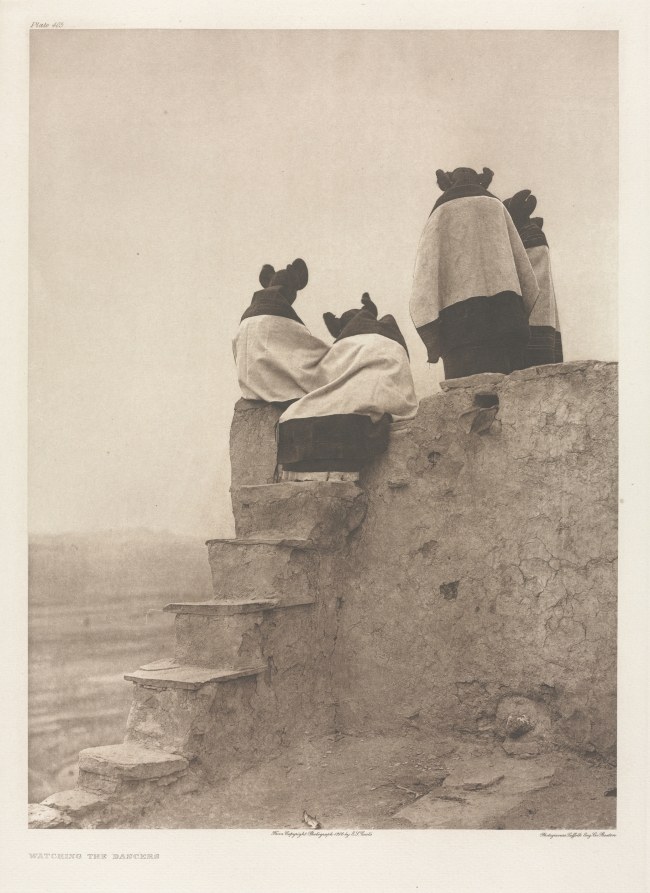
Portfolio XII, Plate 405: Watching the Dancers
Edward S. Curtis (American, 1868–1952)
- Medium:
- photogravure
- Collection:
- Photography
- Source:
- Cleveland Museum of Art
- Rights:
- Public domain — free to use, share and adapt.
- Recorded as:
- CC0
This work is crucial for understanding how Indigenous dance and ceremony were represented to American audiences in the early 20th century. Curtis's *North American Indian* project was widely circulated and became foundational to how non-Indigenous people imagined Native American cultural life; the decision to photograph *spectators* rather than *performers* reflects both the reality of ceremonial contexts and Curtis's own compositional priorities. For historians of Indigenous dance, the work documents not just movement but the social and spatial frameworks in which that movement occurred—and raises essential questions about who has the authority to photograph, frame, and interpret Indigenous performance.
What you are looking at
Three figures in light-colored wraps or blankets stand on the edge of a high stone structure, gazing out over a vast, misty landscape. The two figures on the left sit or crouch closer together, while a taller figure on the right stands more upright, all three with their heads turned to look toward the distant view. The stone platform beneath them is weathered and ancient, with rough-hewn blocks and visible steps descending on the left side. The atmosphere is contemplative and still—the figures are not moving but witnessing, their bodies oriented toward observation rather than performance. The background shows water or plains dissolving into atmospheric haze, suggesting height and distance. The photogravure technique renders the scene in soft, muted tones that emphasize the timeless quality of both the setting and the moment.
The dancing
The three figures wear light wraps that drape across their shoulders and bodies, leaving their heads and limbs partially exposed. Their postures are relaxed and informal—some appear to be sitting or crouching with weight distributed low, while the figure on the right maintains a more upright stance. There is no formal alignment or synchronized movement; instead, the bodies are arranged in a loose, natural grouping, all oriented toward the same viewpoint. The heads are turned in the direction of their gaze, necks extended slightly as though engaged in sustained looking rather than dancing.
The dance depicted
This image does not depict dance in the conventional sense. The title *Watching the Dancers* indicates that these figures are observers rather than performers—they are spectators positioned to view a dance or ceremonial event occurring outside the frame. The work captures a moment of attention and anticipation, the pause before or during a performance. The setting and the figures' wrapping suggest a Native American context, possibly Plains or Southwest peoples, and the high vantage point may indicate a location of ceremonial or cultural significance. Without seeing what is being watched, we cannot identify a specific dance tradition, but the framing suggests Curtis was documenting not just movement but the social and spatial structure of Indigenous ceremonial life.
How it was made
This is a photogravure, a photomechanical printing process that combines photography with intaglio printing. Photogravure allowed photographic images to be translated into fine detail while permitting multiple impressions, making it ideal for publication in portfolios. Curtis used this technique extensively for his *North American Indian* series, of which this plate is part. The soft tonality and rich blacks characteristic of photogravure suit the atmospheric, ethnographic intent of the work—the process renders the scene with documentary precision while lending it a fine-art quality that elevated the status of Indigenous subjects in early 20th-century galleries and collections.
About this work
Edward Curtis's *Watching the Dancers* is a photogravure from his monumental *North American Indian* project, a 20-volume documentation of Native American peoples published between 1907 and 1930. The image frames three figures wrapped in light textiles, positioned on a high stone structure overlooking a distant landscape. Rather than capturing active dancers, Curtis has composed a portrait of spectatorship—the moment of anticipation and collective attention that surrounds performance. The work is ethnographic in ambition but compositionally sophisticated, using the vantage point and atmospheric perspective to suggest both the geographical and cultural distance from which Curtis, as outsider-photographer, was observing Indigenous life.
This plate belongs to a larger visual and textual archive that shaped 20th-century understandings of Native American dance and ceremony. Curtis's photography, while invaluable as documentary evidence, was also shaped by artistic convention, romantic primitivism, and the photographer's own aesthetic choices. *Watching the Dancers* is characteristic of his approach: it presents Indigenous people engaged in culturally significant activity while maintaining a narrative distance that positions the viewer as another spectator, invited to share in the moment of observation.
How to look at it
Pay attention to the composition's use of height and distance: Curtis has positioned the camera to align the viewer's eye with the spectators' gaze, making us share their vantage point and their act of looking. The stone structure and the mist beyond create layers of separation—between observer and observed, between the viewer of the photograph and the subjects within it. Note how the figures' wrapped clothing and turned heads create a unified gesture of attention without overt movement or drama. The title becomes essential to interpretation: without it, one might read this simply as three people on a cliff; with it, the work becomes about the social and ceremonial dimensions of Indigenous performance—the preparation, anticipation, and community witness that surround any significant cultural act.
The artist
Edward Sherriff Curtis (1868–1952) was an American photographer who spent three decades documenting Native American peoples. Between 1907 and 1930, he published *The North American Indian*, a 20-volume work with over 2,000 photogravures, considered one of the most ambitious photography projects of its era. Curtis was trained as a studio photographer but became increasingly focused on ethnographic documentation, traveling extensively across the western United States and Canada. His work was both pioneering and problematic: while it provided valuable visual records of Indigenous cultures, communities, and practices, his images were also shaped by early 20th-century racial hierarchies, romantic idealization of Indigenous peoples, and artistic conventions that sometimes staged or arranged scenes for compositional effect. His influence on how Indigenous Americans were perceived in mainstream American culture was profound and lasting.
The period
Curtis's photography emerged during the height of American ethnographic collecting and the "vanishing race" narrative that dominated Progressive Era attitudes toward Native Americans. The early 20th century saw intense documentation efforts by anthropologists, photographers, and collectors who believed Indigenous cultures were disappearing and should be preserved on record. Simultaneously, Native American ceremonial practices were under pressure from U.S. government assimilation policies, including restrictions on certain ceremonies. In the world of art, photogravure was experiencing a renaissance as a fine-art medium through the Photo-Secession movement led by Alfred Stieglitz, which elevated photography to gallery status. Curtis's work sat at the intersection of these movements: ethnographic documentation presented through fine-art printing techniques, reaching audiences who encountered his images as both scientific record and aesthetic object.
Where it lives
This photogravure is Plate 405 from Portfolio XII of Edward Curtis's *The North American Indian*, a monumental 20-volume publication issued in limited edition between 1907 and 1930. The work is held in the Photography collection of the Cleveland Museum of Art, one of numerous institutions that acquired Curtis's portfolios for their research and exhibition value.
Dance in this work
Questions about this work
Why does the title say 'Watching the Dancers' when there are no dancers visible?
Curtis has framed the image to show spectators observing a ceremony or dance occurring outside the photograph's boundaries. This compositional choice emphasizes the social context of performance—the community, anticipation, and collective attention that surround Indigenous ceremonial life. It also reflects Curtis's documentary approach: rather than stage a performance for the camera, he captured the moment of witness.
Is this image staged or documentary?
Curtis's work exists in a complex space between these categories. While he was a trained studio photographer working from aesthetic principles, *The North American Indian* was framed as ethnographic documentation. Scholars have identified instances where Curtis arranged subjects or scenes for compositional effect. This particular image appears to capture a genuine moment of spectatorship, but the decision about where to position the camera, what to include, and how to frame the view was entirely Curtis's artistic choice.
What Indigenous people does this photograph show?
The catalogue record does not specify which Nation or tribe is depicted. The light wrappings, the architectural style of the stone structure, and the landscape suggest a southwestern or plains context, but without additional documentation this cannot be stated with certainty. Researchers consulting Curtis's original publications or archival records may find more specific information in the portfolio's accompanying text.
What is a photogravure and why did Curtis use it?
Photogravure is a photomechanical printing process that combines a photographic image with intaglio printing, allowing fine detail and tonal richness while producing multiple identical prints. Curtis used this technique for *The North American Indian* because it offered both documentary precision and fine-art quality, elevating ethnographic subjects to gallery status while enabling wide distribution through limited-edition portfolios sold to collectors and institutions.
More dance artwork





