49 works in this view — arrow keys or swipe to move between them.
Dance in Art
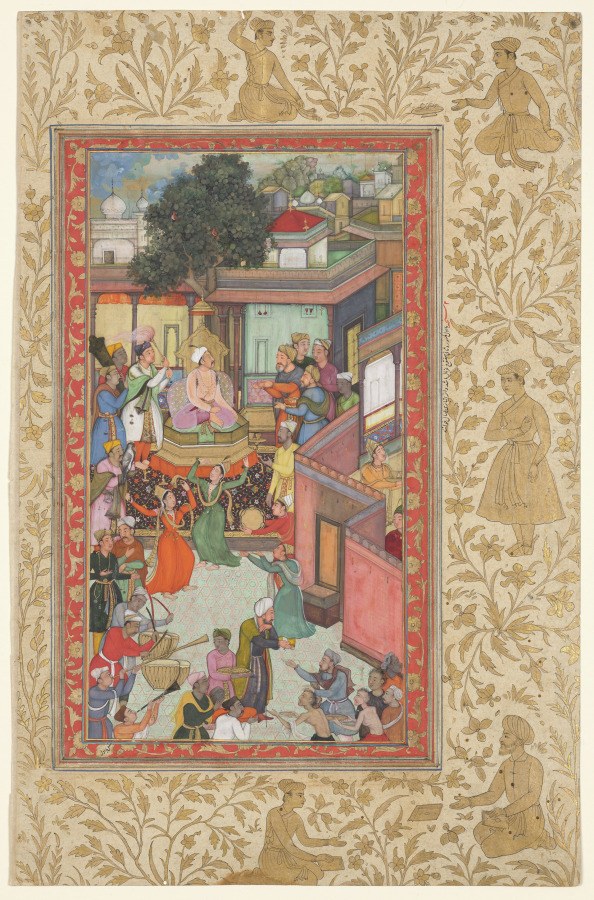
Circumcision ceremony for Akbar’s sons, painting 126 from an Akbar-nama (Book of Akbar) of Abu’l Fazl (Indian, 1551–1602)
Dharam Das (Indian, active c. 1580–1605)
- Medium:
- gum tempera, ink, and gold on paper
- Collection:
- Indian and Southeast Asian Art
- Source:
- Cleveland Museum of Art
- Rights:
- Public domain — free to use, share and adapt.
- Recorded as:
- CC0
This image is one of the few surviving visual records of 16th-century Mughal court dance, documenting both the performers and the context in which entertainment functioned within royal ceremony. For dancers and historians, it reveals how military costume, professional performance, and courtly spectacle intersected in early modern South Asia, and how an imperial celebration orchestrated the movement of hundreds of bodies as part of a display of power and munificence.
What you are looking at
A multi-story palace interior teeming with courtiers, servants, and musicians arranged across distinct architectural levels. The composition uses the characteristic Mughal manuscript technique of simultaneous perspective: we see multiple rooms and a courtyard with a large tree occupying the same pictorial space. In the central chamber, seated on a raised platform, Emperor Akbar receives the gathered assembly. Below and around him, hundreds of figures mill about in an atmosphere of festival celebration. The architectural setting features rendered in warm ochres, blues, and reds with gold accents—flat walls, arched doorways, and crenellated rooflines typical of Fatehpur Sikri. Three young princes being honored with the circumcision ceremony are visible on the elevated platform. The right side of the composition shows densely packed figures in the courtyard and lower chambers; the left side features more restrained groupings. The palette is dominated by earth tones, with vivid accents of crimson, deep blues, and gold leaf marking important figures and textiles.
The dancing
The figures are rendered in Mughal court style: small-headed, elongated bodies with characteristic poses showing profile heads and frontal torsos. Dancers visible in the lower left and center wear Turkish dress with fitted tunics and tall hats, standing or moving in loose, unstructured arrangements rather than rigid formations. Their arms hang naturally or gesture openly; no formal ballroom holds or closed partnerships are evident. The movement appears social and informal—bodies are upright but not rigidly aligned. Most figures are stationary witnesses; only the designated dancers show any implied motion, and even that is restrained and gestural rather than athletic.
The dance depicted
The dancers visible here are performing court entertainment during the royal circumcision festivities of 1573. They wear Chaghatai Turkish dress, suggesting they were professional performers or soldiers dancing in military costume—a common entertainment format at Mughal court. This appears to be a form of court dance or processional movement rather than a choreographed theatrical dance; the performers move among courtiers as part of a larger ceremony of wealth distribution (Akbar's weight in gold being given to the poor). The dance style is undocumented and likely represents a courtly entertainment genre specific to 16th-century Mughal practice, combining military display with festive movement. No classical Indian dance tradition (Kathak, Bharatanatyam) is evident in the dress or body carriage.
How it was made
This is tempera, ink, and gold on paper—characteristic of Mughal manuscript painting. The technique allows for the simultaneous depiction of multiple spatial planes and moments within one frame, a convention that freed the artist from European perspective rules and allowed narrative richness. The gold leaf, applied with precision to armor, jewelry, textiles, and architectural details, creates luminosity and signals imperial wealth and power. The tempera paint is applied in thin, translucent layers over ink underdrawing, visible in the fine detail of facial features and costume ornament. This technique was labor-intensive and produced works for elite court libraries, circulated only within the imperial household and presented as gifts to honored allies.
About this work
This page from the Akbar-nama (Book of Akbar), painted by Dharam Das around 1600, documents a royal circumcision celebration at the newly built palace of Fatehpur Sikri in 1573. The scene records not merely an event but the visual ideology of Mughal imperial power: the emperor as the center of a cosmos of servants, soldiers, and subjects, wealth flowing outward, and entertainment as a form of courtly magnificence. The dancers in Turkish dress performing among the crowds represent one of the few surviving visual records of court entertainment dance under Akbar—a figure known for his patronage of arts and his unusual religious tolerance. The work sits at the intersection of historical documentation, imperial propaganda, and aesthetic achievement; it is simultaneously a picture of a real event, a visualization of power, and a showcase for the refined technique of Mughal painters working at the height of the empire's cultural confidence.
How to look at it
Approach this work as a map of social hierarchy frozen in a moment of celebration. Note where Akbar sits in relation to the dancers and crowd—he is geographically centered and elevated, the still point around which all activity orbits. Look at the dancers' dress and their movement vocabulary: they are costumed performers, not courtiers, and their Turkish garments and upright carriage mark them as professionals. Follow the eye from the central drama of the circumcision platform down through the courtyard: this is not a dance scene where movement is the subject, but a ceremonial scene where dance is one element among many forms of courtly display. The rendering of the building's structure and the accumulation of small, precise figures should remind you that this is a document as much as a spectacle—the artist is recording the occasion with something close to ethnographic intent.
The artist
Dharam Das (active c. 1580–1605) was one of the principal painters of the imperial Mughal workshop under Emperor Akbar. He was part of a team of artists, many trained in Persian court painting traditions and then schooled in the emerging Mughal style that blended Persian, Central Asian, and Indian elements. Dharam Das was particularly skilled at architectural rendering and the depiction of large-scale court scenes; his work on the Akbar-nama is among the most ambitious narrative cycles of the period. The workshop was located in Agra and later at Fatehpur Sikri itself, giving Dharam Das direct knowledge of the palaces and ceremonies he depicted.
The period
The reign of Emperor Akbar (1556–1605) was a period of unprecedented cultural synthesis and imperial expansion in South Asia. Akbar's court attracted artists, musicians, poets, and scholars from across the Islamic world and from Hindu, Christian, and Jain traditions. Court entertainment under Akbar included Persian-style music and dance, Indian classical traditions, Turkish military displays, and newly synthesized forms. The circumcision of royal sons was a major state occasion, combining Islamic religious law with imperial spectacle and the redistribution of wealth—a key mechanism of Mughal statecraft. The creation of the Akbar-nama itself (a biographical and historical chronicle in words and images) was part of Akbar's project to establish his own legend and codify the visual language of imperial power. This manuscript was created in the last years of Akbar's life and completed shortly after his death, representing a retrospective celebration of his reign.
Where it lives
This page is from a copy of the Akbar-nama (Book of Akbar) held in the Indian and Southeast Asian Art collection. The Akbar-nama is one of the most significant historical and artistic documents of the Mughal empire; multiple copies were made for the imperial library and distributed as diplomatic gifts. This particular copy was completed not long before Akbar's death in 1605, making it a near-contemporary record of events depicted.
Dance in this work
Questions about this work
What were Chaghatai dancers and why are they performing here?
Chaghatai refers to Turkish-speaking peoples from Central Asia, and their dress signals both their cultural origin and their status as professional military-entertainers in the Mughal court. Turkish and Central Asian military dances and martial displays were prestige entertainments under Akbar, who had strong ties to Central Asian dynasties through his lineage. These performers would have combined elements of folk dance, martial display, and courtly sophistication.
Why does this painting show so many rooms and spaces at once?
This is a characteristic convention of Mughal manuscript painting called simultaneous perspective or continuous narrative. Instead of a single vanishing point, the artist shows multiple viewpoints on the same page, allowing the viewer to see the ceremony from above and inside at the same time. This technique suited narrative painting and allowed the artist to show as much of the event as possible within a single frame.
Who was Akbar and why is this painting important?
Akbar (1556–1605) was the third Mughal emperor and is widely regarded as one of the greatest rulers in Indian history. He expanded the empire, implemented religious tolerance unusual for the period, and was a major patron of the arts. This painting is important as a historical document of court life, as a masterpiece of Mughal manuscript painting, and as one of the few surviving images of 16th-century court dance.
Were there Indian classical dances performed at Akbar's court?
Very likely yes, though this particular image shows Turkish entertainers. Akbar's court included musicians and dancers trained in Indian classical traditions (Kathak emerged as a major court dance form during this period), as well as dancers from Persian, Turkish, and other traditions. The Akbar-nama depicts multiple kinds of courtly entertainment, though this circumcision scene emphasizes the Turkish performers.
More dance artwork





