49 works in this view — arrow keys or swipe to move between them.
Dance in Art
Figure of the Dancer (La Danseuse)
Vincennes Porcelain Factory (France, 1740–56)
- Medium:
- unglazed soft-paste porcelain (biscuit porcelain)
- Collection:
- Decorative Art and Design
- Source:
- Cleveland Museum of Art
- Rights:
- Public domain — free to use, share and adapt.
- Recorded as:
- CC0
For dancers and historians, this figure is evidence of how the eighteenth-century court understood feminine elegance and the female body in motion—not as an active, striving form, but as a composed, graceful presence. The porcelain medium itself tells us something about the status of dance in the rococo period: it was refined enough to merit representation in an expensive, luxury material intended for the homes of the wealthy. And the pose—poised between stillness and motion—reflects a fundamental value of galant-era dance, in which control, restraint, and the appearance of effortless grace were more prized than virtuosic display.
What you are looking at
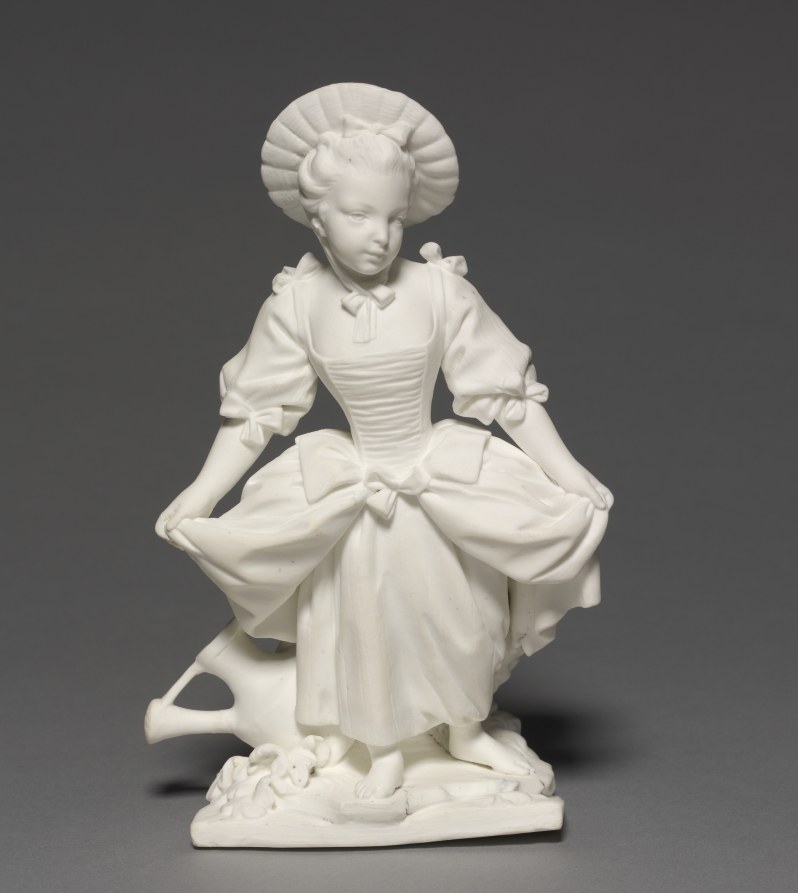
A young woman in eighteenth-century dress stands alone against a neutral grey ground, her body posed in a graceful contrapposto stance. She wears a pale cream-coloured gown with a fitted, horizontally ribbed bodice and voluminous three-quarter-length sleeves gathered at the elbow; the skirt is full and falls to mid-calf, held at the waist by a large bow. Her hair is styled in the fashion of the 1740s, swept back and crowned with an elaborate headdress composed of tall, scrolled forms that frame her face. She gazes downward with a serene expression. Her right arm is extended slightly forward, while her left arm draws the fabric of her skirt outward in a gesture suggesting either a curtsy or the moment before a dance movement. The pose conveys elegance and restraint rather than active motion; she appears to be caught between stillness and the initiation of movement. At her feet is a small rocky base, a conventional element in porcelain figurine sculpture.
The dancing
The figure is depicted in a single, composed pose with an upright torso and forward-facing orientation. Her weight appears evenly distributed, though the slight turn of her head downward and the extension of her arms suggest preparation for movement rather than its execution. The extended right arm and the drawing of her skirt fabric with the left hand create a frame that is both elegant and restrained—the pose reads as an introduction to dance rather than its climax. There is no partnering, no weight transfer visible in the legs, and no dynamic torsion in the spine that would indicate active steps or turns.
The dance depicted
The work most likely depicts a dancer of the court ballet or ballroom tradition of the 1740s, though the specific dance cannot be definitively identified from the pose alone. The costume—the fitted bodice and full skirt—is consistent with fashionable women's dress of the period and the sort worn by dancers in theatrical and social contexts. The pose itself resembles the preparation for a courtly dance movement, possibly a minuet or other galant-era courtly dance, given the refined deportment and the gesture of arranging the skirt. However, the artist has chosen a moment of almost balletic stillness rather than capturing the movement itself, which is characteristic of porcelain figurines intended to suggest refinement and grace rather than narrative action.
How it was made
This is an unglazed soft-paste porcelain figurine (biscuit porcelain), a technique in which the piece is fired once and left without the glossy glaze that would otherwise be applied. The matte, marble-like surface of biscuit porcelain creates a sculptural effect that mimics marble or stone, elevating the figure to the status of fine art sculpture rather than mere decorative tableware. The technique required considerable skill in modelling, as every detail of the costume and physiognomy is carved or impressed into the clay; the delicate folds of the skirt, the texture of the headdress, and the subtle modeling of the face all testify to fine hand-work. Biscuit porcelain was a luxury product associated with royal manufactures and the European courts, and its durability and whiteness made it ideal for figurines intended as display pieces in rooms of considerable refinement.
About this work
This is a porcelain figurine of a young woman posed as if about to dance, made at the Vincennes Porcelain Factory during the height of the rococo period. The Vincennes factory, established under royal patronage, pioneered the production of biscuit-porcelain figures in Europe, and this work exemplifies the aesthetic values of that moment: elegance, restraint, refinement of costume and deportment, and the suggestion of motion suspended in time. The figurine belongs to a tradition of courtly and theatrical imagery that was highly fashionable in the 1740s, when the minuet and other galant dances dominated social life among the European aristocracy. Such figures were made as collectible objects for the display cabinet, and they served as indices of taste, wealth, and cultural knowledge. The work is both a portrait of a moment in fashion and an artifact of a particular moment in the history of ceramics and the decorative arts.
How to look at it
Attend to the artist's choice of pose: rather than capturing the energy of a step or turn, the sculptor has frozen a moment of preparation, or the moment just after a movement has concluded. Notice the careful balance of the body, the slight extension of the arms, and the downward gaze—all of which suggest a kind of performative composure. The costume itself is as much the subject as the body: the elaborate headdress, the fitted bodice, and the full skirt are rendered with fine detail, and the way the fabric is gathered in the left hand suggests both the reality of silk and linen clothing and the conventional gestures of courtly dance. The rocky base, though modest, elevates the figure from decorative object to sculpture, inviting comparison with marble statuary. Look, too, at the surface of the porcelain itself—the matte finish catches light differently than glazed ceramic, emphasizing the sculptural qualities of form and line.
The artist
The Vincennes Porcelain Factory was established in France in 1740 under the patronage of King Louis XV and operated under royal privilege. The factory pioneered the development of soft-paste porcelain in Europe and became celebrated for the quality of its wares and figurines. The factory employed some of the finest modellers and sculptors of the period, many of whom were trained in the fine arts. In 1756, the factory relocated to Sèvres and continued under royal patronage as the Manufacture Royale de Sèvres. The figurines produced at Vincennes were part of a broader rococo aesthetic that prized elegance, refinement, and the depiction of courtly leisure and social life. The factory's work was highly influential across Europe, and biscuit-porcelain figurines became a fashionable collectible among the European nobility and wealthy bourgeoisie.
The period
The 1740s were a period of considerable elegance and refinement in European court dance, dominated by the minuet and other galant dances that emphasized grace, restraint, and the expression of courtly virtues. The rococo aesthetic in visual art—characterized by lightness, asymmetry, pastel colours, and references to courtly life and amorous themes—was at its height. The invention of soft-paste porcelain by French potters in the 1740s coincided with a new taste for small-scale, refined domestic objects meant for display rather than use. Figurines of dancers, shepherdesses, and courtly figures became fashionable collectibles, serving as visual references to a cultivated way of life and taste. The female figure in particular was a subject of intense visual interest in rococo art, and the depiction of women in fashionable dress, often in moments of leisure or gentle social intercourse, was a dominant theme in painting, sculpture, and the decorative arts.
Where it lives
The figurine is held in the Decorative Art and Design collection, indicating its classification as a work of applied or decorative art rather than fine art. The Vincennes Porcelain Factory produced such figurines as luxury collectibles for royal and noble patrons across Europe, and their survival in museum collections attests to their value and the care with which they were preserved.
Dance in this work
Questions about this work
Was this figurine meant to be a portrait of a real dancer?
Almost certainly not. Such figurines represented a type—the fashionable young woman, the dancer, the shepherdess—rather than specific individuals. They served as ideal images of elegance and refinement, meant to display the owner's taste and knowledge of courtly aesthetics. Any resemblance to a particular person would have been coincidental.
Why is it unglazed?
Biscuit porcelain was left unglazed deliberately. The matte, white surface mimics marble and elevates the object to the status of fine sculpture. The technique also allowed for finer detail in the modelling, since the absence of glaze did not obscure carved or impressed lines. Glazed porcelain would have been shinier and less sculptural in appearance.
What dance is being depicted?
The pose and costume are consistent with the galant dances of the 1740s, particularly the minuet, but the artist has not captured a recognizable step or movement. The figure seems to be posed in a moment of stillness or preparation rather than mid-motion, which is typical of porcelain figurines intended to suggest refinement and grace rather than narrative action.
Why would someone collect such a figurine?
Biscuit-porcelain figurines from Vincennes were expensive luxury objects meant for display in the homes of the wealthy. They served as indices of taste, knowledge of courtly culture, and access to goods from the royal manufactory. Collecting them was a mark of refinement and participation in fashionable society.
More dance artwork





