49 works in this view — arrow keys or swipe to move between them.
Dance in Art
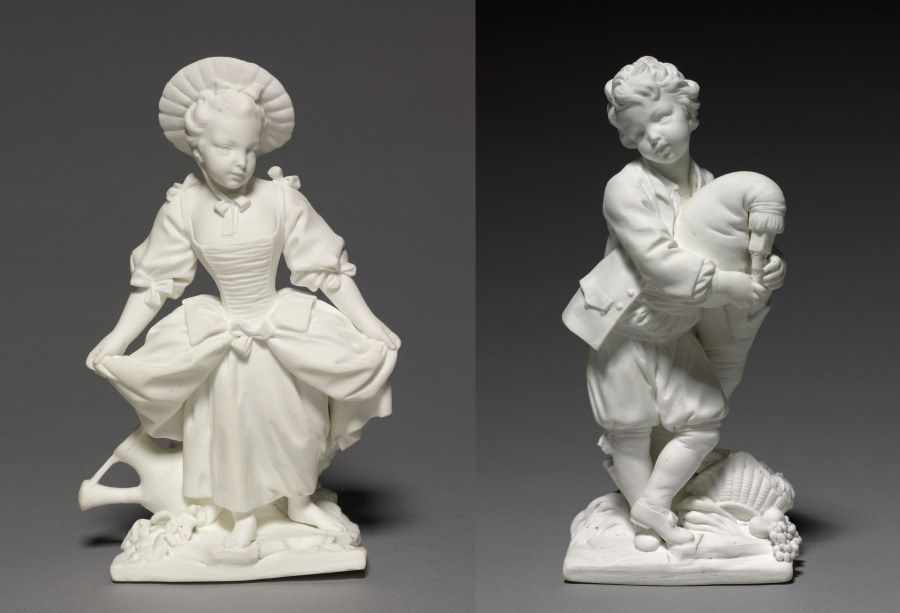
Figure Pair of the Dancer (La Danseuse) and the Bagpiper (Le Joueur de Musette)
Vincennes Porcelain Factory (France, 1740–56)
- Medium:
- unglazed soft-paste porcelain (biscuit porcelain)
- Collection:
- Decorative Art and Design
- Source:
- Cleveland Museum of Art
- Rights:
- Public domain — free to use, share and adapt.
- Recorded as:
- CC0
For dance historians, these figures mark a crucial moment when the court and aristocracy began to aestheticize and collect images of popular music and dance as objects of refinement rather than as practices to perform. The combination of the bagpipe (a rustic instrument) and the lifted skirt (a gestural hint at danced entertainment) shows how pastoral imagery encoded desire and fantasy for an urban elite. The biscuit porcelain format—expensive, fragile, collectible—tells us that by mid-century, rural dance and music had become a luxury commodity.
What you are looking at
Two unglazed white porcelain figures stand separately against a neutral ground, each on a low base. The left figure is a young woman in 18th-century dress, wearing a full skirt with deep pleats radiating from the waist, a fitted bodice, and full sleeves. Her hair is styled in an elaborate coiffure with wings of curled hair framing her face. She stands with her skirt lifted and gathered at the sides, revealing bare feet, in a pose of modest display. The right figure is a young man in simple breeches, vest, and shirt, bare-legged and barefoot, playing a bagpipe (musette). He stands in a relaxed, lively contrapposto with his weight on one leg, his torso turning toward the instrument. Both figures are rendered with fine detail in the smooth, pale biscuit porcelain that was the hallmark of Vincennes manufacture.
The dancing
The woman's body is upright and frontal, her arms holding the sides of her skirt in a modest lifting gesture; her pose is static, presentational rather than caught mid-movement. The musician adopts a more dynamic weight shift, with his hip dropped and his frame angled to accommodate the bagpipe. Both are rendered as individual figures rather than as a couple in direct contact or interaction. The barefoot stance of both—highly unusual for formal 18th-century dress in reality—signals the pastoral fantasy the designs evoke.
The dance depicted
These are not depictions of active dancing but rather of pastoral musical and courtly entertainment in an idealized rustic mode. The woman's pose, lifting her skirt, might reference a moment of coquettish display or the preliminary movement before a dance begins; the man is positioned as a musician-performer. The ensemble represents the *Enfants de Boucher* tradition in which the French aristocratic elite consumed imagery of virtuous rural simplicity. The bagpipe (musette) places the scene in a romanticized countryside and was associated with pastoral and rustic dances, though no specific dance form is enacted here.
How it was made
These are soft-paste porcelain figures in the biscuit (unglazed) state, fired to a matte white finish that mimics marble. Biscuit porcelain was labour-intensive and expensive, requiring skilled hand-modeling and multiple firings. This technique allowed for fine detail in facial features, fabric texture, and hair, and the matte finish enhanced the sculptural, marble-like appearance prized by collectors. The pair was produced at the Vincennes factory, which from 1740–1756 was the primary manufactory for porcelain in France and was celebrated for its ability to translate painted designs into three-dimensional form.
About this work
This pair of porcelain figures belongs to a suite of eight child musicians and dancers designed by François Boucher and manufactured at Vincennes in the mid-18th century. They represent the taste of the French court and aristocracy for pastoral imagery rendered in the most fashionable and costly material of the age. The figures are not meant to document actual peasant dance or music but to offer an elegant fantasy of rural virtue and simplicity, staged through the fashionable bodies of idealized youth. As objects, they are among the finest examples of soft-paste porcelain craftsmanship and represent both the technical achievement and the social meaning of Vincennes manufacture: the translation of court taste into portable, collectible sculpture.
How to look at it
Attend first to the contrast between the two figures: the woman is presented, passive, her body a display; the man is active, his body oriented toward his instrument and the labour of playing. Notice the barefoot stance, which is naturalistic for a peasant but idealized and exposed for an aristocratic viewer—the bare feet are a signature of Rococo pastoral fantasy. Look at how the lifted skirt reveals the woman's legs and creates a triangular silhouette that reads as both modest and flirtatious. The figures are not frozen in a single recognizable dance step but in a moment of readiness or display, which is characteristic of how Rococo court portraiture represented leisure and entertainment.
The artist
François Boucher (1703–70) was the principal painter to the French court under Louis XV and the supreme master of the Rococo style. He designed countless works for manufacture at Vincennes and Sèvres, translating his painted compositions into porcelain. Boucher's *Enfants de Boucher* designs were among his most celebrated and were reproduced repeatedly over decades, becoming a signature of Vincennes identity. Boucher's work was characterized by lush, idealized pastoral scenes populated by graceful young figures, and his designs for porcelain helped establish the taste for such imagery in European courts.
The period
The 1740s–1750s marked the height of the Rococo in France and the dominance of pastoral imagery in court taste. This was also the era of the early ballet d'action and the beginning of a broader shift toward theatricalized versions of folk and peasant dance in court entertainment. The Vincennes factory, founded in 1740, was part of Louis XV's drive to establish French supremacy in porcelain manufacture and to redirect courtly consumption toward French products. Porcelain figures of dancers and musicians were a fashionable collecting category, and Boucher's designs set the standard for elegance and refinement in representing the body at leisure.
Where it lives
These figures are held in the Decorative Art and Design collection and are documented as products of the Vincennes Porcelain Factory (1740–56). They form part of a documented suite of eight figures designed by François Boucher and reproduced multiple times.
Dance in this work
Questions about this work
Did people actually dance with bagpipes in 18th-century France?
The musette (French bagpipe) was played at court and in rural contexts, and bagpipes appear in pastoral and rustic dances. However, these porcelain figures do not depict an actual dance; they represent an idealized fantasy of rural entertainment consumed by the aristocracy. The bagpipe was a marker of 'rusticity' in court taste—exotic and charming precisely because it was not part of formal courtly life.
What does 'biscuit porcelain' mean?
Biscuit porcelain is porcelain that has been fired once at high temperature but not glazed. The matte white surface mimics the appearance of marble and allows fine modeling detail to read clearly. It was more expensive and labour-intensive to produce than glazed porcelain, making biscuit figures prestigious luxury objects.
Why are the figures barefoot?
Bare feet were a convention of Rococo pastoral imagery, signaling simplicity, innocence, and proximity to nature. In reality, even peasants would wear shoes; the bare feet are a stylistic choice that emphasizes the fantasy of rural virtue that appealed to the court.
Who was François Boucher?
François Boucher (1703–70) was the most celebrated painter of the French Rococo, famous for pastoral scenes, mythological subjects, and designs for the applied arts. He designed for the Vincennes and Sèvres porcelain factories and set the visual standard for aristocratic taste in the mid-18th century.
More dance artwork





