49 works in this view — arrow keys or swipe to move between them.
Dance in Art
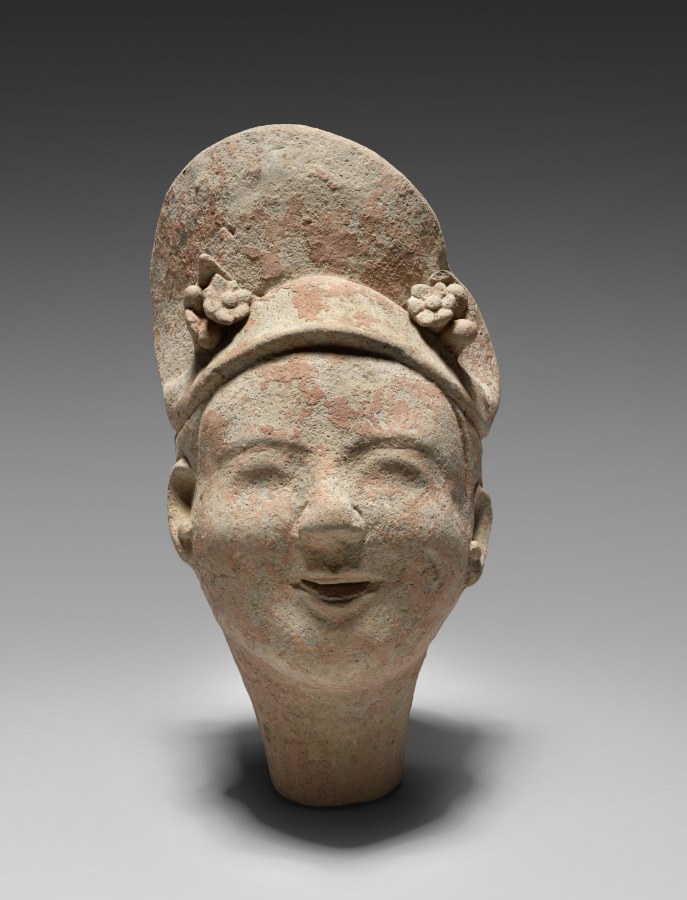
Female Figure of a Court Entertainer Dancing (Head)
Unknown artist
- Medium:
- Pottery with traces of color pigment
- Collection:
- Chinese Art
- Source:
- Cleveland Museum of Art
- Rights:
- Public domain — free to use, share and adapt.
- Recorded as:
- CC0
This sculpture is among the earliest surviving representations of a professional dancer from East Asia, and it shows us that Han court culture recognized dance as a specialized art form worthy of commemorating in permanent form. The work reveals what Han viewers valued in a dancer: not the moment of exertion, but the quality of presence, poise, and visual elegance that framed the performance.
What you are looking at
This is a terracotta head, life-size or near life-size, of a woman from the Han dynasty. The sculptor carved a broad, full face with a serene, smiling expression—eyes downturned at the corners, mouth curved upward—that conveys ease and dignity. The hair is the most elaborate feature: swept upward and back into a tall, rounded mass that rises well above the crown, secured by what appears to be a rigid band or cap, and adorned with small floral ornaments or knots of clay at the sides. The face itself is round and fleshy, with full cheeks and a broad nose, carved with confident definition. The piece is fragmentary—we see only the head and neck, severed at the shoulders—but even as a head it commands presence. The surface shows the warm, mottled ochre and cream of aged terracotta, with areas of darker oxidation and traces of pigment still visible, especially a reddish tone on the face and hair.
The dancing
This is a single figure, depicted only from the neck up. The head is held upright with a slight lift, the chin neither dropped nor thrust forward. The smile and downturned eyes suggest a moment of contemplation or gracious attention—the face of someone aware of being observed. There is no visible strain or exertion; the expression is composed and pleasant. The sculptor has given the work a quality of repose despite the elaborate styling, implying both status and comfort in display.
The dance depicted
The catalogue record identifies this as a female court entertainer and dancer, and the Han practice of furnishing elite tombs with sculpted attendants and performers is well documented. The head alone does not show us the dance itself—no captured mid-movement pose, no extended limb, no dynamic weight shift. However, the serene, smiling face and the meticulous attention to the hairstyle (which the record mentions held by flower ornaments) align with the visual language of entertainment performers in Han court culture. Dancers and musicians in Han tomb sculpture are often portrayed with elaborate dress and grooming, signaling their role in the afterlife service. The upright, composed bearing suggests someone trained to maintain grace and deportment, though the specific dance form—whether she performed court ritual dance, acrobatic spectacle, or rhythmic movement to music—cannot be determined from the head alone.
How it was made
This is hand-modeled terracotta, wheel-thrown or coil-built and then carved and incised to define features. The sculptor worked in the round, paying close attention to the back of the head (which would have been visible) and the underside. The face was carved with a blunt tool to flatten and define planes; details like the eyes, nostrils, and smile were incised or gouged. The hair ornaments were built up separately and attached with slip. This is tomb sculpture, made to last eternally in the ground, so durability mattered more than surface polish; the rough texture visible in the photograph is characteristic. The technique allowed for fluid, naturalistic form while remaining economical—the sculptor did not need to cover the whole figure, only the essential parts. The fragments we see today suggest the original figure was life-size or larger, which would have made it a significant commitment of labor and material.
About this work
This is a head of a Han-dynasty court entertainer, carved in terracotta and placed in a tomb around 100 CE. It belongs to a class of mortuary sculptures—often called 'spirit attendants' or 'mingqi'—made to populate the afterlife with representations of living service. The head alone does not show us the dancer in motion; instead it shows us how a dancer was seen and remembered: groomed, smiling, composed, and ready to entertain. The elaborate hairstyle and peaceful expression are the sculpture's way of saying 'this woman was valued, skilled, and at ease in her role.' For a gallery of dance in art, this object matters not because it captures a dance step, but because it shows us how dance was understood in court culture—as a form of skilled service that required training, taste, and the kind of grace that survives even in the afterlife.
How to look at it
Look at the hairstyle first: the sculptor took unusual care to render it in three dimensions, with ornaments that catch light and cast shadow. This detail tells us that appearance and adornment were central to the woman's role and identity. Then observe the face: the slight downward turn of the eyes and the soft smile create a moment that is neither posed nor unguarded, but somewhere in between—the expression of someone accustomed to being watched while remaining composed. The sculptor chose not to show her in action, but in a state of attentive repose, which is itself a kind of performance.
The period
The Han dynasty (206 BCE–220 CE) inherited and expanded the court ceremonial and entertainment practices of the Qin. By the Later Han period (around 100 CE), court dance had become an established profession, with dancers, acrobats, and musicians regularly employed in imperial service and in the great households of the nobility. These performers were often enslaved or indentured, but they occupied a visible and valued position in court life. Han tomb sculpture shows us the visual culture of the afterlife: the deceased was provided with an entire retinue of servants, entertainers, guards, and officials, all in miniature or life-size form. The practice reflects both the persistence of beliefs in an afterlife requiring service, and the wealthy family's desire to display the scope of their living household through its commemorative art.
Where it lives
The work is held in the Cleveland Museum of Art (CMA) as part of their Chinese Art collection. It is documented as Han-dynasty terracotta with traces of pigment. The catalogue record does not provide acquisition or provenance details beyond the attribution.
Dance in this work
Questions about this work
Can you tell what kind of dance she performed from this head alone?
No. The sculpture shows us only her face and hairstyle, not her body or the movement. We know from the catalogue record that she was a dancer and entertainer, and the elaborate styling suggests courtly performance, but the specific form—whether court ritual dance, acrobatic display, or another genre—is not represented here. The head tells us who she was; the body, now lost, would have shown us how she danced.
Why is this head separated from the body?
It may have broken in the tomb over two thousand years, or it may have been displayed separately in antiquity. Tomb sculpture was often made in modular sections for easier assembly and handling. We cannot know from the image alone whether the separation was accidental or intentional.
What do the flower ornaments mean?
They mark her as someone of status and special training. Flowers were symbols of beauty and cultivation in Han art. The ornaments also served a practical purpose in a tall, elaborate hairstyle: they helped secure and display the hair while adding visual richness and movement when she danced.
Is this a portrait of a real person?
We cannot say. The face is naturalistic and individual in its features—the full cheeks, the particular curve of the mouth—but it may be a generic 'type' of entertainer, not a likeness of someone specific. Han tomb sculpture often blurs the line between portrait and archetype.
More dance artwork





