49 works in this view — arrow keys or swipe to move between them.
Dance in Art
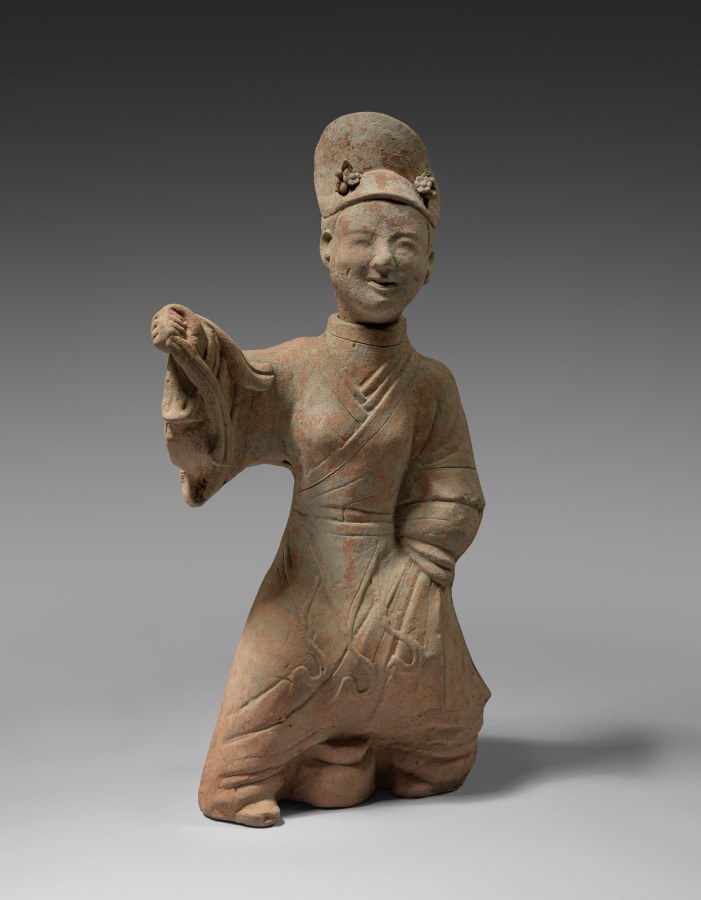
Female Figure of a Court Entertainer Dancing
Unknown artist
- Medium:
- Pottery with traces of color pigment
- Collection:
- Chinese Art
- Source:
- Cleveland Museum of Art
- Rights:
- Public domain — free to use, share and adapt.
- Recorded as:
- CC0
This is one of the few surviving images of female court dancers from early imperial China, offering concrete evidence of costume, posture, and the integration of music and movement in Han Dynasty performance. The figure shows that dance in the Han court was not primarily about footwork or acrobatic skill, but about cultivated grace, refined gesture, and the strategic display of expensive fabric and ornament—a conception of dance as a branch of courtly accomplishment.
What you are looking at
A terracotta figure kneels in a formal pose, depicted with a serene, smiling expression. She wears an elegant high-waisted robe with carefully articulated folds and fitted sleeves, characteristic of Han Dynasty court dress. Her elaborate hair is arranged in a tall, cylindrical structure topped with ornamental flower finials that frame her face. In her raised right hand she holds her sleeve extended outward in a graceful gesture; her left hand lifts her robe to reveal what appears to be a drum or musical instrument tucked beneath her garment. The figure is rendered in warm terracotta with traces of colored pigment still visible, and sits on a thick, columnar base. The kneeling posture, the careful balance of the extended arm and lifted fabric, and the calm, knowing smile suggest a moment of professional performance rather than spontaneous movement.
The dancing
The dancer is a single female figure in a kneeling position with her upper body upright and composed. Her right arm is raised and extended, holding the wide fabric of her sleeve aloft in a controlled, deliberate gesture; her left hand gathers her lower robe. The posture is formal and restrained—the weight settled on the knees, the torso stable and dignified. There is no sense of vigorous movement; instead, the pose conveys skilled presentation of dress and deportment, suggesting that the beauty of the fabric and the precision of the gesture are themselves the performance.
The dance depicted
This appears to depict a court entertainer of the Han Dynasty, likely performing a form of theatrical or ceremonial dance that emphasized elegance, costume display, and musical accompaniment rather than dynamic footwork. The drum visible beneath her robe suggests she was both dancer and musician. The kneeling pose and controlled arm placement indicate a performance genre rooted in court ritual and formal entertainment, where grace of movement, refinement of dress, and skilled presentation of props or instruments were the primary measures of skill. Such performers were essential to elite Han tombs, placed there to continue entertaining the deceased in the afterlife.
How it was made
The figure is hand-modeled terracotta, built from clay and refined with careful carving to articulate the folds of fabric, the flowers in her hair, and the features of her face. Traces of pigment—likely mineral-based paint applied after firing—survive on the surface, indicating that the figure was originally more vividly colored than it now appears. The hollow construction typical of Han tomb figures allowed for lighter weight and easier firing. The technique permits remarkable detail in facial expression and costume while maintaining the sturdy permanence required for a funerary object intended to endure for centuries.
About this work
This Han Dynasty terracotta figure documents a now-lost court entertainment tradition in which elegantly dressed female performers danced, played music, and manipulated their costumes as part of formal ritual and entertainment. She kneels in a composed, graceful pose with one arm raised to display her flowing sleeve and her other hand lifting her robe to reveal a drum—gestures that suggest both musical and choreographic skill. The figure was part of a tomb's furnished entourage, a miniature servant of the deceased in the afterlife, and offers rare visual evidence of how Han court performers dressed, carried themselves, and coordinated movement with music and textile display.
How to look at it
Notice the deliberate stillness of the pose—this is not a dancer caught mid-leap, but an entertainer composing herself for display. The raised arm and lifted hem are controlled, theatrical gestures designed to showcase the fineness of her dress and the grace of her bearing. Observe the care with which the robe is carved to show individual pleats and folds; the costume itself is as much the subject as the figure wearing it. The serene facial expression and the centered, dignified posture convey authority and professional composure rather than emotion or narrative. This is a document of courtly refinement translated into permanent clay.
The period
The Han Dynasty (206 BCE–220 CE) was a period of consolidated imperial power and extraordinary investment in elite tombs. These burial chambers were furnished with pottery figures of musicians, dancers, attendants, guards, and animals—a practice rooted in earlier Shang and Zhou traditions but reaching its peak in scale and sophistication during the Han. The figured pottery served both practical and symbolic functions: it provided the deceased with a full retinue in the afterlife and displayed the tomb owner's wealth and cosmological rank. Court entertainment during this period was highly formalized, combining music, dance, mime, and acrobatics, and female performers held established roles in aristocratic ritual and celebration.
Where it lives
The figure is part of a Chinese art collection and is recorded with the source code CMA, typically indicating the Cleveland Museum of Art or a similar institution with Chinese holdings. It dates to the Han Dynasty (100 CE or thereabouts) and was almost certainly excavated from a tomb site, as tomb figures make up the vast majority of Han Dynasty ceramics known to the West.
Dance in this work
Questions about this work
What is that drum doing under her dress?
Court entertainers in the Han Dynasty were often both dancers and musicians. The drum was likely part of her act—she would play it while performing, possibly manipulating her costume to display it or create percussion effects. This suggests a choreography that integrated music-making, gesture, and costume display as a unified performance rather than separating them as modern practice often does.
Why is she kneeling?
Kneeling was the formal sitting posture in Han Dynasty court settings. It signals respect and formality and was the expected position for receiving guests, performing before superiors, or maintaining composure during ritual. For an entertainer, it also allowed for stable, centered performance and was likely the base position from which other gestures and movements were executed.
Was she actually buried with the tomb owner?
Almost certainly not. These figures are miniatures—typically 8 to 24 inches tall—created specifically to furnish the tomb. They are a symbolic retinue meant to serve the deceased in the afterlife. They would be placed in the burial chamber before sealing, often in groups organized by function (musicians in one area, guards in another, attendants scattered throughout).
How much of the original color is left?
Very little. The terracotta was originally painted with mineral pigments—reds, blacks, yellows, and blues—that made the figures far more vivid and lifelike. Most color has been lost to time and handling, though microscopic analysis and fragments can sometimes reveal what the original palette was. What we see now is the warm orange-brown of bare clay.
More dance artwork





