49 works in this view — arrow keys or swipe to move between them.
Dance in Art
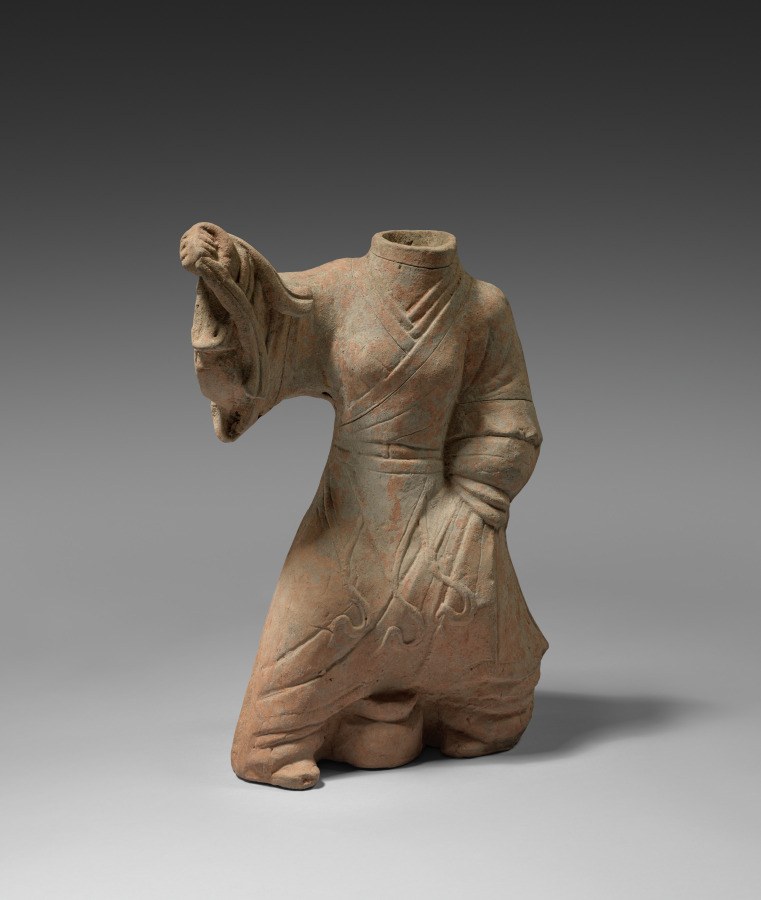
Female Figure of a Court Entertainer Dancing (Body)
Unknown artist
- Medium:
- Pottery with traces of color pigment
- Collection:
- Chinese Art
- Source:
- Cleveland Museum of Art
- Rights:
- Public domain — free to use, share and adapt.
- Recorded as:
- CC0
This figure is one of the primary visual documents of Han-dynasty court dance, a tradition otherwise recorded mainly in fragmentary written sources. It shows us directly how a performer of that era was costumed, how the body was held and moved during performance, and what instruments accompanied the dance—information no text can convey as vividly. For anyone studying the history of East Asian dance, or the relationship between sculpture and performance in ancient cultures, this work is foundational evidence.
What you are looking at
A terracotta figure portraying a court entertainer from the Han dynasty, shown from the waist up in a kneeling position. The figure wears an elaborately draped robe with deep folds and pleats rendered in fine detail, and the upper garment features crisp diagonal lines across the chest and shoulders that suggest a crossover wrap or sash. The head tilts slightly back with a broad smile, the face animated and expressive. Most striking is the elaborate hairstyle: the hair is swept upward and secured with ornamental flower or plume ornaments that project outward, creating a distinctive crown-like silhouette. The right arm is raised and bent at the elbow, the hand grasping fabric—presumably the wide sleeve mentioned in the catalogue—which flows outward. The left arm appears to gesture toward or lift the robe, revealing a drum or similar percussion instrument tucked beneath the garment. The entire figure is carved from a warm tan pottery with traces of pigment still visible in the surface weathering.
The dancing
A single figure in a kneeling posture, weight settled on the lower legs and buttocks, the torso upright and animated. The raised right arm creates an open, expansive line across the upper body, while the left arm engages with the robe in a lifting or revealing gesture. The overall frame is asymmetrical and dynamic rather than static—the tilted head, the raised arm, and the engaging expression all suggest a moment of active performance. The posture is one of display and engagement with an audience rather than abstraction.
The dance depicted
This figure most likely represents a Han-dynasty court dance or entertainment performance, probably from the 1st-2nd century CE. The costume, the drum, and the theatrical pose all point to a female entertainer (possibly a dancer or musician-dancer) performing for an elite household. The raised arm and engaged body position suggest rhythmic movement accompanied by percussion. The exact dance style cannot be identified from the image alone, but the context of Han tomb entertainment sculpture indicates this would have been a form of court performance combining dance with music-making, possibly related to early Chinese theatrical traditions. The figure's prominent smile and open gesture suggest entertainment meant to delight and impress.
How it was made
This is a hand-modeled terracotta sculpture, carved and assembled from separate pieces (evident in the join lines visible at the neck and where the arms meet the torso). The folds and surface details were incised or carved into the leather-hard clay before firing. The remaining traces of pigment—visible as discoloration and surface variations—suggest the figure was originally painted in bright colors, likely with mineral-based pigments such as cinnabar (red), azurite (blue), and ochre (yellow and brown). As a tomb furnishing, this piece was not meant for public display but rather to serve the deceased in the afterlife, which shaped both its material (durable fired clay rather than precious materials) and its intended audience (the household and the spiritual realm rather than living viewers).
About this work
This terracotta torso represents a female court entertainer from Han-dynasty China, likely dating to the 1st or 2nd century CE. It was created as a tomb furnishing to accompany an elite person in the afterlife, one of many sculptural attendants—musicians, dancers, servants—that furnished Han tombs to preserve the deceased's status and comfort beyond death. The figure's animated pose, elaborate costume, and prominent drum identify her as a performer, probably a dancer-musician who provided entertainment in the court. The work demonstrates how deeply dance and music-making were embedded in elite Han culture and funerary practice, and how the surviving visual record of Han performance comes largely from these tomb sculptures rather than from written description or other sources.
How to look at it
Notice first the asymmetry and energy of the pose: the raised arm, the tilted head, the smile. This is not a still, formal pose but a captured moment of animated performance. Look at the care lavished on the costume—the precise pleating of the robe, the wrapped sash across the chest, the ornamental hairstyle—which tells us this is a person of importance and skill, not an incidental figure. The drum peeking from beneath the robe is the key to understanding her role: she is simultaneously a dancer and a musician, or one whose performance was accompanied by percussion. The artist has chosen to show her in a moment of engagement—turned toward an unseen audience, displaying the instrument, gesturing with an open arm—rather than in a static pose of rest.
The period
Han-dynasty China (206 BCE–220 CE) was a period of great prosperity and cultural flowering, when the imperial court and wealthy households maintained large retinues of entertainers, musicians, and dancers. Performance was a mark of status and sophistication, and the court supported professional musicians and dancers. The custom of placing terracotta figures in tombs developed during the Qin dynasty (221–206 BCE) and reached its height during the Han, when tombs became elaborate underground replicas of the household, complete with servants, entertainers, animals, and miniature buildings. These sculptures are among the most important sources for understanding daily life, costume, and performance practices of ancient China. By the Han period, Chinese court dance had developed distinctive styles influenced by both indigenous traditions and contact with Central Asian and other neighboring cultures.
Where it lives
This work is held in the Chinese Art collection of the Cleveland Museum of Art. It is a tomb furnishing (mingqi), one of thousands of terracotta figures created specifically for burial and not for display in the living world. The collection notes indicate the work dates to the Han dynasty, approximately 100 CE, though the exact tomb and original context are not recorded in the catalogue.
Dance in this work
Questions about this work
Is this figure a dancer, a musician, or both?
Both. The raised arm and animated posture suggest active dancing, while the drum visible beneath her robe indicates she was also a musician or that her dance was accompanied by percussion she could manipulate. In Han court entertainment, these roles were often combined: performers danced while playing or gesturing toward instruments, creating a unified performance.
Why is the hairstyle so elaborate?
The ornamental hairstyle is a marker of status, skill, and beauty. In Han-dynasty court culture, an entertainer's appearance was carefully curated as part of her performance and her value. The distinctive upswept hair with flower or feather ornaments would have made her instantly recognizable and striking, drawing the eye of the household or tomb's imagined audience.
What do the folds and pleats in the robe tell us?
The elaborate pleating suggests a high-quality, substantial fabric—silk or a silk-like material—that would have been expensive and prestigious. The way the fabric is carved shows the sculptor's attention to how cloth moves with the body in motion. The crossover sash and wrapped chest suggest a functional garment designed to allow movement while remaining elegant and modest.
How do we know this figure was originally painted?
The visible traces of pigment—areas of discoloration and surface variation—indicate that the terracotta was painted with mineral-based pigments after firing. Han tomb figures were routinely painted in bright colors, which would have made them appear much more lifelike and vivid than they do today. The loss of pigment is a natural result of burial, handling, and time.
More dance artwork





