49 works in this view — arrow keys or swipe to move between them.
Dance in Art
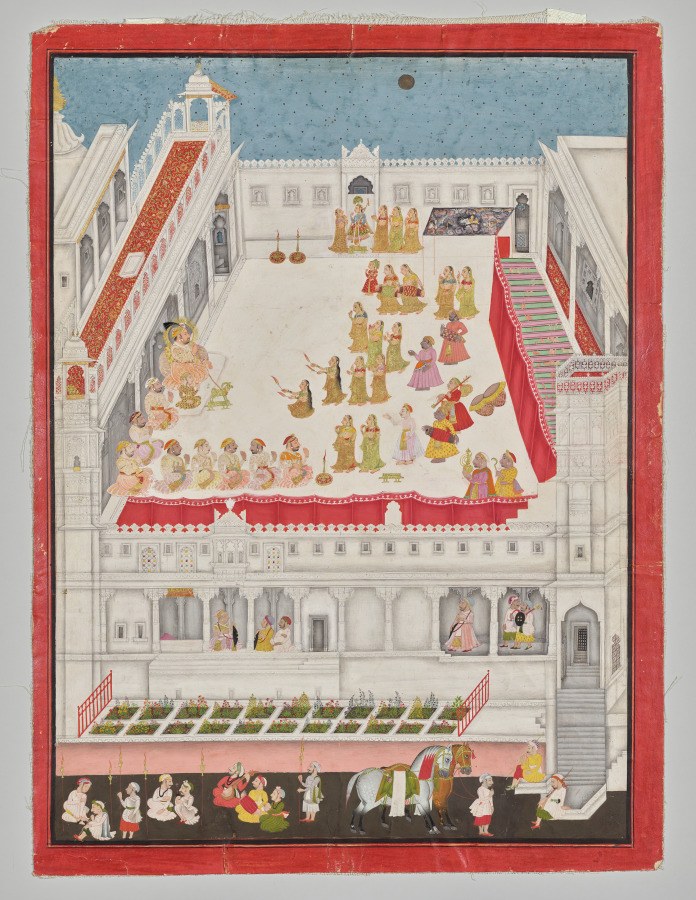
Maharana Jagat Singh Attending the Raslila
Jai Ram (Indian, active 1710–40)
- Medium:
- Gum tempera, gold, and silver on paper
- Collection:
- Indian and Southeast Asian Art
- Source:
- Cleveland Museum of Art
- Rights:
- Public domain — free to use, share and adapt.
- Recorded as:
- CC0
This painting is one of the few extant visual records of how the Raslila was actually performed and staged in a royal context during the 18th century, offering choreographic and institutional evidence for a tradition that has continued for centuries but is now documented mainly through text and oral transmission. For historians of South Asian dance, the work shows the architecture of the performance space, the number of dancers, the use of live music, the central position of Krishna, and the devotional posture of the attendant figures—evidence that the Raslila was a complex ensemble practice involving many participants in a courtly setting, not a small or improvised event. The painting also demonstrates how sacred dance was patronized and legitimized by nobility: by depicting the king as a witness and beneficiary of the divine power invoked by the Raslila, the artist articulates the political and spiritual functions of royal patronage in early modern India.
What you are looking at
A palace courtyard is arranged as a stage for the Raslila, a dramatic reenactment of episodes from the life of the Hindu god Krishna. The composition is organized in horizontal registers: at ground level, in the foreground, grooms and attendants sit with horses and musical instruments; the main courtyard occupies the center, where dozens of figures in jewel-toned silks and gold ornaments move through the performance space under a full moon; at the top, a canopied pavilion holds the royal retinue. The entire scene unfolds under candlelight, suggested by the pale ground and deep blue starlit sky. The artist has rendered the space with Mughal-influenced perspective, showing the courtyard as if viewed from above and slightly forward, with architectural details—crenellated walls, domed structures, stairs with red carpeted runners—defining the boundaries. A figure dressed in blue with an elaborate peacock-feather crown (Krishna) stands centrally, while attending dancers and musicians surround him in clusters. At the left, the king reclines with a golden goat-shaped hookah, his young heir at his side, both marked by halos indicating divine sanction. In the upper right, a canopy painted with swirling storm clouds frames the god Indra and his consort on a seven-trunked elephant, representing the jealous rainfall sent to disrupt the divine dance.
The dancing
The dancers are posed in small groups rather than in unified ensemble movement, suggesting the episodic nature of the Raslila rather than a single continuous choreography. The figure of Krishna stands with a characteristic weight shift, one leg slightly bent, arms positioned for interaction with the surrounding dancers. The attendant figures—both dancers and musicians—are oriented toward Krishna and toward each other, creating visual lines of attention and devotion. Many stand with hands in namaste or gesture toward the central action, while a few appear to be in movement, with their garments caught mid-motion. The postures are upright and dignified, with no bent backs or floor work; this is a standing, processional dance. The sheer number of figures (easily forty or more) suggests a large ensemble performance with multiple simultaneous actions rather than synchronized group choreography.
The dance depicted
This is a Raslila, the most sacred form of devotional dance-drama in North Indian Hindu culture, performed to celebrate Diwali and other festivals. The Raslila reenacts episodes from the life of Krishna, particularly his youthful exploits and his divine love play (rasa) with the gopis, or cowherd women. The painting captures the performance as a courtly event: the king sponsors and watches the performance, placing it under his royal patronage and his divine authority. The structure of the scene—with Krishna at the center, surrounded by attendants and gopis in smaller groups, with live music and candlelit atmosphere—reflects the actual staging of Raslila in this period. The painted canopy with Indra and the storm references the mythological narrative of the dance itself, where Indra sends rain to test Krishna's devotion. The dancers are not in formal ballet positions but in the upright, processional stance characteristic of North Indian classical dance traditions (Kathak, Manipuri), though the Raslila's structure is narrative and devotional rather than purely formal.
How it was made
The work is executed in gum tempera, gold, and silver on paper—a technique of the Mughal and Rajasthani courts that allowed for luminous color and precious-metal highlights. The gold and silver details (the king's hookah, jewelry, architectural ornaments, halos) catch light and would have been especially brilliant when viewed in courtly interiors by candlelight, echoing the painting's subject. The fine paper support and the precision of the line work suggest this was created for a royal patron or court collection. The medium is well suited to the narrative detail and the density of small figures; the artist could render hundreds of individual people and ornaments without the work becoming murky. The technique indicates an audience of the educated elite—this was not a mass-produced or widely circulated image but a precious object for royal or scholarly collection.
About this work
This painting documents a Raslila performance—a sacred Hindu devotional dance-drama celebrating Krishna—as it was staged at the royal court of Maharana Jagat Singh in Rajasthan in the early 18th century. The work sits at the intersection of three traditions: the ancient Hindu mythological narrative, the courtly dance practices of Rajput rulers, and the visual vocabulary of the Mughal court, which the painter has selectively adopted to create a narrative scene of extraordinary complexity and beauty. The Raslila was a living tradition, performed across North India by communities of devotees and also, as this painting shows, sponsored and watched by nobility as an expression of religious and cultural authority. By depicting the king and his son within the scene, with halos indicating their divine sanction, the painting makes a political and spiritual claim: that the ruler's patronage of this sacred performance connects him to the divine, much as Krishna's dance connects the human and the divine. The work is one of a substantial series, suggesting it was part of a royal court manuscript or album, a form of art that conveyed both prestige and sacred knowledge.
How to look at it
The viewer should first notice the hierarchical organization of space: the king and his authority occupy the left foreground, Krishna stands centrally in the courtyard, and the divine realm (Indra's canopy) hovers at the top. This is not a unified action but a series of simultaneous events, typical of narrative art in this tradition. Pay attention to the costume and ornament: the peacock-feather crown and blue garments of Krishna mark him as divine and as the focus of all attention; the layered silks and gold jewelry of the dancers and courtiers indicate wealth and refinement; the red carpet and architectural ornaments frame the event as courtly and formal. Notice also the density and variety of the figures: rather than geometric formations or synchronized lines, the dancers and attendants are arranged in small clusters and groups, each with their own internal orientation and gesture. The artist chose to show the moment not as a peak of movement but as a stable, ceremonial arrangement—the entire gathering in attendance, rather than a single dramatic instant. The pale ground and blue sky, with the moon at the top, establish the candlelit atmosphere; this is a nocturnal, intimate, sacred event being witnessed under protection of both the king and the cosmos.
The artist
Jai Ram was an active painter at the court of Rajput rulers in Rajasthan during the first half of the 18th century, known for large-format narrative works depicting court life, sacred performance, and mythological events. His style synthesizes Mughal painting conventions—particularly the use of perspective, architectural detail, and the organization of figures in narrative sequences—with Rajasthani color sensibilities and iconography. The attribution to Jai Ram and the dating to 1736 place the work within a prolific period of court painting that served to document and celebrate Rajasthani noble life and devotional practice. His works are characterized by their complexity, their integration of sacred and secular narrative, and their visual witness to the structures of princely patronage and religious sponsorship.
The period
In early 18th-century Rajasthan, the Rajput courts were consolidating their cultural identity and political legitimacy through the patronage of arts and religious performance. Though the Mughal Empire remained nominally dominant, regional rulers like Maharana Jagat Singh asserted their independence and authority through elaborate court ceremonies, sacred festivals, and the sponsorship of performance. The Raslila tradition, which had ancient roots in devotional practice, was being increasingly formalized and incorporated into courtly ritual. At the same time, Rajasthani court painting was absorbing Mughal visual techniques—particularly the use of perspective, architectural framing, and the systematic organization of narrative space—while maintaining its own color palette and mythological vocabulary. The result was a hybrid visual culture in which sacred performance could be depicted with courtly sophistication and imperial grandeur. The painting of the Raslila thus represents both a moment in the history of dance practice and a moment in the visual arts, when regional courts were asserting their cultural authority through the synthesis of local devotional tradition and imported imperial style.
Where it lives
The work is held in the Indian and Southeast Asian Art collection of the Cleveland Museum of Art. It is part of a larger series of large-format paintings, likely created for a royal court album or manuscript intended to document and celebrate the patronage and cultural achievements of Maharana Jagat Singh and his court.
Dance in this work
Questions about this work
What is the Raslila and why was it danced?
The Raslila is a sacred devotional dance-drama that reenacts episodes from the life of Krishna, the Hindu deity, particularly his youthful plays and divine love with the gopis (cowherd women). It was performed to celebrate religious festivals like Diwali and to invoke Krishna's presence and blessing. The performance was believed to enact and invoke divine power, making it both entertainment and spiritual practice. By the 18th century, the Raslila had also become a courtly event, sponsored by nobility as a display of religious devotion and cultural prestige.
Who was Maharana Jagat Singh and why did he sponsor the Raslila?
Maharana Jagat Singh ruled a Rajput kingdom in Rajasthan in the early 18th century. Like other regional rulers of the period, he asserted his authority and legitimacy through the patronage of arts, architecture, and sacred performance. By sponsoring the Raslila and being depicted as a witness to it—with a halo indicating divine sanction—he made a political and spiritual claim: that his rule was connected to the divine and that his kingdom was a realm where sacred power could manifest. The painting thus serves as both a religious image and a political document.
How many dancers are in this Raslila, and how are they organized?
The painting depicts at least 40–50 figures, including Krishna, gopis, musicians, attendants, and the royal retinue. They are not organized in a single synchronized formation but in smaller clusters and groups scattered throughout the courtyard, each with their own internal focus and gesture. This structure reflects the actual organization of the Raslila as a narrative performance: it unfolds through a series of episodes and interactions between Krishna and different groups, rather than as a unified ensemble choreography. The painting captures the moment as a gathering or assembly, rather than a single peak of movement.
What do the costumes tell us about this performance?
The costumes are lavish and formal, indicating that this is a courtly, not a rural or popular, version of the Raslila. The dancers wear layered silks in jewel tones (deep greens, reds, golds), heavy jewelry, and elaborate ornaments. Krishna's peacock-feather crown and blue garments are recognizable attributes that mark him as divine and as the focus of devotion. The sheer richness of the dress suggests the wealth and status of the royal patron and the importance of the occasion. This is a performance staged and sponsored by nobility, not a spontaneous or improvised village event.
What do the architectural details and setting tell us?
The palace courtyard is rendered with precise architectural detail—crenellated walls, domed structures, stairs with red-carpeted runners—indicating that this is a formal, enclosed, royal space. The perspective and composition are influenced by Mughal court painting, showing the artist's familiarity with imperial visual traditions. The full moon and candlelit atmosphere establish a nocturnal, intimate setting, appropriate to the sacred and devotional nature of the performance. The formal courtyard setting, rather than a rural grove or village space, emphasizes that this is a courtly event, held under royal authority and protection.
More dance artwork





