49 works in this view — arrow keys or swipe to move between them.
Dance in Art
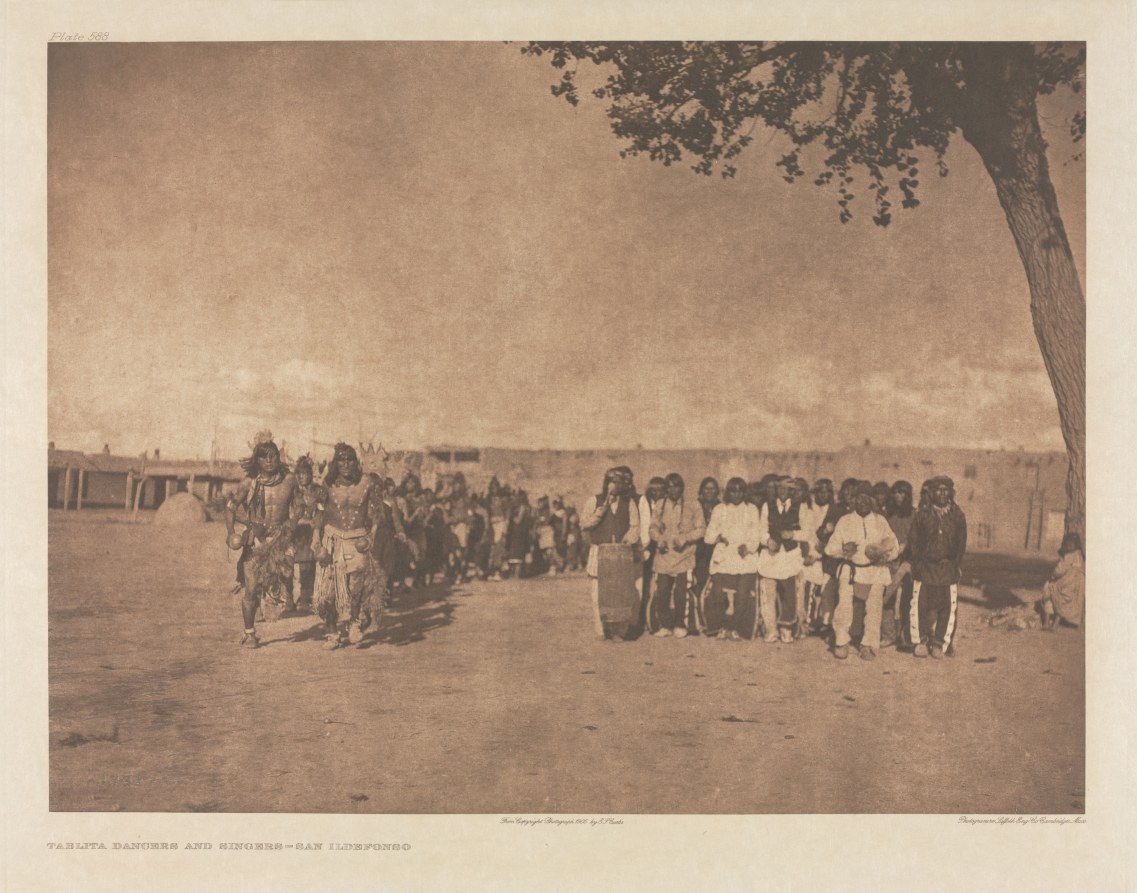
Portfolio XVII, Plate 588: Tablita Dancers and Singers - San Ildefonso
Edward S. Curtis (American, 1868–1952)
- Medium:
- photogravure
- Collection:
- Photography
- Source:
- Cleveland Museum of Art
- Rights:
- Public domain — free to use, share and adapt.
- Recorded as:
- CC0
This image is one of the earliest systematic photographic records of Pueblo ceremonial life, made before many of these practices were suppressed by U.S. federal policy. It documents not just the Tablita dance but the ceremonial context and community structure that made the dance meaningful—evidence that scholars, dancers, and Pueblo people themselves have drawn on to understand, preserve, and revive these practices. Curtis's photogravures were widely circulated and shaped how non-Native Americans understood Native American dance, for better and worse: they are simultaneously valuable historical records and products of a colonial perspective.
What you are looking at
A large gathering of Pueblo people assembled in an open plaza under a tree in bright daylight, arranged in a loose crowd formation. The photograph captures what appears to be a ceremonial or festive occasion: figures in traditional dress—many wearing patterned textiles and blankets—stand and sit in small groups. The composition is taken from a distance that includes the full assembled group, the bare ground of the plaza, wooden structures visible at the edges, and a large tree providing shade in the upper right. The light is even and bright, characteristic of high-altitude New Mexico sun, casting minimal shadow. The image has the warm, muted tonality of an early photogravure, with a soft sepia wash that softens detail while preserving the scale and arrangement of the gathering.
The dancing
The figures are stationary or moving very slowly—no rapid movement or clear dance positions are frozen here. Some individuals stand upright in groups; others appear to be seated or at ease. The clothing is layered and decorative: visible are wrapped blankets, woven textiles, and what may be traditional jewelry. The postures suggest a processional gathering or ceremony rather than active dancing; bodies are oriented loosely toward a central focus or toward one another rather than in the tight frames or holds characteristic of staged dance photography.
The dance depicted
This image documents a Tablita or Corn Dance gathering at San Ildefonso Pueblo, a ceremony that is both sacred and social, combining ritual song, movement, and community gathering. The Tablita is a shield-like wooden headdress worn by women dancers, and the dance is performed to ensure fertility and successful harvests. However, this photograph appears to capture the gathering or assembly moment rather than the active dance itself—the dancers in full regalia may be present among the crowd, but the image shows the ceremonial assembly, the singers, and community members rather than dancers in motion. The Tablita dance involves rhythmic stepping and swaying in formation, typically performed by pairs or groups of women, but that active phase is not visible here; instead, we see the ceremonial context and preparation.
How it was made
This is a photogravure, a photomechanical process that transfers a photographic image onto a copper plate via gelatin and acid etching, then printed as an intaglio. The process was favored for fine-art publications because it preserved photographic tone and detail while allowing artistic control over inking and paper. Edward Curtis used photogravure extensively for his multi-volume portfolio *The North American Indian* (1907–1930), which aimed at a scholarly and wealthy audience. The warm, slightly softened tonality visible here is characteristic of the process: the image reads as both document and artistic print, a quality that was central to Curtis's ambition to create authoritative yet aesthetically refined records of Native American life.
About this work
This photogravure documents a Tablita dance gathering at San Ildefonso Pueblo in 1905, one of Edward Curtis's images from his landmark ethnographic portfolio *The North American Indian*. Rather than capturing the active dance itself, it records the ceremonial assembly—the community gathered, the singers, and the ritual context in which the Tablita, the corn dance of the Pueblo, takes place. Curtis's choice to photograph the gathering rather than the moment of performance reveals both the social and sacred dimensions of the ceremony: the dance is not a staged performance for the photographer but a lived community ritual. The work sits at the intersection of ethnographic documentation and artistic photography, addressing both anthropological audiences and collectors of fine prints.
How to look at it
Look first at the scale and arrangement of the figures: this is a gathered community, not a staged performance. The photographer has positioned himself at a distance that includes the whole plaza and the assembled people, creating a document of the event as a whole rather than isolating individual dancers or choreographic detail. Observe the variety of dress and posture—some figures clearly in ceremonial garb, others in everyday clothes, children and elders mixed with younger people. The tree framing the upper right creates a natural boundary; the bare earth and modest structures suggest San Ildefonso Pueblo as it was in the early 1900s. The soft photogravure tonality gives the image a timeless quality that was partly Curtis's artistic choice and partly the limitations of the medium; it is worth asking whether that softness serves the community or obscures the specificity of the moment.
The artist
Edward Curtis (1868–1952) was a Seattle-based photographer who spent three decades documenting Native American peoples, cultures, and ceremonies across North America. His monumental *The North American Indian* (1907–1930), comprising 20 volumes with over 2,200 photogravures, was an ambitious attempt to create a comprehensive visual ethnography. Curtis was self-taught in anthropology and worked with advisors including Frederick Webb Hodge of the Smithsonian; his project was funded by J.P. Morgan. His work was groundbreaking in bringing Native American life to a wide audience and is treasured as historical documentation, but it was also shaped by Curtis's aesthetic choices, his sometimes romantic view of Native peoples, and the colonial context of early 20th-century America. He was not always welcomed by the communities he photographed, and some of his images were staged or modified to fit his artistic vision.
The period
In 1905, when this photograph was made, U.S. federal Indian policy actively suppressed Native American ceremonies and languages through the boarding school system and BIA control of reservations. The Indian Reorganization Act was still three decades away; Pueblo communities were under intense pressure to abandon their religious practices. At the same time, there was growing interest among white American artists, collectors, and intellectuals in Native American art and culture—part of a broader primitivist aesthetic movement in early modernism, but also genuine ethnographic curiosity. Curtis's work arrived at a moment when these ceremonies were genuinely threatened and when photographic documentation seemed urgent. The photogravure as a fine-art medium was itself at its height in the early 1900s; Curtis's use of it elevated his work from journalism to fine art, ensuring it would circulate among collectors and institutions, not just anthropologists.
Where it lives
This image is from the Cleveland Museum of Art's photography collection. It is one plate from Curtis's *The North American Indian*, a twenty-volume portfolio published between 1907 and 1930 and now held in many major institutions. The specific portfolio and plate number are recorded in the image.
Dance in this work
Questions about this work
Is this actually a dance, or just a gathering?
Both. The Tablita ceremony includes singing, movement, and the wearing of ceremonial dress, and it is sacred. But this photograph captures the assembly and preparation phase rather than the active dance itself. Curtis sometimes chose to document the ceremonial context rather than the moment of greatest visual drama—a choice that tells us something about his priorities and his relationship to the communities he photographed.
What is a Tablita?
The Tablita is a tall, wooden, shield-shaped headdress worn by women dancers in certain Pueblo ceremonies. The word also names the dance itself. The Corn Dance or Tablita is performed at multiple Pueblos, including San Ildefonso, and is central to agricultural and fertility ceremonies. It involves rhythmic stepping, communal singing, and the participation of both dancers and singers. The ceremony is still performed today, though it was suppressed during much of the 20th century.
Why did Curtis photograph Native ceremonies?
Curtis believed he was documenting cultures that were disappearing under pressure from U.S. assimilation policy. His project was funded by J.P. Morgan and framed as a salvage ethnography. He aimed to create a comprehensive visual record for posterity and for non-Native audiences. However, his work also shaped how Native peoples were imagined and sometimes reinforced the idea that Native cultures were vanishing rather than changing and persisting.
What is a photogravure?
A photogravure is a photomechanical printing process in which a photograph is transferred to a copper plate, etched with acid, and then inked and printed like an engraving. It produces rich, subtle tones and was valued for fine-art publications. Curtis used photogravure for *The North American Indian* to ensure his images would be seen as both authoritative documents and artistic photographs. The process was labor-intensive and expensive, which limited the audience to wealthy collectors and institutions.
More dance artwork





