49 works in this view — arrow keys or swipe to move between them.
Dance in Art
Piping and Dancing Satyr
Unknown artist
- Medium:
- bronze
- Collection:
- Greek and Roman Art
- Source:
- Cleveland Museum of Art
- Rights:
- Public domain — free to use, share and adapt.
- Recorded as:
- CC0
This statuette is one of the finest surviving images of how the ancient Greeks understood and depicted ecstatic, ritual dance. It shows a culture that valued the representation of movement so highly that it invested in the difficult technique of multi-part bronze casting to capture a single moment of dynamic action. For dancers and historians, it is evidence that the Hellenistic world understood dance as worthy of serious sculptural attention.
What you are looking at
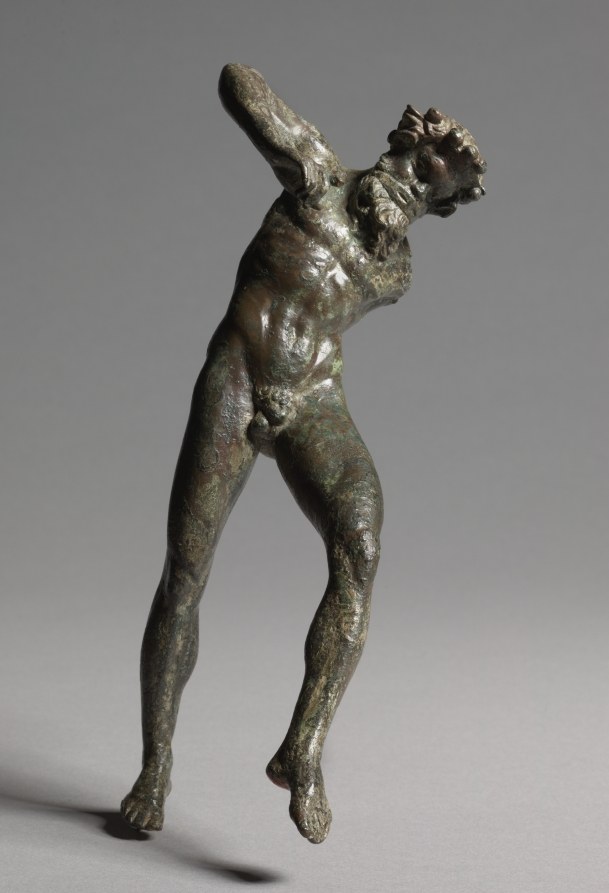
A bronze statuette captures a male satyr mid-dance, his body twisted into a dynamic, unbalanced pose that conveys vigorous movement. His musculature is defined across his torso and limbs, which are elongated and lean. He wears a vine or berry crown on his head, and his pointed ears mark him unmistakably as a satyr—a creature of the Dionysian revel, part man and part horse in Greek mythology. His right hand is raised and shaped as if holding pipes (auloi), with a strap visible crossing his mouth, the mark of a pipe player. His left arm is now missing. His legs are splayed wide, one knee bent, the other extended, suggesting the moment of ecstatic movement rather than a static pose. The figure appears to leap or gyrate, embodying the wild energy of Dionysian festivity. The patina of the bronze is greenish and aged, indicating ancient manufacture.
The dancing
A single male figure, depicted nude except for the crown and pipe strap. His posture shows one leg bent and planted while the other extends or lifts, creating an asymmetrical, off-balance stance typical of ecstatic dancing. His torso twists sharply, and his shoulders are uneven—the right raised, the left lower—amplifying the sense of rotational movement. The missing left arm would have completed a gesture; the raised right hand is the only remaining limb to suggest what he held and how he moved. The extreme elongation of the limbs and the exaggerated musculature are conventions of Hellenistic statuettes, emphasizing physicality and strain.
The dance depicted
This is a representation of a satyr's dance, likely the kordax or a similar ecstatic ritual dance of Dionysian festival. Satyrs were stock figures in Greek satyr plays and in the revels of Dionysus, known for lascivious, intoxicated, and exuberant movement. The presence of the pipes confirms that this satyr is both dancer and musician—a double role familiar from Greek drama and vase painting. The pose captures the kind of uncontrolled, energetic movement associated with Dionysian worship and symposium entertainment. Hellenistic sculptors were particularly interested in catching the body in momentary, dramatic action; this statuette is a masterwork of that ambition, freezing the satyr at the peak of his abandon.
How it was made
Cast bronze, assembled from multiple pieces joined together—a technique demanding skill in both modelling and metalwork. Bronze allowed the sculptor to create the elongated, intertwined limbs without the structural brittleness that marble would impose; it also permitted fine surface detail and the definition of musculature visible here. The jointure technique suggests this was a high-value object, likely made for a wealthy patron's collection. Bronze statuettes of this quality were circulated among the educated elite and would have been displayed in homes or sanctuaries. The technique speaks to confident command of the figure and an audience sophisticated enough to appreciate virtuoso anatomical distortion in service of capturing movement.
About this work
This is a Greek bronze statuette of the Hellenistic period, probably 4th–3rd century BCE, depicting a satyr in ecstatic dance. The satyr, marked by his pointed ears and vine crown, raises one hand to play the pipes while his body twists into a dynamic, seemingly unbalanced pose that conveys the frenzy of Dionysian revel. It is a monument to Hellenistic sculptural ambition: the desire to freeze the body mid-movement, to make bronze and muscle speak the language of abandon and intoxication.
The work belongs in a dance gallery because it is not merely a portrait of a creature but a study in movement itself. The sculptor has chosen the instant of maximum energy and distortion, the moment when control is surrendered to the music and the god. For anyone interested in how ancient cultures represented the dancing body, or in how ritual movement was imagined and valued, this statuette is a primary document.
How to look at it
Attend to the asymmetry: the satyr's body is off-balance by design, not accident. One leg is grounded, the other airborne or lifting; his shoulders twist against his hips; his torso leans forward while his head turns. The sculptor is showing you the instant *during* the movement, not before or after. Notice how the elongated limbs and exaggerated musculature make the movement look superhuman, possessed—exactly the effect desired. The raised right hand and the strap across his mouth complete the image: he is musician and dancer at once, piping his own ecstasy into being.
The period
The Hellenistic period (c. 323–31 BCE) saw a dramatic expansion of interest in movement, emotion, and the body in sculpture. Artists moved beyond the geometric idealism of Classical Greek sculpture toward more dramatic, naturalistic, and psychological representation. Satyrs became increasingly popular as subjects, both in sculpture and in theater (satyr plays). The cult of Dionysus remained vibrant, and satyrs represented not merely mythological creatures but embodiments of ecstasy, intoxication, and the liberation of the body from social constraint—themes that resonated with Hellenistic audiences. Bronze statuettes were luxury goods, owned by the educated and wealthy, and served as tokens of cultural refinement and philosophical engagement with questions of the body, movement, and divine possession.
Where it lives
The work is held in the Greek and Roman Art collection, catalogued as a bronze statuette dating to approximately 300 BCE. No artist is recorded. The collection source is listed as CMA (likely the Cleveland Museum of Art), a major holding institution for Hellenistic bronzes.
Dance in this work
Questions about this work
Why are the satyr's ears pointed?
In Greek mythology, satyrs were hybrid creatures—part man, part goat or horse—and pointed ears were a standard marker of this otherness. The ears signal to the viewer that this figure is not human but divine or semi-divine, and therefore exempt from human norms of behavior. The pointed ears also appear in satyr masks worn in theater, making them instantly recognizable to an ancient Greek audience.
What are the auloi, and why is he holding them?
The auloi are double-reed pipes, a standard musical instrument in Greek ritual and theater. Satyrs were traditionally musicians as well as dancers, often depicted playing pipes while dancing in Dionysian processions. The strap across the satyr's mouth (a sling that held the pipes in place) and the shape of his raised hand both indicate that he is mid-performance, piping while he dances.
What does the missing left arm tell us?
The arm was cast separately and joined to the body at the shoulder—a typical technique for bronze statuettes of this period. It has been lost to time. Its original position would have balanced the composition and likely extended the sense of ecstatic movement, perhaps raised or gesturing outward. Its absence reminds us that we are viewing a fragmentary survival of the ancient world.
How does this compare to satyr images on Greek vases?
Vase paintings show satyrs in similar poses—often with pipes, often in pursuit or revelry—but the three-dimensionality and the moment-by-moment realism of the bronze offer a different kind of evidence. The statuette captures muscular strain and weight-shift in a way flat painting cannot; it suggests how a satyr's body would actually move in space, making it invaluable for understanding Hellenistic dance practice.
More dance artwork





