49 works in this view — arrow keys or swipe to move between them.
Dance in Art
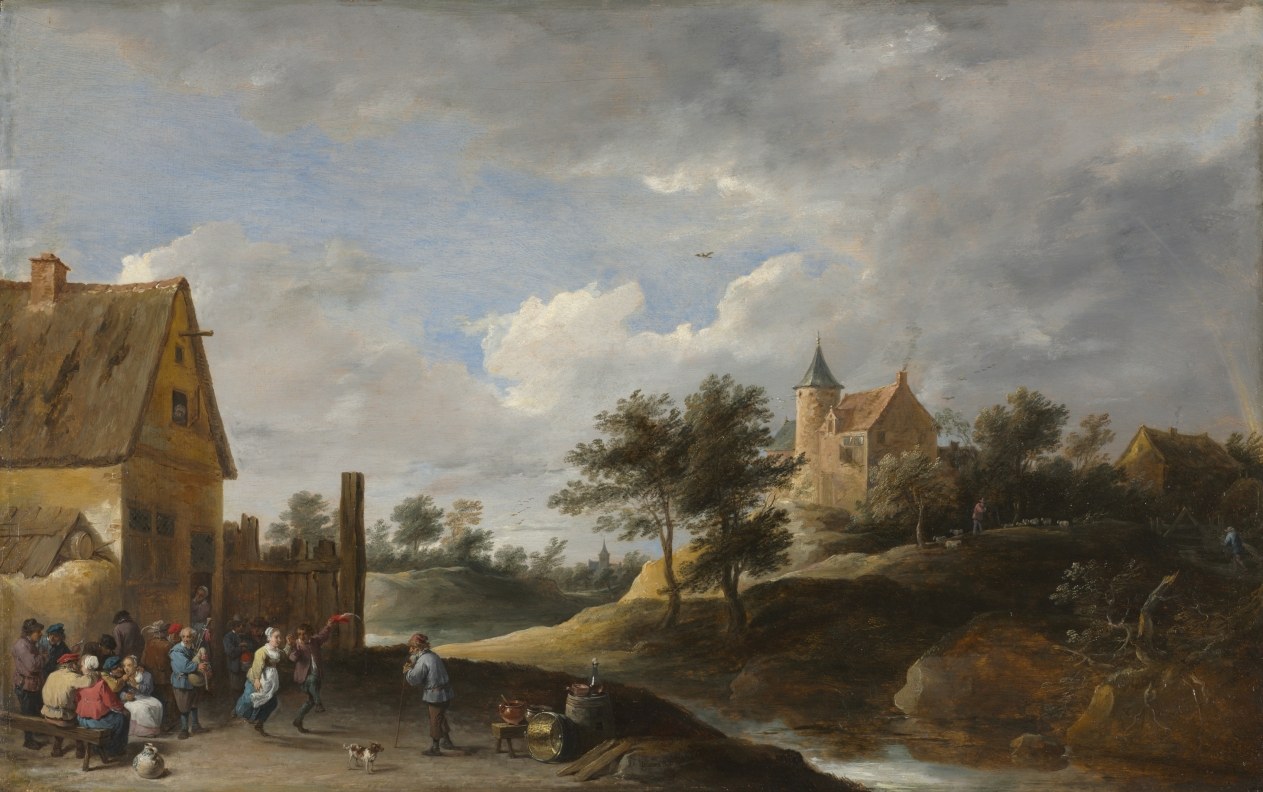
Landscape with Peasants Dancing
David Teniers (Flemish, 1610–1690)
- Medium:
- oil on wood
- Collection:
- European Painting and Sculpture
- Source:
- Cleveland Museum of Art
- Rights:
- Public domain — free to use, share and adapt.
- Recorded as:
- CC0
Teniers is one of the earliest and most reliable visual witnesses to European folk dance in motion. His careful observation of peasant gesture and dress, and his treatment of dance as a continuous social act rather than a posed spectacle, gives historians concrete evidence of body language, clothing, musical accompaniment, and the gender dynamics of village celebration in the 1640s. For dancers, the work shows the lineage of informal, group-based dance traditions and the aesthetic of play and physical ease that persists in European folk practice today.
What you are looking at
A village gathering unfolds before a modest inn with a thatched roof on the left. The foreground is crowded with peasants in bright colors—reds, blues, yellows, whites—some dancing, others standing in conversation or embrace. A bagpiper in the middle distance provides music; dancers move in loose groupings rather than formal couples. Beyond the inn, the landscape opens to gentle hills and a river, with a church or manor house visible on the far bank among trees. The sky is dramatic with white clouds and patches of blue. The whole scene is bathed in warm, golden light that suggests late afternoon or early evening. This is a celebration of rural life painted with meticulous attention to fabric, gesture, and the texture of village sociability.
The dancing
The dancers show relaxed, informal posture—arms linked or raised, bodies leaning into one another, weight distributed loosely. One couple in the foreground appears to be in a simple folk embrace or holding position, but the groupings are fluid and naturalistic rather than structured. A woman in a red dress is prominent; her posture suggests movement or turning. The figures vary in height and age, including children. No rigid frame or formal hold is evident; this is social rather than courtly or theatrical dancing, with the kind of easy physical contact typical of village celebrations.
The dance depicted
This depicts peasant or folk dancing at a rural festival or aleho use gathering, almost certainly a northern European folk tradition of the 17th century. The bagpiper dates the music-making and places the tradition as Netherlandish or Flemish. The style appears to be unstructured country dancing, closer to social recreation than codified folk forms. The loose groupings, informal dress, and outdoor setting all suggest the kind of communal dancing that village people would have done at fairs, feast days, or after markets. Teniers captures not a specific named dance but the spirit and practice of rural revelry.
How it was made
Oil on wood panel, a format common for Netherlandish cabinet paintings of the 17th century. The small scale and portable surface suggest this work was made for a wealthy collector rather than public display—typical of Teniers's market. The technique is meticulous: fine detail in costume and physiognomy, careful modeling of light and shadow, and a warm, atmospheric use of color. The wood support allowed Teniers to work with precision while keeping the painting intimate in scale, making it the kind of luxury object that would hang in a burgomaster's study or merchant's cabinet.
About this work
This is a village dance scene by David Teniers the Younger, one of the most prolific and successful painters of Flemish peasant life in the 17th century. The work celebrates rural festivity and social dancing in a small, jewel-like oil painting on wood. It belongs in a dance gallery because it documents both the fact of folk dancing in early modern Europe and the aesthetic distance between elite viewers (for whom Teniers painted) and the rural life they consumed as entertainment and nostalgia. The painting is precise enough to show how bodies actually moved and related to one another in village celebrations, yet composed and framed as a picturesque scene for urban collectors who would never experience such a gathering.
How to look at it
Notice how the artist has positioned the viewer at ground level, neither above nor distant from the action—you are invited to stand at the edge of the gathering and watch. The composition pulls the eye from the busy foreground (where the dancing is densest) toward the calm landscape beyond, which frames and dignifies the scene. Look at the costumes: the women's linen caps, the men's wool hose and simple doublets, the bright colors of ribbon and linen, all of which are accurately rendered. Watch the hands and arms, which tell the story of the music and movement—linked, raised, gesturing. The bagpiper is small and easy to miss but central: he is why this gathering is happening. Teniers freezes a moment of celebration, but the painting is organized to feel continuous, as though the music and dancing would resume the moment you look away.
The artist
David Teniers the Younger (1610–1690) was the dominant Flemish painter of peasant and village scenes in the 17th century. He inherited the tradition from Pieter Bruegel but refined it into a more intimate, cabinet-painting scale. Teniers was court painter to Archduke Leopold Wilhelm of the Spanish Netherlands and also maintained a large workshop producing paintings for wealthy merchants and collectors. His peasant scenes were enormously popular among the urban elite—they offered comedy, morality, and picturesque charm without requiring grand historical or religious learning. He painted hundreds of variants on village dances, feasts, and fairs, making him the visual historian of Flemish rural culture by default.
The period
In the 1640s, when this work was made, Flanders was culturally and economically prosperous despite political instability. Urban merchants and minor nobility were hungry for paintings of rural life—a genre that had exploded after Pieter Bruegel's pioneering work a century earlier. Folk dancing itself was continuous and unremarked; it was not yet collected, codified, or studied. Teniers captures it as lived practice: the bagpipe was the standard village instrument across Northern Europe, and the loose, celebratory dancing he shows was typical of market days, seasonal festivals, and life-cycle celebrations. Meanwhile, at court and in cities, dancing was becoming more formal, regulated, and theatrical—making peasant dance an exotic subject for elite viewers.
Where it lives
Part of the European Painting and Sculpture collection at the Cleveland Museum of Art. Teniers's village scenes were so popular that many versions and copies exist; the museum's attribution record does not specify provenance but confirms the work as oil on wood, typical of Teniers's cabinet paintings.
Dance in this work
Questions about this work
What dance are they doing?
Teniers does not depict a named, structured dance. This is social dancing at a village celebration—the kind of improvised, group-based movement that would happen at a fair or feast day to live music. The bagpiper provides the rhythm; the dancers link arms, turn, and celebrate together. It is the practice of dancing as community ritual rather than performance of a specific form.
Is this realistic or idealized?
Both. Teniers painted from observation and understood rural costume and gesture well. But he also composed the scene for urban collectors, softening poverty and emphasizing picturesque charm. The landscape is more beautiful, the light more golden, the chaos more orderly than actual village celebrations would have been. It is documentary with a patina of poetry.
Why did wealthy people want paintings of peasants dancing?
Urban elites of the 1600s were fascinated by rural life as exotic, entertaining, and morally instructive—peasants were seen as closer to nature, less corrupt by civility. Teniers's paintings satisfied curiosity and nostalgia for a simpler life that the viewers' own class was leaving behind. They were also funny: the implicit message was often that peasant behavior was crude or comic when seen through educated eyes.
How does Teniers paint dance?
He does not stop motion or pose it formally. Instead, he captures bodies in natural relationships—linked, leaning, turning—and lets the viewer infer the movement from gesture and position. The bagpiper, the arrangement of figures, and the composition all suggest ongoing music and motion rather than a frozen moment. This approach makes the scene feel alive and improvisational.
More dance artwork





