49 works in this view — arrow keys or swipe to move between them.
Dance in Art
Children Dancing
Le Nain (French)
- Medium:
- oil on canvas
- Collection:
- European Painting and Sculpture
- Source:
- Cleveland Museum of Art
- Rights:
- Public domain — free to use, share and adapt.
- Recorded as:
- CC0
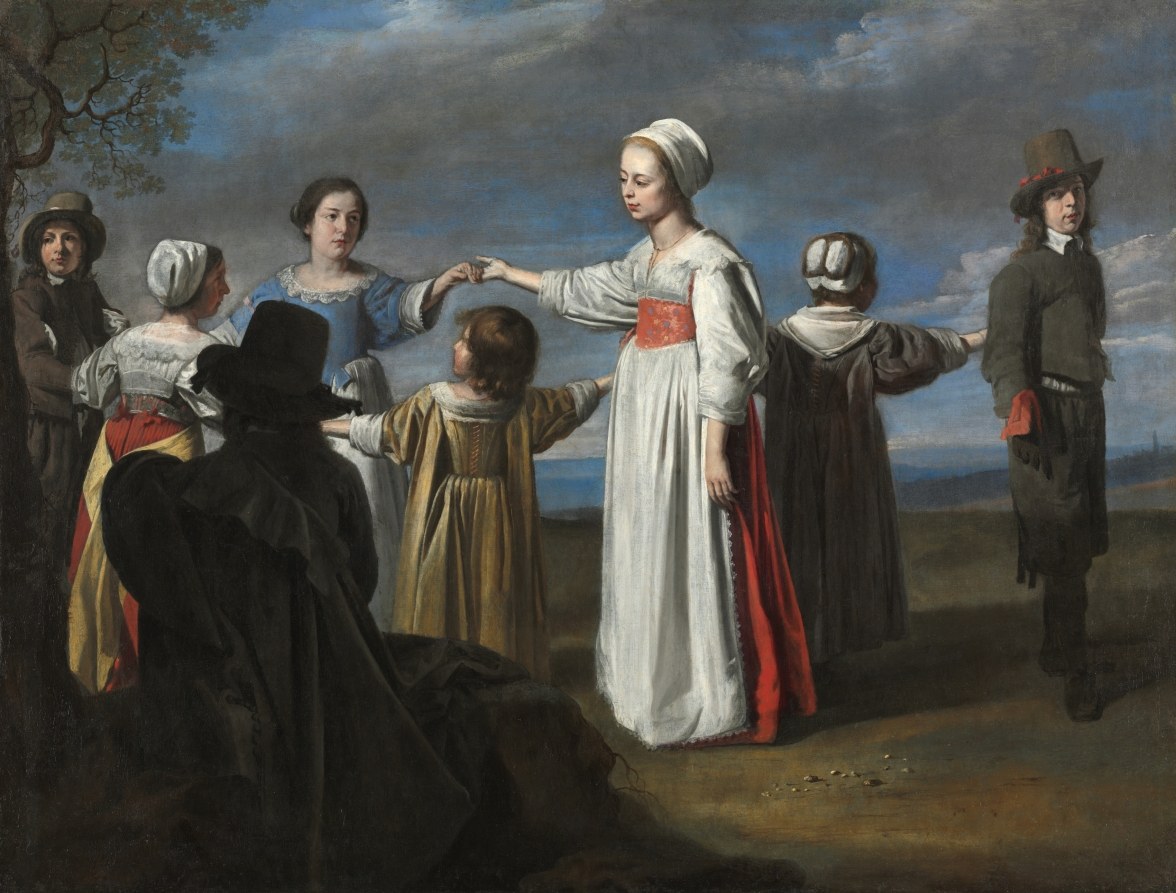
The work documents how children of rank learned formal dance in the 17th century and reveals the emotional and social stakes of that learning. It is one of very few paintings from this period that centers dance instruction rather than performance, showing dance as a discipline and social technology rather than entertainment, and preserving the faces and particularities of the young people being trained.
What you are looking at
A tall figure in white linen dress with a red underskirt stands at center, her body angled gracefully as she gestures to guide a chain of children. With her back to the viewer, a musician in shadow plays an instrument—likely a pipe or recorder—setting the rhythm for the dance to begin. The children form a loose processional line, each individually characterized: a boy in ochre-gold holds the central figure's hand, a smaller child in burgundy and white stands nearby, others in dark clothing flank the group. The setting is a broad open landscape with a tree branch visible at upper left, a body of water in the distance, and a pale, cloud-filled sky. The light is cool and even, casting the children's shadows long and distinct across the earth, creating a melancholic atmosphere despite the potential for joy in the scene.
The dancing
The woman at center uses her extended arm in an invitational or instructive gesture, her posture open and hierarchical—she is teacher or leader. The children's bodies are upright and formal, standing rather than moving; their hands are connected in a chain formation, ready but static. Their expressions, visible on several faces, read as solemn or wary rather than animated. No one is captured mid-movement; this is a moment of gathering and preparation. The musician's position—turned away, in shadow—emphasizes the subordination of music-making to the dance instruction itself.
The dance depicted
The painting depicts children learning or preparing for a formal chain or processional dance, likely a court or social dance of the 17th century. The chain formation, the hierarchical role of the adult woman as guide, and the formality of stance suggest a historic-baroque dance tradition, possibly a branle or allemande—dances commonly taught to children of aristocratic families. The act of instruction is the subject: children arranged in order, awaiting the adult's signal to begin movement. The melancholic tone and the notation of individual character suggest this may depict real children, possibly a family group, in a formal educational or social ritual rather than an imagined genre scene.
How it was made
Oil on canvas, allowing the painter to render subtle gradations of light and texture in fabric, skin, and air. The technique is characteristic of mid-17th-century French practice: figures are modeled with restraint, line is subordinate to tone, and the composition is balanced around a central vertical axis. The even illumination and careful attention to the individuality of each child's face and dress—the intricate lace, the particular fall of fabric, the wearied or thoughtful expressions—suggests a commission of some importance, likely a family record or allegory of familial virtue through ordered social practice.
About this work
This painting records a moment of formal dance instruction or preparation, with a woman guiding a group of children into a chain formation while a musician plays in the shadows. The work is characteristic of Le Nain studio practice: it combines genre observation (the practical teaching of dance) with portraiture (the individualization of each child) and allegory (dancing as a symbol of family harmony and social order). The children's solemn, wistful expressions and the cool, even light create an emotional depth unusual in dance scenes of the period—this is not a celebration of dance but a record of its role in aristocratic socialization and possibly a memorial to real children, living and dead.
How to look at it
Look first at the woman's gesture and the children's formation: this is not a moment of movement but of attention and readiness. Observe the individual faces—the catalogue notes their weariness and wistfulness, and you can read this in the downcast eyes, the pursed lips, the slight tension in young bodies held in formal posture. Notice the musician in shadow: he is essential to the scene but subordinate to it, suggesting that the real work here is the instruction, not the music. The long shadows cast by the children tell you this is morning or late afternoon, a specific and quiet moment. The landscape background—water, open sky, a solitary tree—is unusually spacious for a genre scene, elevating the private moment into something more monumental and elegiac.
The artist
The Le Nain brothers—Antoine, Louis, and Mathieu—ran a collective studio in Paris from ca. 1630 until Antoine and Louis's deaths in 1648. Mathieu continued the practice into the 1650s. The workshop was known for rural and domestic scenes rendered with unusual psychological depth and attention to social detail. The brothers' work sits between Flemish realism and French court portraiture, recording the textures of ordinary life—children, peasants, musical occasions, family gatherings—with a gravity and compositional discipline typically reserved for history painting. Attribution among the three remains uncertain; this work has been assigned to Mathieu but has also been attributed to a follower known as the Master of the Games.
The period
In the 17th century, dance was a core skill for children of the nobility and professional classes. Formal branles, allemandes, and courtly pavanes were taught as part of social training and were understood as expressions of order, harmony, and familial virtue. At the same time, the Le Nain workshop was responding to a broader shift in French art toward the documentary and psychological observation of contemporary life, influenced by Flemish realism and the rise of cabinet painting. The melancholic tone and focus on the private, domestic moment of learning reflect a new interest in the interior emotional life of ordinary people—even as the scene itself depicts a ritual of social discipline.
Where it lives
The work is held in the European Painting and Sculpture collection at the Cleveland Museum of Art. It has been catalogued as a Le Nain work, most confidently attributed to Mathieu, though scholars have questioned this attribution in favor of the Master of the Games. It is one of four paintings in the museum's holdings attributed to the Le Nain workshop.
Dance in this work
Questions about this work
What dance are these children learning?
We cannot identify a specific dance with certainty, but the chain formation and the formal instruction suggest a court dance of the 17th century such as a branle or allemande. These were the standard dances taught to children of aristocratic families as part of their social education. The painting shows the moment before the dance begins—the children arranged in order, awaiting the musician's signal and the adult's guidance.
Are these real children?
Possibly. The catalogue notes that the individuality of the children's faces and expressions has led scholars to hypothesize that these are portraits—both of living children and of children now dead. The painting may therefore be both a document of a social ritual and a memorial, combining genre scene with family portraiture in a way characteristic of Le Nain workshop practice.
Why does the scene feel so sad?
The children's expressions are constrained and wearied rather than joyful. Their bodies are formal and still, not animated. The cool light and the broad, empty landscape create a mood of solemnity. Together these choices suggest that the painter was interested in recording not the pleasure of dance but the discipline of learning it—the effort required of young bodies to hold themselves in order, and perhaps the loss or passing of childhood itself.
Who was the artist?
The work is attributed to Mathieu Le Nain or to a follower called the Master of the Games. Mathurin (Mathieu) Le Nain was the youngest of three brothers who ran a successful studio in Paris in the mid-17th century. The brothers were known for scenes of domestic and rural life rendered with psychological depth and social observation unusual for the period. The attribution of individual works among them remains uncertain.
More dance artwork





