49 works in this view — arrow keys or swipe to move between them.
Dance in Art
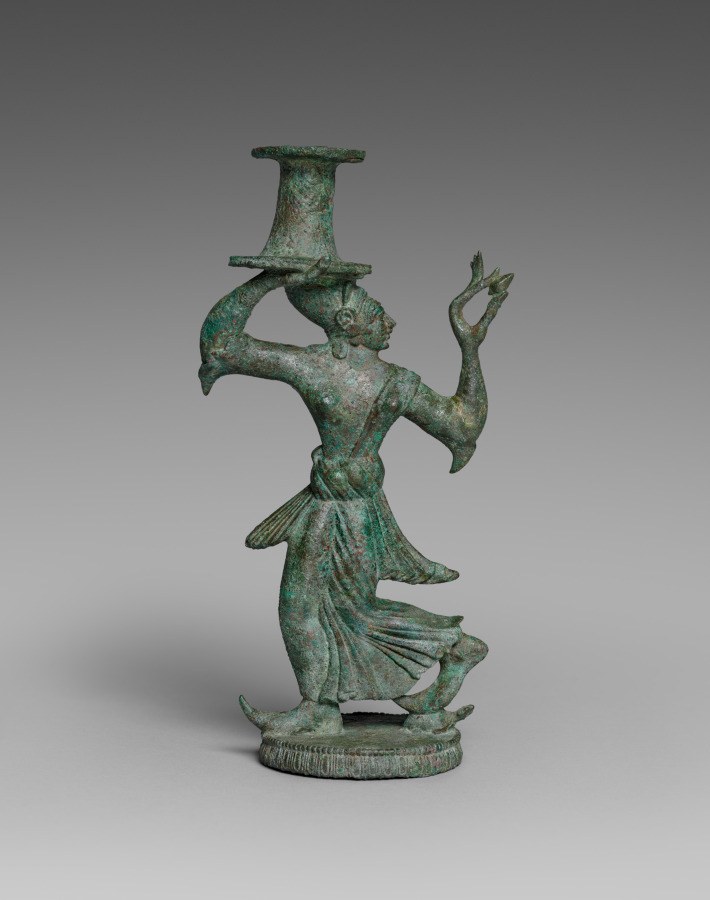
Candelabrum Stand of a Dancing Maenad
Unknown artist
- Medium:
- bronze
- Collection:
- Greek and Roman Art
- Source:
- Cleveland Museum of Art
- Rights:
- Public domain — free to use, share and adapt.
- Recorded as:
- CC0
Maenads are among the oldest documented images of ecstatic, non-courtly dance in Western art, representing a tradition of divine possession and uninhibited movement that predates European concert dance by over two millennia. This bronze shows that ancient artists understood the body's capacity to express altered states through asymmetrical, energetic poses and that such states were valued enough to warrant representation in precious materials. It also demonstrates that dance was not separate from religious practice, domestic life, and functional art—it was woven into all three.
What you are looking at
A bronze figure of a dancing maenad in Etruscan style, shown in dynamic motion against a neutral ground. The figure wears a long, elaborately pleated dress with deep, formal folds that fall to her feet and convey dramatic movement rather than naturalistic drapery. Her right arm is raised high, supporting a cylindrical object—likely a candelabrum finial—balanced on her palm with the arm fully extended upward. Her left arm extends outward and slightly downward, the hand grasping what appears to be a small rounded object, possibly a fruit or a percussion instrument. Her head is turned, and her face shows the stylized features characteristic of Etruscan work. The figure stands on a small base and wears distinctly pointed shoes. The patina is green bronze throughout, suggesting considerable age. The pose suggests rapid movement, with the body weight distributed to convey momentum even in stillness.
The dancing
A single standing figure with weight forward, one arm raised vertically in a sustained lift while the opposite arm extends laterally. The pointed shoes and forward-tilted torso suggest motion—walking or turning rapidly. The raised right arm is fully extended and locked at the elbow, bearing a structural load, while the left arm is relaxed and grasping. The figure's upper body and head are rotated slightly, creating a sense of spiral movement through the vertical axis. The elaborate folds of the dress cascade downward, framing the lower body and suggesting the figure is in a continuous, flowing motion.
The dance depicted
This is a maenad—a female attendant of Dionysus in Greek and Roman religion—depicted in the ecstatic, abandoning movement characteristic of Dionysian ritual and bacchic procession. Maenads were believed to dance in states of possession or divine frenzy, and artistic representations consistently show them in dynamic, often asymmetrical poses that suggest rapid, uninhibited movement. The raised arm carrying the candelabrum suggests this figure had a practical function in a ritual or festive setting, but the body's energy and the deliberate elongation of the pose convey the spiritual abandon associated with maenadism. The Etruscan style and the work's function as a decorative element for a candelabra or incense burner indicate this was part of elite domestic or religious practice.
How it was made
Cast bronze, a technique requiring sophisticated metalwork and the ability to capture dynamic form in three dimensions. The small scale and the integration of the figure with architectural elements (the candelabrum finial) suggests this was made by a specialist workshop, likely for a wealthy household or sanctuary. Bronze casting allowed the artist to achieve the fine linear detail visible in the pleats of the dress and the delicate definition of the hands and feet, and the material's durability ensured these ritual objects could be treasured and reused over generations. The green patina indicates the object has survived for over 2,500 years.
About this work
This is a small Etruscan bronze candelabrum stand, cast in the shape of a dancing maenad and dated to around 525 BCE. The maenad—a female follower of Dionysus—is shown in a pose of rapid, ecstatic movement, her body twisted and her arms raised and extended in positions that suggest abandonment to divine frenzy. The figure combines practical function (supporting a candelabrum) with spiritual and artistic content, making it both a lighting fixture and a representation of ritual trance-dance. It belongs in a history of dance in art because it documents a specific, historically significant form of movement—maenadism—as understood and represented in the ancient world, and because it shows how dance imagery was embedded in everyday luxury objects and devotional practice.
How to look at it
Attend to the asymmetry: the figure is not in a pose of rest or repose, but in a moment of violent, ongoing motion. The raised right arm and the low, grasping left hand create a diagonal tension through the body. The spiral twist of the torso and the turned head suggest a dancer executing a rapid rotation or turn. The formalized, almost architectural treatment of the dress folds contrasts with the dynamic energy of the pose—the artist is using the crisp, linear drapery to heighten rather than soften the sense of movement. The pointed shoes ground the figure while the upper body seems to lift and spiral, creating the illusion of suspension in motion.
The artist
Unknown. The work is attributed to Etruscan craftsmanship on the basis of stylistic features—the exaggerated length of the fingers, the highly formalized treatment of the dress folds, and the pointed shoes—all consistent with Etruscan metalwork of the Archaic period. Etruscan workshops were among the most sophisticated in the central Mediterranean, combining Greek artistic influence with local traditions and religious practice.
The period
This bronze was made around 525 BCE, during the Late Archaic period, when Etruscan culture was at its height and Greek artistic idioms were being adapted and transformed by Etruscan craftsmen. In Greece itself, this was the era of early red-figure pottery and the consolidation of Dionysian religion, which emphasized ecstatic experience and the figure of the maenad. Maenadism represented a form of religious practice and embodied spirituality that contrasted sharply with the ordered, citizen-centered public culture of classical Athens. For Etruscan elites, who had strong ties to Dionysian imagery and practice, the maenad was a compelling subject—exotic, spiritually charged, and loaded with associations of wealth, imported taste, and access to mystery religions.
Where it lives
The work is held in the Greek and Roman Art collection of the Cleveland Museum of Art. It was made as a functional element of a larger object—probably a candelabrum (a standing lamp) or incense burner—and would have been displayed in a wealthy household or sanctuary, where it served both practical and devotional purposes.
Dance in this work
Questions about this work
What is a maenad?
A maenad (or bacchante) is a female follower of Dionysus, the Greek god of wine, ecstasy, and theater. In mythology and religious practice, maenads were believed to be seized by divine possession and to dance in wild, ecstatic states. They were often depicted in ancient art in dynamic, uninhibited poses, sometimes carrying ritual objects like thyrsus staffs or vessels. The figure of the maenad fascinated ancient artists because she represented an alternative to orderly, civic culture—a form of embodied spirituality and abandon that was both feared and celebrated.
How do we know this is Etruscan and not Greek?
The style is distinctly Etruscan rather than Greek. The exaggerated elongation of the fingers, the highly formalized treatment of the dress folds in sharp, linear pleats, and the distinctive pointed shoes are all characteristic of Etruscan metalwork. Etruscan artists adopted Greek imagery—including the maenad—but transformed it through local stylistic conventions. The figure's proportions and surface treatment are consistent with other known Etruscan bronzes of the Archaic period.
What did this object do?
This bronze figure was the supporting element of a candelabrum or incense burner. The cylindrical form rising from the figure's raised right hand would have held a candle, torch, or burning incense. Such objects were luxury items in wealthy Etruscan households and sanctuaries, and they combined practical function with religious and aesthetic significance. The dancing maenad transforms a utilitarian object into an image of divine possession and spiritual power.
What does the left hand hold?
The left hand grasps what is likely either a small fruit or a clapper—a percussion instrument made of two pieces of wood or bone struck together to produce sound. Both are consistent with images of maenads and with the instruments used in Dionysian ritual. Clappers or castanets were used to produce music for ecstatic dancing, making either interpretation plausible.
More dance artwork





