49 works in this view — arrow keys or swipe to move between them.
Dance in Art
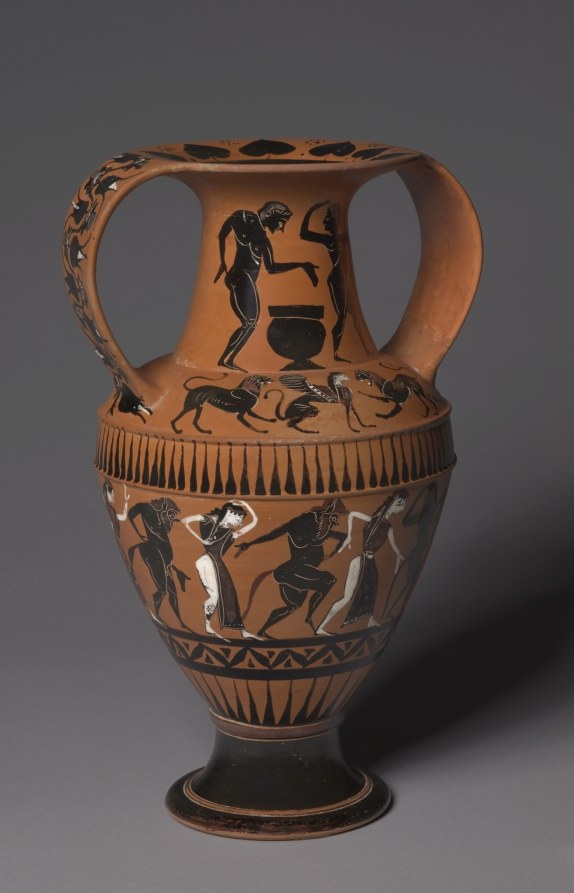
Black-Figure Nikosthenic Amphora (Storage Vessel): Dancing Youths; Sphinxes and Lions; Satyrs and Maenads
Nikosthenes (Greek, Attic, active c. 545–510 BCE)
- Medium:
- ceramic
- Collection:
- Greek and Roman Art
- Source:
- Cleveland Museum of Art
- Rights:
- Public domain — free to use, share and adapt.
- Recorded as:
- CC0
This vessel preserves one of the most detailed Archaic representations of Dionysian ritual movement and ecstatic states, showing how Greeks visualized sacred possession and mythological frenzy through exaggerated body postures, twisting forms, and alternating male-female energy. It is also a key example of how dance imagery functioned in Greek ceramic culture—not as documentation of actual practice but as a marker of elite knowledge, mythological authority, and the artist's ability to convey dynamic bodily motion in a static medium. The signed work testifies to the high status of the potter's craft in Archaic Athens and the sophisticated trade networks that distributed Athenian pottery to Etruscan elites.
What you are looking at
This black-figure ceramic amphora presents three distinct registers of mythological and youthful figures arranged around the vessel's body and neck. The neck features a pair of slender dancing youths in profile, their bodies arched in dynamic postures suggestive of coordinated movement. The shoulder zone displays sphinxes alternating with reclining lions, rendered in the characteristic silhouette style of Attic black-figure pottery. The main body shows a continuous processional frieze of satyrs and maenads in animated interaction: the satyrs are bearded, often shown with exaggerated features and sometimes bent forward or gesturing, while the female figures (maenads) are rendered in contrasting technique with added white slip for their flesh, their bodies twisting and lunging in ecstatic movement. The vessel itself is monumental and functional—a storage amphora with two robust handles and a flared rim—but every available surface is occupied by narrative or mythological imagery. The terracotta ground is warm orange-brown; the figures are rendered in glossy black slip with incised linear details for anatomy and pattern, creating sharp graphic contrast.
The dancing
The dancing youths on the neck are rendered with lean, elongated bodies and small heads, their limbs extended in asymmetrical poses that suggest rapid or leaping movement—one figure appears to twist mid-step while the other maintains a contrasting pose, suggesting call-and-response or mirrored timing. The satyrs below are characterized by pronounced forward bends, splayed limbs, and gestural arms; their bodies often curve sharply at the waist in postures of pursual or revelry. The maenads, identified by their distinct white-slip rendering and female form, show sharper directional changes—their bodies twist, their legs stride or kick, and their arms reach outward or upward in gestures of exaltation. The frieze is rhythmic: satyrs and maenads alternate around the body, creating a visual pulse of masculine and feminine figures in dynamic relation.
The dance depicted
This imagery documents the sacred-ceremonial ecstatic tradition of Dionysian ritual, specifically the mythological procession and possessed state of satyrs and maenads in the entourage of Dionysus. These figures do not dance in the formal sense of structured steps but rather move in states of frenzy and divine possession—the satyr's forward-bending posture and the maenad's twisting, reaching gestures are iconic representations of the orgiastic, improvisational movement associated with Dionysian ritual practice and mystery cult experience. The pairing of satyrs and maenads in alternating rhythm suggests the reciprocal energy of male and female participants in these ecstatic processions. The youths on the neck may represent a more restrained, youthful counterpart to the mythological frenzy below, possibly evoking gymnasium or symposium culture rather than Dionysian excess.
How it was made
This is a black-figure ceramic vessel, a technique dominant in Attic pottery from the mid-6th century onward. The artist (the potter Nikosthenes) has signed his name and the verb epoiesen ('made'), establishing this as a signed work in a context where potter signatures were uncommon; nearly 150 surviving vessels bear Nikosthenes' name, making him the most prolific signed potter of his era. The black-figure technique—figures rendered in glossy black slip with incised linear detail against the natural terracotta ground—is labor-intensive and demands precision, as corrections are impossible once the slip is fired. The addition of white slip for the maenads' flesh tones creates visual distinction and marks a deliberate choice to differentiate gender in the composition. The vessel's distinctive shape with conical neck, wide strap handles, and ribbed upper body is Nikosthenes' signature form, intentionally emulating Etruscan metalwork and bucchero ceramics, suggesting this amphora was made for export to Etruscan clients and served both functional and prestige purposes.
About this work
This is a monumental storage amphora made in Athens around 535 BCE and signed by the potter Nikosthenes, one of the most prolific named potters of the Archaic period. The vessel is entirely covered with figured decoration across three zones: dancing youths on the neck, sphinxes and lions on the shoulder, and an elaborate processional frieze of satyrs and maenads on the body. The imagery is mythological and ecstatic, documenting the Dionysian tradition of possession and ritual movement, with figures rendered in the black-figure technique—figures in glossy black silhouette against the warm terracotta ground. The vessel's distinctive shape deliberately imitates precious Etruscan metalwork, indicating it was made for elite clients in central Italy, where many such amphorae have been found. The work represents a moment when Athenian pottery reached a high degree of formal sophistication and when signed potter's signatures became a mark of artistic reputation and export prestige.
How to look at it
Examine the three registers separately: the neck youths show a restrained, almost mirrored pair engaged in some form of coordinated stepping or leaping, their small heads and elongated limbs suggesting youthful agility. Then move to the main frieze and notice the rhythm created by the alternating satyrs and maenads—the satyrs bend forward sharply, their bodies compressed and urgent, while the maenads twist and reach, their bodies more extended and their limbs more akimbo, suggesting different energies within the same ritual space. The white slip on the maenads' flesh creates a visual distinction that reads as presence and vitality against the black ground. Finally, trace the pattern around the vessel—the frieze is designed to be continuously readable as the pot is rotated, suggesting it was meant to be viewed in the round, handled, and displayed, not simply seen from one angle.
The artist
Nikosthenes is the most prolific named potter of the Attic black-figure tradition, active c. 545–510 BCE. His signature appears on nearly 150 surviving vases, far more than any contemporary potter or vase-painter, suggesting either a long career, a prolific workshop, or both. His workshop specialized in the black-figure technique and in a distinctive vessel form—the Nikosthenic amphora—that deliberately imitated the shape and prestige of Etruscan metalwork and ceramic bucchero ware. This strategic emulation indicates a sophisticated understanding of international markets and elite taste. The presence of his signature on such a high proportion of works suggests that the potter's name, not the painter's, was the primary mark of quality and prestige in this phase of Athenian pottery production, and that Nikosthenes' workshop enjoyed sustained demand, particularly from Etruscan collectors.
The period
This amphora was made during the height of the Archaic period in Athens (c. 535 BCE), a moment when Athenian black-figure pottery was at the peak of its technical refinement and international prestige, competing with and eventually displacing Corinthian wares as the leading ceramic export. The 6th century was a period of intensive mythological elaboration in Greek art, and Dionysian imagery was particularly prominent in pottery aimed at symposium culture and elite consumption. The figure of the satyr and the ecstatic maenad became standardized iconographic types during this period, appearing frequently in vase painting as markers of mythological knowledge and access to mystery cult traditions. Simultaneously, Athenian potters were becoming increasingly conscious of their work as high-status craft worthy of a maker's signature—Nikosthenes' prolific signing reflects a shift toward recognizing the potter as an individual producer rather than an anonymous artisan. The export of Athenian black-figure pottery to Etruscan elites in central Italy was a major economic and cultural phenomenon, and the deliberate imitation of Etruscan metalwork shapes (as in Nikosthenes' amphora form) demonstrates how Greek potters understood and responded to foreign elite taste.
Where it lives
The vessel is held in the Greek and Roman Art collection of the Cleveland Museum of Art. It is catalogued as a black-figure nikosthenic amphora and is one of many Athenian export vessels of this type that survive, particularly from Etruscan contexts in central Italy, where they were valued as prestige goods.
Dance in this work
Questions about this work
What do the satyrs and maenads represent?
These are mythological figures from the entourage of Dionysus, god of wine, theatre, and ecstasy. Satyrs are hybrid creatures—part man, part beast—known for pursuing maenads (female devotees) in states of divine possession. On this vessel, they are shown in the characteristic postures of Dionysian frenzy: bent forward, gesturing urgently, and locked in dynamic interaction with the maenads. The imagery represents sacred ritual and mythological knowledge rather than documentation of actual practice.
Why are the maenads rendered in white slip rather than black?
The white slip applied to the maenads' flesh tones creates visual distinction and hierarchy. This technique, called added white in black-figure pottery, allowed the artist to differentiate female from male figures and to create visual contrast and emphasis. The white figures appear to advance against the black ground, making the maenads more visually prominent than the satyrs in the processional frieze.
Why would a potter in Athens make a vessel in the shape of Etruscan metalwork?
Nikosthenes deliberately designed his amphora to echo the forms of expensive Etruscan bucchero vessels and precious metal containers, which were highly valued by Etruscan elites. By making his amphorae in these shapes, he was competing directly with luxury goods and signaling that his pottery could serve the same prestige function. Many Nikosthenic amphorae have been found in Etruscan tombs, confirming they were prized as elite exports.
What does it mean that Nikosthenes signed his work?
Pottery signatures were rare in the Archaic period, making Nikosthenes exceptional. His prolific signing (on nearly 150 surviving vessels) suggests that the potter's name—not the painter's—was becoming a mark of quality and prestige. This shift indicates that individual potters were beginning to be recognized as makers worthy of credit, an early step toward the artist as a known, valued producer rather than an anonymous craftsperson.
More dance artwork





