49 works in this view — arrow keys or swipe to move between them.
Dance in Art
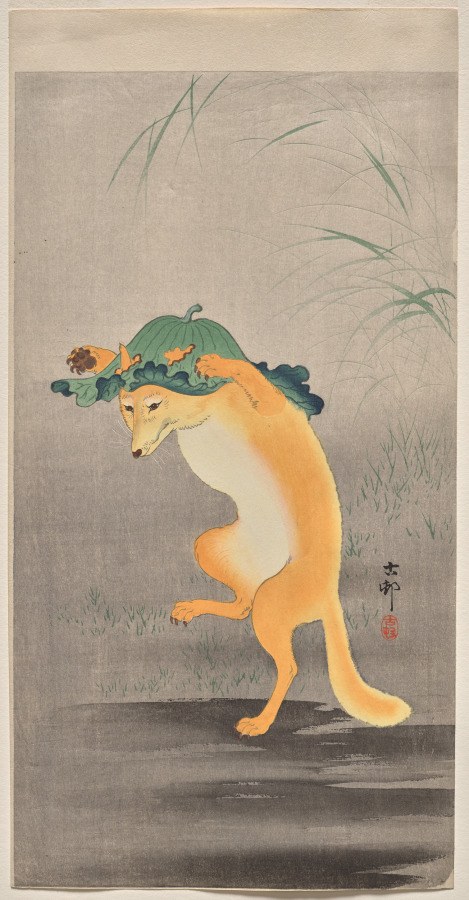
Dancing Fox
Ohara Koson (Japanese, 1877–1945)
- Medium:
- Color woodcut
- Collection:
- Japanese Art
- Source:
- Cleveland Museum of Art
- Rights:
- Public domain — free to use, share and adapt.
- Recorded as:
- CC0
This work demonstrates how dance imagery in non-Western art traditions can operate symbolically and fantastically rather than documentary: the fox's dancing becomes a vehicle for exploring grace, transformation, and the boundary between the animal and the civilized. For historians of dance representation, it shows how printmakers understood dance not as a specific technique or style but as an embodied principle of beauty and animation applicable to any living creature.
What you are looking at
A golden-orange fox stands upright on its hind legs on a dark ground, balanced in a precarious dancing pose. The animal wears an oversized green leaf as a hat, which sits askew on its head and is decorated with small orange flowers or blossoms that cascade down one side. The fox's expression is composed and dignified despite the whimsical costume. Fine grasses emerge from the ground around its feet, and delicate green plant stems arch gracefully across the upper portion of the composition, suggesting a rain-soaked garden or meadow. The background is a soft, neutral wash that emphasizes the fox as the sole subject. The entire scene is rendered in the restrained palette typical of Japanese woodblock printing—soft greens, warm oranges and creams, with deep blacks for definition.
The dancing
The fox's posture is upright and balletic, with its body weight shifted slightly to one side as if mid-movement. Its front legs are raised and bent, with one paw higher than the other in an asymmetrical, gestural pose that suggests lightness and momentary balance rather than grounded stability. The head is held with a gentle tilt toward the raised leaf-hat, and the tail extends downward, providing visual ballast. The overall frame is vertical and elongated, emphasizing the delicate verticality of the standing figure.
The dance depicted
This is not a depiction of human dance or a recognizable dance form, but rather an anthropomorphic fantasy in which an animal adopts a dancing posture. The fox's upright stance, raised limbs, and poised balance invoke the aesthetic conventions of theatrical dance—particularly the elongated verticality and weightless quality prized in classical and contemporary traditions—without representing any specific human dance style. The image demonstrates an artist's understanding of dance as an expression of grace and playfulness, transposed onto a creature from folklore. This is a whimsical imaginative scenario rather than documentation of actual dance practice.
How it was made
This is a color woodcut (woodblock print), a technique requiring separate carved blocks for each color layer, which here are green, orange, yellow, black, and the reserved paper white. The soft gradations visible in the background and the precise registration of colors demonstrate skilled carving and printing. The medium allowed for multiple impressions and broad circulation among educated Japanese audiences who collected prints; the technique was well-suited to capturing fine linear detail (the grass stems) and flat, luminous color areas (the leaf, the fox's coat). Woodcut's graphic clarity and decorative sensibility shaped how the subject is composed and simplified.
About this work
This is a whimsical Japanese color woodcut by Ohara Koson, a prolific printmaker of the early 20th century, depicting a fox standing upright and dancing while crowned with an outsized green leaf. The work belongs to the *kachōga* genre—images of nature translated into woodblock prints—but is exceptional for its imaginative scenario: rather than observing animals in their natural state, Koson imagines an animal adopting human dance-like behavior. The print celebrates movement, grace, and the playful anthropomorphism common in East Asian art and folklore, where animals serve as vehicles for humor and philosophical reflection.
The work invites viewers to recognize dance itself as a mode of expression that transcends human bodies and into the realm of the magical or fantastic. By rendering the fox in a pose that echoes the upright, weightless ideal of theatrical dance, Koson suggests that the qualities we associate with human artistry—poise, balance, dignity in motion—are universal aesthetic principles. The print reflects the sophisticated taste of Meiji-era Japan, where traditional woodblock arts coexisted with fascination for both nature study and imaginative invention.
How to look at it
Look first at the fox's posture: notice how the artist has positioned the animal to maximize verticality and weightlessness, with one paw raised and the body slightly off-balance, as if captured mid-leap or mid-gesture. The leaf-hat is deliberately oversized and precarious, adding visual comedy and emphasizing the fox's concentration and dignity despite the absurd costume. Observe how the spare background and delicate foreground plants frame the figure, drawing all attention to the dancer's pose. The work invites you to recognize the fox's posture as *dance-like* and to appreciate the precision of the printmaking technique, which allows fine grass stems to coexist with bold areas of color.
The artist
Ohara Koson (Japanese, 1877–1945) was a leading figure in the shin-hanga ('new print') movement and one of Japan's most prolific and celebrated printmakers. Active during the Meiji and early Taishō periods, Koson specialized in nature subjects—particularly birds, flowers, insects, and small mammals—executing hundreds of designs that were widely collected and exported. He is known for his refined color sense, precise carving technique, and ability to capture the intimate textures and movements of animals and plants. While most of his work documented nature with near-scientific observation, he occasionally indulged in whimsical scenarios like this one, demonstrating his range beyond naturalism.
The period
This print dates to 1900, a moment when Japanese printmaking was undergoing renaissance after decades of decline during early modernization. The shin-hanga movement reestablished woodblock printing as a serious art form, combining traditional techniques with new subjects and Western-influenced compositional principles. Simultaneously, Japanese visual culture was deeply engaged with animal imagery drawn from folklore, theater, and Zen philosophy, where animals frequently embodied human virtues and folly. In the broader context of early 20th-century dance, while this predates the major international expansion of Japanese theatrical forms like Butoh, it reflects the cultural moment in which bodily movement and grace were subjects of artistic fascination.
Where it lives
Held by the Cleveland Museum of Art (CMA), this work is part of their Japanese Art collection. It is one of a few designs by Koson in which he departed from straightforward nature observation to imagine an anthropomorphic scenario, making it distinctive within his large body of work.
Dance in this work
Questions about this work
Why is this considered a dance image when it's just a dancing fox?
The image represents dance—the aesthetic principle of graceful, poised movement—even though the dancer is not human. By rendering the fox in a balletic, upright pose with raised limbs and weightless suspension, Koson invokes the visual language of human theatrical dance. The work invites viewers to recognize dance as an expression of beauty that can be attributed to animals as well as people, and to appreciate the artist's understanding of how movement conveys grace and dignity.
What is *kachōga*?
*Kachōga* is a Japanese print genre literally meaning 'bird and flower pictures,' encompassing nature subjects including animals, insects, and plants. Printmakers like Koson created hundreds of *kachōga* designs, often combining careful observation with decorative beauty. While most *kachōga* were naturalistic, artists occasionally introduced imaginative elements, as Koson does here by staging an animal in human-like behavior.
Is the leaf a hat, or does it mean something else?
The leaf functions as a whimsical hat or crown in this fantastical scenario. In Japanese folklore and art, animals often wear or are associated with objects that transform their identity or suggest magical properties. Here, the oversized leaf adorned with flowers is decorative and playful, emphasizing the fox's role as a dancer and suggesting a character from a folk tale or theatrical scene.
More dance artwork





