49 works in this view — arrow keys or swipe to move between them.
Dance in Art
Dancing Apsaras
Unknown artist
- Medium:
- dry lacquer
- Collection:
- Chinese Art
- Source:
- Cleveland Museum of Art
- Rights:
- Public domain — free to use, share and adapt.
- Recorded as:
- CC0
Apsara sculptures are among the most important sources for understanding pre-modern Asian dance aesthetics, yet they are often studied as religious art rather than dance documentation. This piece demonstrates that celestial dancers were conceived not as static icons but as bodies in motion, with specific attention to spinal articulation, spatial extension, and emotional transport. It shows that by the 10th century, the vocabulary of dance—the twisted spine, the lifted arms, the averted gaze—was already codified and recognized as the signature of celestial performance.
What you are looking at
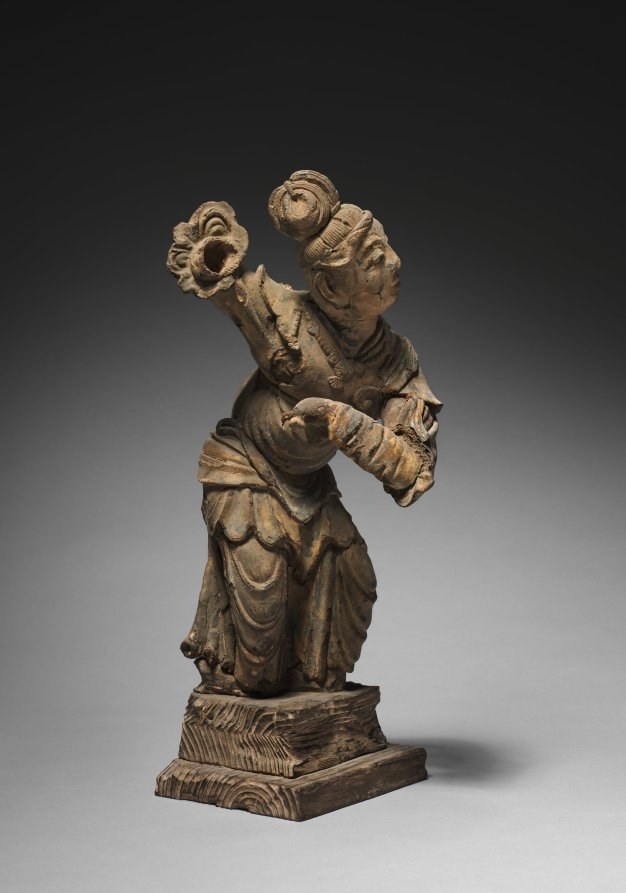
A wooden sculpture in the round depicts a celestial dancer frozen mid-movement, her body arched with dynamic energy. The figure wears flowing robes with deeply carved drapery that falls from her shoulders and torso, creating dramatic shadows in the relief. Her upper body twists and leans back, right arm raised and bent at the elbow while the left arm extends across her body. Her head turns upward and to the side in rapt attention or ecstasy. Most strikingly, she holds aloft elaborate floral ornaments—what appear to be large flowering blooms with curled petals at the ends of long stems held in both hands above her head. The sculpture is mounted on a tiered rectangular base with a narrow plinth. The dry lacquer medium gives the carved wood a warm, honey-coloured patina, with darker tones in the deep relief of the drapery and between the petals of the flowers.
The dancing
A single female figure dominates the composition in a pronounced contrapposto stance, with weight shifted and spine arched in a spiral twist. Her raised right arm and extended left create an open frame across her torso. The handling shows clear understanding of how fabric moves with the body—the robes cling and flow simultaneously, with pronounced folds at the waist and hips suggesting both weight and motion. Her gaze is lifted and averted, indicating emotional absorption in the performance rather than direct engagement with the viewer.
The dance depicted
This is an apsaras, a celestial dancer from Hindu and Buddhist tradition, identifiable by the flower ornaments, the ecstatic facial expression, and the dynamic contrapposto pose characteristic of apsara sculpture. Apsaras perform in the courts of the gods and are depicted throughout South and Southeast Asian temple art, especially in Khmer and Indian sculpture. The flowers she holds—likely lotus or similar blooms—are attributes of celestial status and divine abundance. The spiraling twist of her body and the emotional intensity of her upturned face suggest a moment of transcendent movement rather than a codified pose. The sculpture captures the moment of flight or levitation that apsara dances depict.
How it was made
Dry lacquer is a demanding sculptural technique in which wood is carved and then sealed and finished with lacquer coatings, creating a glossy, durable surface. The technique allows for fine detail in the facial features and delicate carving of the flower petals while maintaining structural integrity in the extended limbs and projecting arms. This method was labour-intensive and typically reserved for high-status religious and courtly objects, suggesting this piece served either a temple, palace, or elite collector. The warm honey-toned patina visible here is characteristic of dry lacquer aged over centuries.
About this work
This is a dry lacquer sculpture of an apsaras, a celestial dancer from the Hindu and Buddhist cosmological tradition. Dating to the 10th century and likely of East or Southeast Asian origin (possibly Khmer, given the style), it represents one of the finest artistic traditions for depicting dance in the pre-modern world. The apsara is not a secular performer but a divine being, yet the sculpture captures her through the language of human movement—the twist of her torso, the lift of her gaze, the grace of her extended limbs. The work sits within a continuous tradition stretching from Angkor temple reliefs to later Southeast Asian court sculpture, where the boundary between sacred and aesthetic collapse into unified celestial performance. For dance historians, it offers rare evidence of how the movement vocabulary of classical Asian dance was imagined in the visual arts.
How to look at it
Notice the violent twist of the spine—it is not a gentle sway but a full torque that pulls the shoulders and hips in opposing directions, with the head following the upper spine. This is not the pose of a standing figure at rest but a dancer captured at the moment of maximum extension and rotation. The flowers held aloft function as both attribute and counterweight, their upward lift echoing the lift of the face and the arch of the back. Watch how the drapery follows the body's movement, bunching at the hips and falling freely below—the sculptor understood that fabric betrays motion. The asymmetry of the pose, with one arm raised and one extended, creates dynamic imbalance that reads as active rather than posed.
The period
The apsara tradition reaches its fullest artistic expression in Khmer sculpture of the 10th to 13th centuries, particularly in the relief carvings at Angkor Wat, where hundreds of celestial dancers surround the temple in stone. However, sculpted apsaras in the round, in precious materials like dry lacquer, belong to the same cosmological vision and likely served similar purposes—to populate the divine realm in three dimensions, making it architecturally and spatially present. The 10th century date places this piece at or near the height of the Khmer Empire, a period of extraordinary artistic production. In Indian sculpture, the apsara tradition has roots in earlier centuries, particularly in the dancing figures of Chola bronzes and temple sculpture. Both traditions understood the apsara as a figure through which physical grace and divine status could be expressed simultaneously.
Where it lives
The sculpture is held by the Chinese Art collection of the Cleveland Museum of Art (CMA). The catalogue record provides minimal information beyond the title, date, and medium, suggesting it may have entered the collection as a single object without documented provenance documentation, which is not uncommon for Asian sculpture acquired in the mid-20th century.
Dance in this work
Questions about this work
What is an apsaras and why did artists carve them so often?
Apsaras (or apsara) are celestial dancers and courtesans in Hindu and Buddhist cosmology, attendants to the gods who perform in heavenly courts. They appeared in temple sculpture, palace decoration, and manuscript painting across Asia because they embodied divine grace, feminine beauty, and the connection between mortal and immortal realms. In temple contexts, they populated the sacred boundary; in court contexts, they legitimized earthly dance as a shadow of celestial performance.
How do we know this depicts a dancer and not just a beautiful woman?
The pose itself is the evidence. The pronounced spiral twist of the spine, the extended arms at different heights, the upturned face in rapture—these are the gestural signatures of movement, not of standing. The flowers held aloft function as attributes of celestial status but also as part of the kinetic frame, balanced against the body's torsion. In Asian dance iconography, this pose is unmistakably a dancer, not a standing figure.
Is dry lacquer a common sculptural technique?
Dry lacquer was labour-intensive and expensive, typically used for high-status religious objects, temple furniture, and royal commissions. It allowed sculptors to carve fine detail and achieve a lustrous, durable surface. It was most prominent in East and Southeast Asian sculpture, particularly in Buddhist contexts. The technique reflects the importance of this apsaras figure within its original context.
What does the flower ornament symbolize?
Lotus and similar flowers are attributes of celestial status, divine beauty, and purity in Hindu and Buddhist tradition. They also reference the natural world—gardens, groves, and floral abundance—settings in which celestial dances take place. In the hands of an apsaras, they transform from botanical objects into costume and insignia of her divine role.
More dance artwork





