49 works in this view — arrow keys or swipe to move between them.
Dance in Art
Peasant Couple Dancing
Albrecht Dürer (German, 1471–1528)
- Medium:
- engraving
- Collection:
- Prints
- Source:
- Cleveland Museum of Art
- Rights:
- Public domain — free to use, share and adapt.
- Recorded as:
- CC0
This work challenges viewers to see peasant dance not as a subject for satire or moral judgment but as worthy of serious artistic investigation. For dancers and historians, it documents the physical vocabulary and social dynamics of early modern vernacular dance while revealing how Renaissance artists negotiated the relationship between subject matter and artistic dignity.
What you are looking at
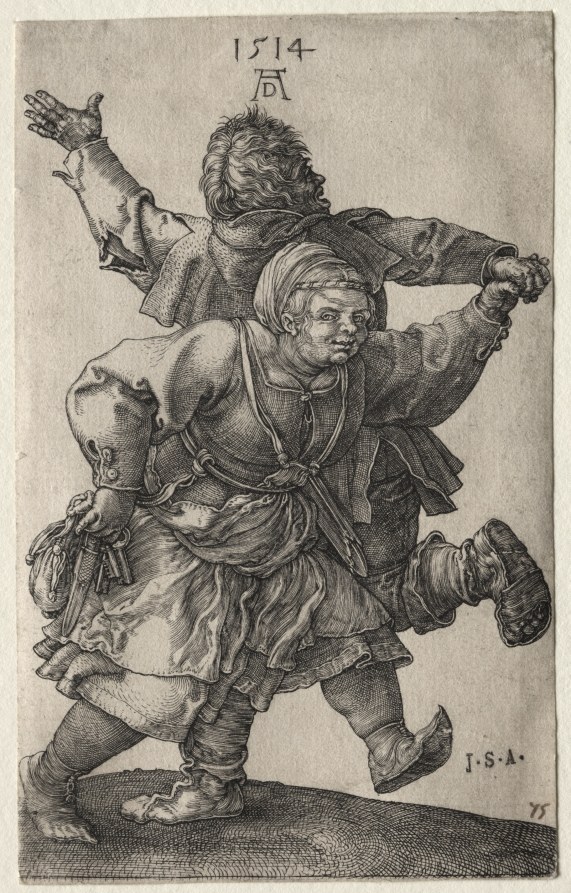
A man and woman dance together in a rural setting, captured in a moment of exuberant movement. The engraving presents them as monumental figures rendered with extraordinary anatomical precision. The woman, positioned as the focal point, wears a full skirt and fitted bodice; she gazes directly outward with assertive presence while her body remains composed and deliberate in posture. At her waist hang keys, a purse, and a knife—symbols of domestic authority. The man behind and beside her, by contrast, throws his arm upward in wild abandon, his body twisted and dynamic. His dress matches hers in period detail: laced bodice, breeches, and hose. The ground beneath them is rendered with simple hatching. The composition captures a specific moment: she anchors the dance while he gestures recklessly, creating a visual dialogue about restraint and excess.
The dancing
The man and woman are in close proximity but not in a formal closed hold. The woman's weight appears centered and stable, her arms positioned with control; her torso faces forward while she looks directly at the viewer. The man's body is in pronounced extension backward and sideways, his right arm thrown high, his left arm bent—a posture of unrestrained exuberance. His weight shifts dynamically. The engraver has rendered their musculature and bone structure with anatomical study, emphasizing the contrast between her stillness and his movement. Their relationship is one of opposition rather than unity: they dance together but embody different energies.
The dance depicted
This is a peasant dance of the early 16th century German or Low Countries tradition, most likely a folk country dance such as those depicted in northern European art from this period. The dancing itself is social and celebratory rather than courtly. The woman's assertive gaze and stable stance suggest she is not a passive partner but an equal or even dominant figure in the exchange. The man's reckless arm gesture and twisted posture suggest vigorous, improvised movement rather than prescribed steps. The dance appears to be one where partners face or stand near each other, moving with varying degrees of restraint—a form of social interaction through movement common in village celebrations and festivals.
How it was made
This is an engraving, a technique that allowed Dürer to achieve fine linear detail and tonal variation through careful hatching and cross-hatching. The precision of the medium serves the artist's apparent goal: to render peasant figures with the monumentality and anatomical sophistication usually reserved for noble or biblical subjects. Engraving as a medium circulated through prints, making this work reproducible and widely distributed—far more accessible than a painted altarpiece. The technique's demand for technical mastery also asserts that the subject matter, rural dance, deserves the same artistic rigor as any other theme.
About this work
This 1514 engraving by Albrecht Dürer depicts a peasant couple dancing with deliberate complexity: the woman centered and authoritative, the man exuberant and uncontrolled. Dürer elevates the rural subject through precise anatomical study and monumental figural treatment, resisting the period convention of portraying peasants as merely comic or debased. The work functions as both a document of early 16th-century social dance and a statement about artistic values—that peasant life merits the same visual intelligence lavished on courtly or religious scenes.
The engraving sits at a cultural crossroads: between medieval and Renaissance attitudes toward rural life, between the emerging study of human anatomy and traditional social hierarchy, between the print's capacity for mass circulation and Dürer's assertion of artistic authority. The dance itself becomes a vehicle for examining social order, gender roles, and human nature—the woman's keys and composed bearing assert domestic power, while the man's gesture speaks to unbridled appetite and abandon.
How to look at it
Observe the contrast between the woman's and man's bodies: her composed stance and forward gaze versus his twisted posture and upraised arm. Notice how her attention to the viewer breaks the fourth wall—she acknowledges the audience while dancing, a gesture that asserts her presence and dignity. The hatching technique that defines musculature and fabric weight shows Dürer's investment in anatomical precision; this is not caricature but studied observation. The positioning of keys, purse, and knife at her waist is deliberate—pause on these details, which are attributes of household authority and speak to her role within the dance and within society.
The artist
Albrecht Dürer (1471–1528) was a German Renaissance painter, printmaker, and theorist whose work spanned painting, engraving, and woodcut. He was intensely invested in human anatomy, proportion, and the study of movement. His peasant scenes, executed in various media, often positioned rural figures with a complexity that resisted straightforward moralizing. Dürer traveled to Italy and incorporated Renaissance principles of anatomy and perspective into his northern European practice. His prints, including engravings like this one, circulated widely and shaped artistic culture across Europe. He was both a maker of fine art and a theorist concerned with establishing the intellectual foundations of artistic practice.
The period
In early 16th-century northern Europe, peasant imagery was conventional but typically satirical or moralizing—presenting rural life as a foil to courtly sophistication or as a subject for humor. Dürer's approach was more ambivalent. The period saw increasing artistic interest in anatomical precision, driven partly by Renaissance revival of classical knowledge and partly by emerging scientific investigation. Simultaneously, the social upheaval of the Reformation and peasant uprisings made rural life a charged subject. In dance, this was the era of transition from medieval carole and estampie toward the social dances of the Renaissance court—yet vernacular rural dancing continued largely unchanged, following local and regional traditions tied to seasonal celebration, courtship, and community gathering.
Where it lives
This work is held in the Prints collection of the Cleveland Museum of Art. It is an engraving from 1514, catalogued and preserved as a print object—one of Dürer's many works in this medium that circulated through distribution networks across northern Europe and beyond.
Dance in this work
Questions about this work
What kind of dance is this?
It is a peasant or folk dance of early 16th-century Germany or the Low Countries. The specific type is not named in the image, but it appears to be a social, celebratory dance of the kind documented in rural communities—likely associated with festivals, courtship, or seasonal gathering. It is not a formal courtly dance but rather a vernacular form rooted in regional tradition.
Why is the woman looking at the viewer?
Her direct gaze is a deliberate compositional choice that asserts her presence and agency. Rather than being a passive participant in the dance, she acknowledges the viewer—and by extension, claims a kind of equality or authority within the scene. This gaze is part of Dürer's elevation of the peasant subject; she is not an object to be observed but an active presence.
What do the keys, purse, and knife mean?
These are symbols of domestic authority and household management—markers of the woman's role and status. In the context of a married or partnered woman, they signify control of household resources and authority. Dürer's choice to emphasize these details locates her as a figure of power, not subordination, within the dance and within society.
Is this a real dance or Dürer's invention?
This is almost certainly based on observation of actual peasant dancing, though Dürer has composed and refined it for artistic purposes. The postures, relative positioning, and dress all accord with documented evidence of early 16th-century rural dance. However, like any artwork, it is an interpretation—a moment chosen and fixed, rather than a neutral recording.
More dance artwork





